Meymand (میمند, also written Maymand) is a village in the mountains of Kerman province where families still spend the winter in houses carved out of soft rock. Its people are semi-nomadic farmers and herders who move between settlements through the year, and in 2015 UNESCO inscribed the “Cultural Landscape of Maymand” as a World Heritage Site for this rare surviving way of life.
| Place | Shahr-e Babak County, Kerman province, south-east Iran |
|---|---|
| What it is | A valley landscape of rock-cut winter houses and seasonal summer and spring settlements |
| Houses | About 400 rock-cut houses recorded, of which 123 are intact (UNESCO) |
| Recognition | UNESCO Melina Mercouri Prize for cultural landscapes (2005); World Heritage Site (2015) |
| Population | A few hundred people in winter; 105 counted in the 2016 census, many more in the past |
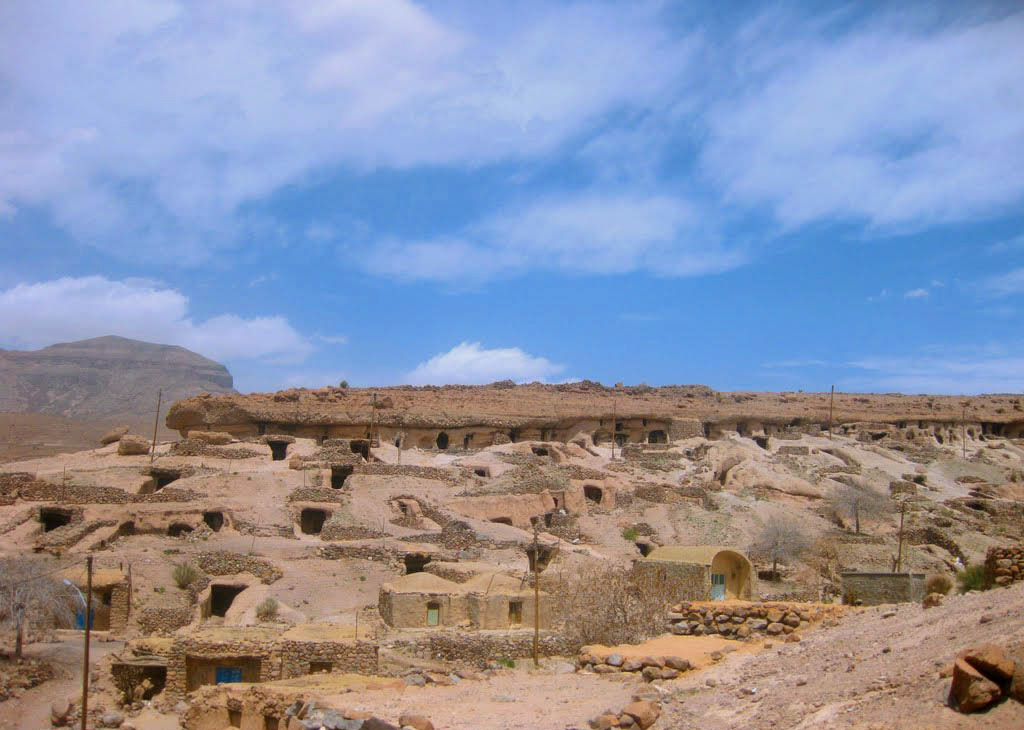

A village that moves with the seasons
Meymand lies at the end of a dry valley at the southern end of Iran’s central mountains. Summers are hot, winters cold, and there is never much water. People here have adapted not by staying in one place but by moving. UNESCO’s description notes that, unusually, it is the people who move, not just the flocks.
The traditional year had four stopping places, more recently three. From late winter to late spring families lived at Sar-e Aghol on the southern fields, in round, half-sunken stone houses with roofs of wood and thistle thatch, or in above-ground huts with conical roofs of branches. In summer and early autumn they moved up to Sar-e Bagh, beside seasonal streams, where they built light shelters, grew wheat and barley on terraces and tended vines and orchards. Pits for boiling grape juice into syrup (دوشاب, dushâb) are still in use there. When the cold came, everyone returned to the permanent village of cave houses.
The rock-cut houses
The winter houses are carved into a soft volcanic rock that locals call kamar. It is easy to cut with hand tools but strong enough to stand as walls and ceilings, and it keeps the rooms warm in winter and cool in summer. The houses, called kiche (کیچه), are stacked in rows up the slopes, in places up to five levels high, linked by paths and steps.
Each house has between one and seven rooms, used for living, sleeping and storing food, fodder and tools. Walls are blackened by centuries of smoke from fires and lamps, and niches cut into the rock serve as shelves. Stables for animals are cut in the same way. Water was collected from springs and rivers, stored in small reservoirs and brought in through qanats to gardens and fields.
How old Meymand is, nobody knows for certain. Figures of many thousands of years are often repeated in travel writing, but they are not established by excavation. What is clear is that this way of living was once more widespread in the region and has survived here longer than elsewhere. The village’s Persian speech is also said to keep old words and forms, a subject for linguists rather than casual visitors.
Why UNESCO listed it
The listing is not for a single monument but for a whole working landscape: houses, fields, gardens, terraces, water systems, and the knowledge and customs that hold them together. UNESCO describes Maymand as a small, mainly self-sufficient community whose seasonal movement between settlements is a rare survival of an older system. Like many rural places in Iran, it faces depopulation as young people leave for towns, and its future depends on whether that way of life can continue alongside tourism.
For Iran’s other inscribed sites, see UNESCO World Heritage Sites in Iran. For another village shaped by its rock, see the cliff village of Kandovan in Azerbaijan.
Visiting Meymand
Meymand is a long drive from Kerman city, and many visitors combine it with Shahr-e Babak or with the road between Kerman and Yazd. A few cave rooms have been restored for overnight stays, and spending a night in the village, when day visitors have left, gives the best sense of the place.
What to see
- The terraces of cave doorways on the slopes, best photographed in low morning or evening light.
- An inside room, if a family or guesthouse invites you in, to see the smoke-darkened ceiling, the niches and the hearth.
- The rock-cut stables and storerooms, which show that much more than homes was carved into the slopes.
- The gardens and orchards along the valley, watered by springs and qanats.
Practical notes and safety
- Meymand is a living village, not an open-air museum. Ask before entering a house or photographing people, and dress modestly.
- Paths between the houses are steep and uneven; wear sturdy shoes.
- Arrangements for entry, guiding and accommodation change; check current information locally before you go.
- Check your own government’s current travel advice for Iran, including for Kerman province.
Persian words from this page
| میمند | Meymand | Meymand |
| کیچه | kiche | rock-cut house (local word) |
| کمر | kamar | cliff, rock face; here, the soft rock |
| دوشاب | dushâb | grape syrup |
| غار | ghâr | cave |
| روستا | rustâ | village |
Sources and further reading
- UNESCO World Heritage Centre, Cultural Landscape of Maymand (inscribed 2015), description and statement of Outstanding Universal Value.
- UNESCO, Melina Mercouri International Prize for the Safeguarding and Management of Cultural Landscapes, 2005 award to Maymand.
- Statistical Centre of Iran, National Census 2016, village population figures for Shahr-e Babak County.
Want to learn Persian? Get the free Starter Pack
Get the 14-page printable Starter Pack (all 32 letters, a 7-day reading plan, 100 core words and 20 survival phrases) and a short 5-email course. Free.
More in Top Places to Visit in Iran
- Naqsh-e Jahan Square
- Shah (Imam) Mosque, Isfahan
- Sheikh Lotfollah Mosque
- Ali Qapu Palace
- Jameh Mosque of Isfahan
- Si-o-se Pol and Khaju Bridge
- Vank Cathedral
- Hasht Behesht Palace
- Naqsh-e Rostam
- Eram Garden, Shiraz
- Nasir al-Molk (Pink) Mosque
- Tomb of Hafez (Hafezieh)
- Tomb of Saadi (Saadieh)
- Shah Cheragh Shrine
- Arg of Karim Khan
- Fin Garden, Kashan
- Historic Houses of Kashan
- Jameh Mosque of Yazd
- Yazd Fire Temple and Towers of Silence
- Dowlatabad Garden and Windcatcher
- Amir Chakhmaq Complex
- Golestan Palace
- National Museum of Iran
- Treasury of National Jewels
- Tehran Grand Bazaar
- Milad Tower
- Imam Reza Shrine, Mashhad
- Tomb of Ferdowsi, Tus
- Tomb of Omar Khayyam, Neyshabur
- Tomb of Avicenna, Hamadan
- Ganjnameh Inscriptions, Hamadan
- Behistun (Bisotun): Visiting the Site
- Taq-e Bostan: Visiting the Site
- Tabriz Historic Bazaar
- Takht-e Soleyman
- Armenian Monastic Ensembles of Iran
- Sheikh Safi al-Din Shrine, Ardabil
- Dome of Soltaniyeh
- Alamut Castle
- Falak-ol-Aflak Castle
- Shushtar Historical Hydraulic System
- Chogha Zanbil: Visiting the Ziggurat
- Susa Archaeological Site
- Arg-e Bam
- Ganjali Khan Complex, Kerman
- Shazdeh Garden, Mahan
- Rayen Castle
- Dasht-e Lut (Lut Desert)
- Maranjab Desert and Caravanserai
- Varzaneh Desert
- Mount Damavand
- Hyrcanian Forests
- Lake Urmia
- Badab-e Surt Springs
- Ali Sadr Cave
- The Kaluts of Shahdad
- Qeshm Geopark
- Hormuz Island Colours
- Visiting Persepolis: A Day Trip from Shiraz
- Visiting Pasargadae
- Persian Caravanserais
- The Qanat of Gonabad
- Meymand Village
- Sasanian Sites of Fars: Firuzabad, Bishapur and Sarvestan
- Gonbad-e Qabus: Visiting the Tower
- Zayandeh Rud and Isfahan’s Bridges
- Tochal and Darband: Hiking Above Tehran
- Mount Sabalan
- Skiing in Iran: Dizin and Shemshak
- Golestan National Park