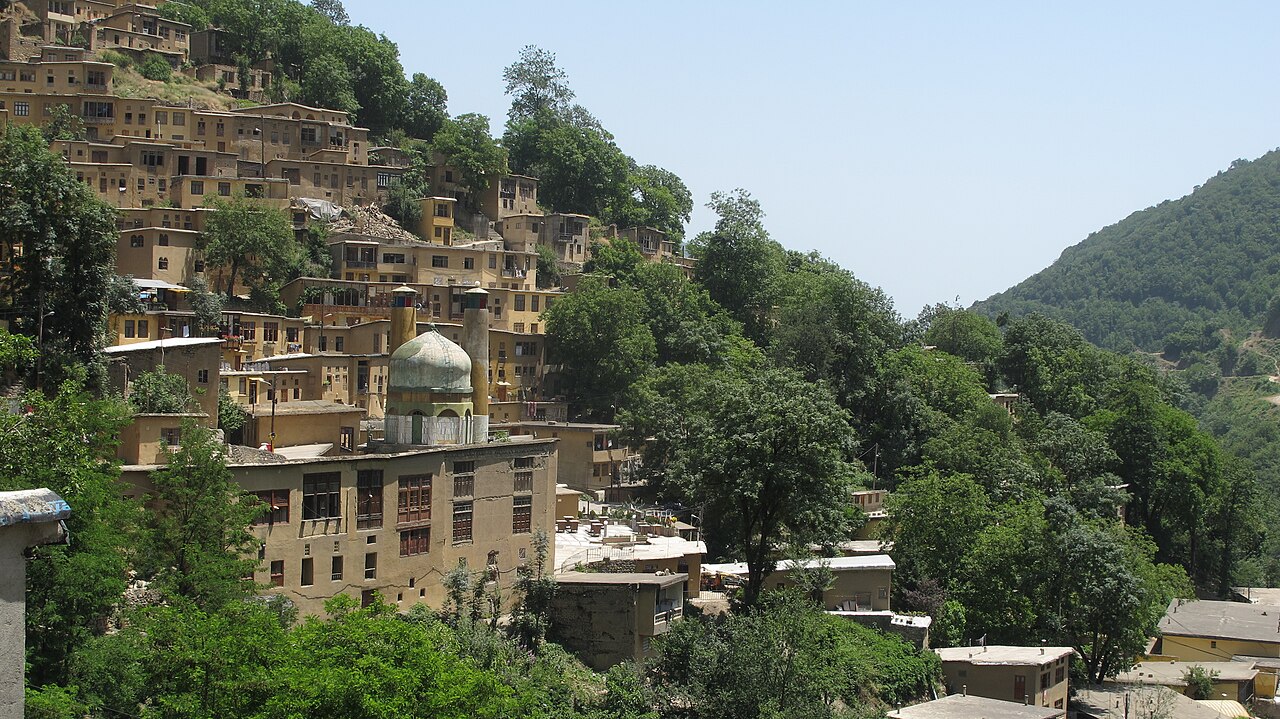
Masuleh is a mountain village in Gilan province, about 60 km south-west of Rasht, whose houses climb a steep slope of the Alborz range in tiers so tightly packed that the roof of one house serves as the yard or street of the house above. Set at about 1,050 m among Hyrcanian forest and frequent mist, it has been settled for many centuries and is one of the most visited villages in northern Iran.
| Persian name | ماسوله (Mâsule) |
|---|---|
| Province | Gilan, Fuman County |
| Elevation | About 1,050 m, with some 100 m between the lowest and highest houses |
| Population | 393 (2016 census), many more in summer |
| Distance | About 32 km west of Fuman, 60 km south-west of Rasht |
| People | Talysh, with Gilaki also spoken |

A village built on its own roofs
Masuleh’s layout comes from its site. The slope is so steep that there is almost no flat ground, so houses were built into the hillside one above another, mostly two storeys high, a few three or four. The flat roof of each row became the walkway, terrace or courtyard for the row behind it. There are no streets for cars: people move along the roofs, narrow lanes and stone staircases, and the whole village is closed to traffic.
The houses are built of stone and mud brick and plastered in a yellowish clay, which gives the village its warm colour against the green of the forest. Upper floors have wooden windows with lattice frames, often painted, that open onto the view down the valley. The village is divided into four traditional quarters, and at its centre, where the slopes meet, is the small covered bazaar and the main mosque.
Iron, trade and the old village
Archaeologists have found traces of people in the Masuleh valley going back to the Palaeolithic, and pottery and stone tools about 7,000 years old. The village’s later wealth came from iron. The mountains held ore, and the forests provided charcoal, so for centuries Masuleh smelted iron and traded tools and weapons with the lowlands of Gilan and the plateau beyond. Slag heaps and the remains of furnaces can still be found in the hills.
About 6 km up the valley is Old Masuleh (کهنه ماسوله, Kohne Mâsule), where the earlier settlement stood. Local tradition says people moved down to the present site after disease, raids or landslides; the exact reason and date are not recorded. The present village is usually said to be around a thousand years old, but no firm founding date exists.
Life in Masuleh today
The winter population is only a few hundred, many of them older residents. In summer families return from Rasht and Tehran, and the village fills with visitors escaping the heat of the plateau. Shops in the bazaar sell hand-knitted wool socks and gloves, wooden spoons, honey and local herbs. Tea houses on the roofs serve tea and local snacks, and Fuman, at the foot of the road, is known across Iran for its kolucheh biscuits.
The weather is a large part of Masuleh’s character. Rainfall is about 940 mm a year, and fog often rises from the valley in the afternoon, hiding the lower rows of houses. Winters are cold and snowy, and the steep lanes become icy.
Visiting
Most people come on a day trip from Rasht, which has the nearest airport and railway station, by road through Fuman. The road ends at a car park below the village, and from there everything is on foot, up steep steps: wear good shoes. There are guesthouses and rooms in village homes for those who want to stay the night, which is worth doing to see the village quiet in the early morning. The busiest times are the Nowruz holidays and summer weekends.
Masuleh is a lived-in village, not a museum. Walking on the roofs is normal, but avoid looking into windows or private doorways and ask before photographing people.
For more on the region, see Rasht, our page on the Hyrcanian forests, and the blog post on travelling in northern Iran. Two other very different villages built to fit their site are Abyaneh and Kandovan.
Persian words from this page
| ماسوله | Mâsule | Masuleh |
| پشتبام | posht-e bâm | roof |
| پله | pelle | step, stair |
| مه | meh | fog, mist |
| آهن | âhan | iron |
| روستا | rustâ | village |
| گیلان | Gilân | Gilan |
Sources and further reading
- Encyclopaedia Iranica, article “Gilan”.
- Christian Bromberger, Un autre Iran: un ethnologue au Gilan (Armand Colin, 2013).
- Statistical Centre of Iran, 2016 National Population and Housing Census.
Want to learn Persian? Get the free Starter Pack
Get the 14-page printable Starter Pack (all 32 letters, a 7-day reading plan, 100 core words and 20 survival phrases) and a short 5-email course. Free.
More in Cities of Iran
- Tehran: Iran’s Capital
- Mashhad
- Isfahan
- Shiraz
- Tabriz
- Yazd
- Kashan
- Kerman
- Hamadan
- Qom
- Ahvaz
- Rasht
- Kermanshah
- Urmia
- Ardabil
- Zanjan
- Qazvin
- Sanandaj
- Khorramabad
- Bandar Abbas
- Bushehr
- Zahedan
- Birjand
- Gorgan
- Sari
- Semnan
- Arak
- Ilam
- Yasuj
- Shahr-e Kord
- Bojnurd
- Karaj
- Abadan and Khorramshahr
- Kish Island
- Qeshm Island
- Hormuz Island
- Masuleh
- Abyaneh
- Kandovan
- Bam
- Neyshabur (Nishapur)
- Shush (Susa) Today