Sanandaj is the capital of Kurdistan province in western Iran, a city of about 410,000 people in a bowl of hills in the Zagros. Known in Kurdish as Sine, it was the seat of the Ardalan princes, who ruled a semi-independent Kurdish principality under the Safavid and Qajar shahs, and it remains the main centre of Kurdish language, music and crafts in Iran.
| Persian name | سنندج (Sanandaj) |
|---|---|
| Kurdish name | Sine (also written Senneh) |
| Province | Kurdistan (capital) |
| Population | 412,767 (city, 2016 census, Statistical Centre of Iran) |
| Elevation | About 1,450 m |
| Climate | Warm, dry summers; cold, snowy winters |
| Main language | Central Kurdish (Sorani, in its Ardalani form), with Persian |
| Distance | About 510 km west of Tehran; about 135 km north of Kermanshah |
Seat of the Ardalan princes
For several centuries the Ardalans, a Kurdish ruling family, governed a principality between the Ottoman and Persian empires, owing loyalty to the shahs but running their own affairs. Their earlier seats were elsewhere in the region, at places such as Hasanabad. According to the local historian Ali-Akbar Vaqaye’-negar, the Ardalan ruler Soleyman Khan founded the city of Sine as his capital in 1046 AH (1636–37 CE), building a fort on the hill that is still the centre of town. A settlement of that name is recorded earlier, so he may have rebuilt and enlarged an existing place rather than started from nothing.
The Ardalans reached their height in the late eighteenth and early nineteenth centuries. Amanollah Khan, who ruled in the early 1800s, built mosques, a palace and the mansion of Khosrowabad, and the court supported poets and historians. The best known is Mastureh Ardalan (1805–1848), a poet who wrote in Persian and Kurdish and composed a history of the Ardalan dynasty, often described as the first history written by a woman in Iran. The Qajars ended the family’s rule in the 1860s and appointed governors from Tehran.
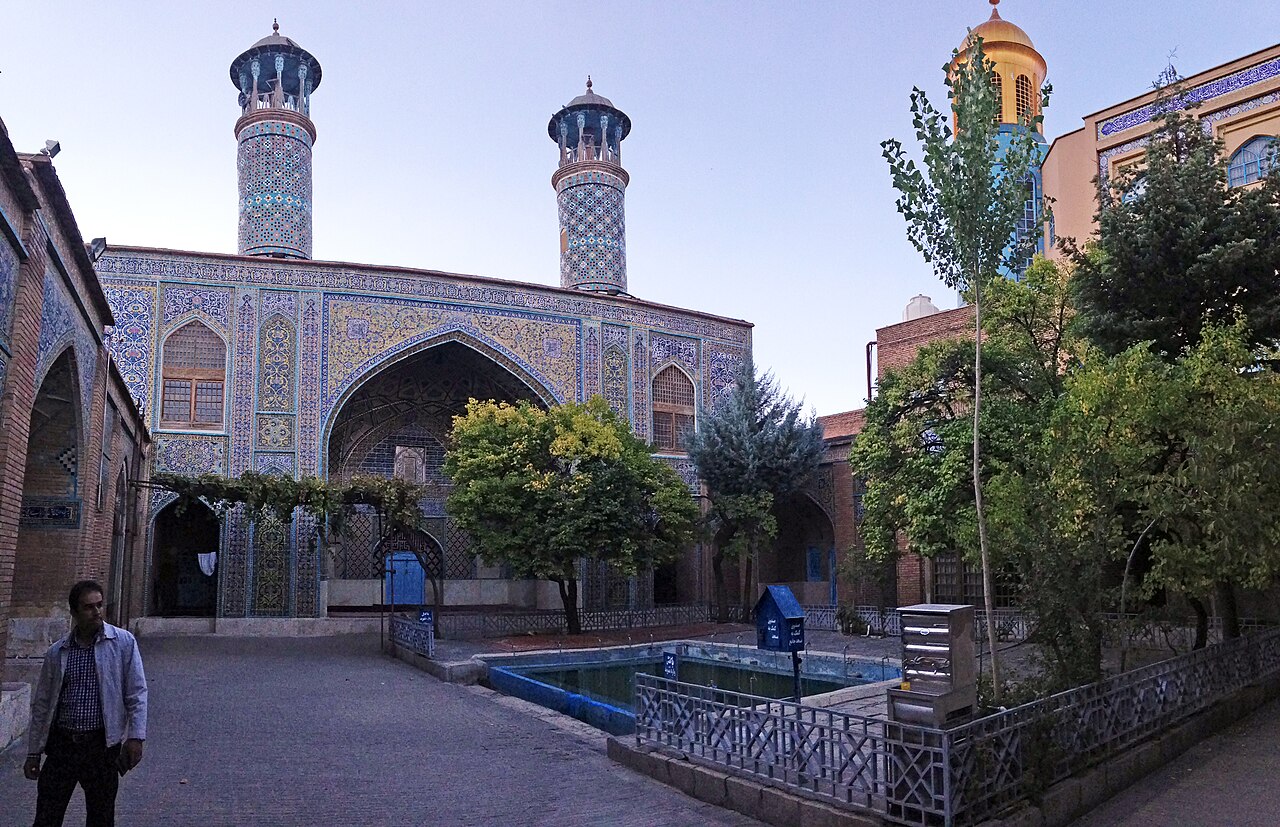

Mosques and mansions of Sanandaj
Dar ul-Ihsan Mosque
The Friday Mosque of Sanandaj, called Dar ul-Ihsan (“house of benevolence”), was built in 1813 by Amanollah Khan Ardalan. It has a courtyard with two minarets, a prayer hall with stone columns, and tilework with Qur’anic inscriptions; most people in Sanandaj are Sunni Muslims, and it is one of the principal Sunni mosques in Iran.
Houses of the Qajar elite
Several grand houses of Sanandaj’s governors and merchants survive, built round courtyards with pools, mirror work and painted ceilings. The Asef Vaziri house, the Moshir Divan house and the Khosrowabad mansion are among the best known, and some now house museums and cultural offices.
Kurdish music
Sanandaj is famous across Iran for its music. The frame drum, دف (daf), is played here both in Sufi gatherings, where long rhythmic sessions lead to trance, and on stage. The Kamkars, a family of musicians from Sanandaj, became one of the best-known ensembles in Iran from the 1980s, playing Kurdish folk and classical music. Weddings in the city still end with the halparke, the Kurdish line dance, in which men and women link arms or little fingers.
Crafts: from Senneh rugs to wooden marquetry
Western carpet dealers have used the name “Senneh” for two things. Senneh rugs and kilims, woven in and around the city, are finely knotted with small, dense patterns, and Senneh kilims are among the most prized flatweaves of Iran. The “Senneh knot”, on the other hand, is a trade name for the asymmetrical Persian knot, which, oddly, is not the knot most Senneh rugs use: they are tied with the symmetrical knot.
Sanandaj craftsmen are also known for moarraq, wooden inlay and fretwork used for boxes, frames and furniture, and for making instruments such as the daf, tar and setar. In the bazaar you will also find گیوه (giveh) or klash, the light cotton-soled shoes of the region, made by hand in the villages of Hawraman.
The people and the language
Almost everyone in Sanandaj speaks Kurdish at home, in the Ardalani form of Central Kurdish (Sorani), and Persian in school and at work. Kurdish clothing is still worn on many days: for men, wide trousers with a sash and jacket; for women, long bright dresses with a velvet waistcoat. Newroz, the Kurdish name for Nowruz, is celebrated with bonfires on the hills around the city. For the wider history, see the Kurds in Iranian history, and for Kurdish among Iran’s languages, languages spoken in Iran.
Hawraman and the mountains
South-west of Sanandaj, towards the Iraqi border, is Hawraman (Persian Uraman), a region of steep valleys where villages such as Palangan and Hawraman Takht are built in terraces down the mountainsides, the flat roof of one house serving as the yard of the one above. The people speak Hawrami, a separate Iranian language. UNESCO listed the cultural landscape of Hawraman in 2021. The road from Sanandaj through Marivan or Kamyaran makes a long day trip or, better, an overnight stay.
Getting there
Sanandaj has an airport with flights from Tehran and is linked by road with Kermanshah, Hamadan and Zanjan. Winters are cold and snowy, and spring, when the hills turn green, is the best season. For transport, entry and safety, check current official information and your own government’s travel advice.
Persian words from this page
| سنندج | Sanandaj | Sanandaj |
| کردستان | Kordestân | Kurdistan |
| کردی | Kordi | Kurdish (language) |
| اردلان | Ardalân | Ardalan (dynasty) |
| دف | daf | frame drum |
| گیوه | giveh | cotton-soled shoe |
| گلیم | gelim | kilim, flatweave rug |
| هورامان | Hourâmân | Hawraman |
Sources and further reading
- Encyclopaedia Iranica, “Ardalān” and “Sanandaj”.
- Mastureh Ardalan, Tarikh-e Ardalan (history of the Ardalan dynasty), 19th century.
- UNESCO World Heritage List, Cultural Landscape of Hawraman/Uramanat (2021).
- Martin van Bruinessen, Agha, Shaikh and State: The Social and Political Structures of Kurdistan, Zed Books, 1992.
- Statistical Centre of Iran, General Population and Housing Census 2016 (1395).
Want to learn Persian? Get the free Starter Pack
Get the 14-page printable Starter Pack (all 32 letters, a 7-day reading plan, 100 core words and 20 survival phrases) and a short 5-email course. Free.
More in Cities of Iran
- Tehran: Iran’s Capital
- Mashhad
- Isfahan
- Shiraz
- Tabriz
- Yazd
- Kashan
- Kerman
- Hamadan
- Qom
- Ahvaz
- Rasht
- Kermanshah
- Urmia
- Ardabil
- Zanjan
- Qazvin
- Sanandaj
- Khorramabad
- Bandar Abbas
- Bushehr
- Zahedan
- Birjand
- Gorgan
- Sari
- Semnan
- Arak
- Ilam
- Yasuj
- Shahr-e Kord
- Bojnurd
- Karaj
- Abadan and Khorramshahr
- Kish Island
- Qeshm Island
- Hormuz Island
- Masuleh
- Abyaneh
- Kandovan
- Bam
- Neyshabur (Nishapur)
- Shush (Susa) Today