Birjand is the capital of South Khorasan province in eastern Iran, a desert-edge city about 1,500 m above sea level and roughly 100 km from the Afghan border. It grew as the seat of the Alam family, the hereditary amirs of the Qaenat region, and is known today for the Akbariyeh Garden, part of Iran’s UNESCO-listed Persian Garden, and for the saffron and barberry grown in the surrounding plains.
| Persian name | بیرجند (Birjand) |
|---|---|
| Province | South Khorasan (capital since the province was created in 2004) |
| Population | 203,636 (city, 2016 national census) |
| Elevation | about 1,490 m |
| Known for | Akbariyeh Garden, saffron, barberry, hand-knotted carpets |

A town of the Qaenat amirs
For most of its history Birjand was a modest market town on routes between Khorasan, Sistan and Kerman. Its rise came in the eighteenth and nineteenth centuries, when the Khozeimeh family, later known by the surname Alam, ruled the Qaenat district almost as local princes under the Qajar shahs. They moved their seat to Birjand, built gardens and mansions there, and made the town the political centre of the eastern frontier.
The family stayed influential into the twentieth century. Mohammad Ebrahim Khan Alam, known as Shokat ol-Molk, governed the region in the late Qajar and early Pahlavi years, and his son Asadollah Alam, born in Birjand in 1919, became prime minister (1962 to 1964) and then minister of the royal court under Mohammad Reza Shah. The family also founded the Shokatiyeh school, one of the earliest schools in eastern Iran to teach a modern curriculum.
The castle and the old town
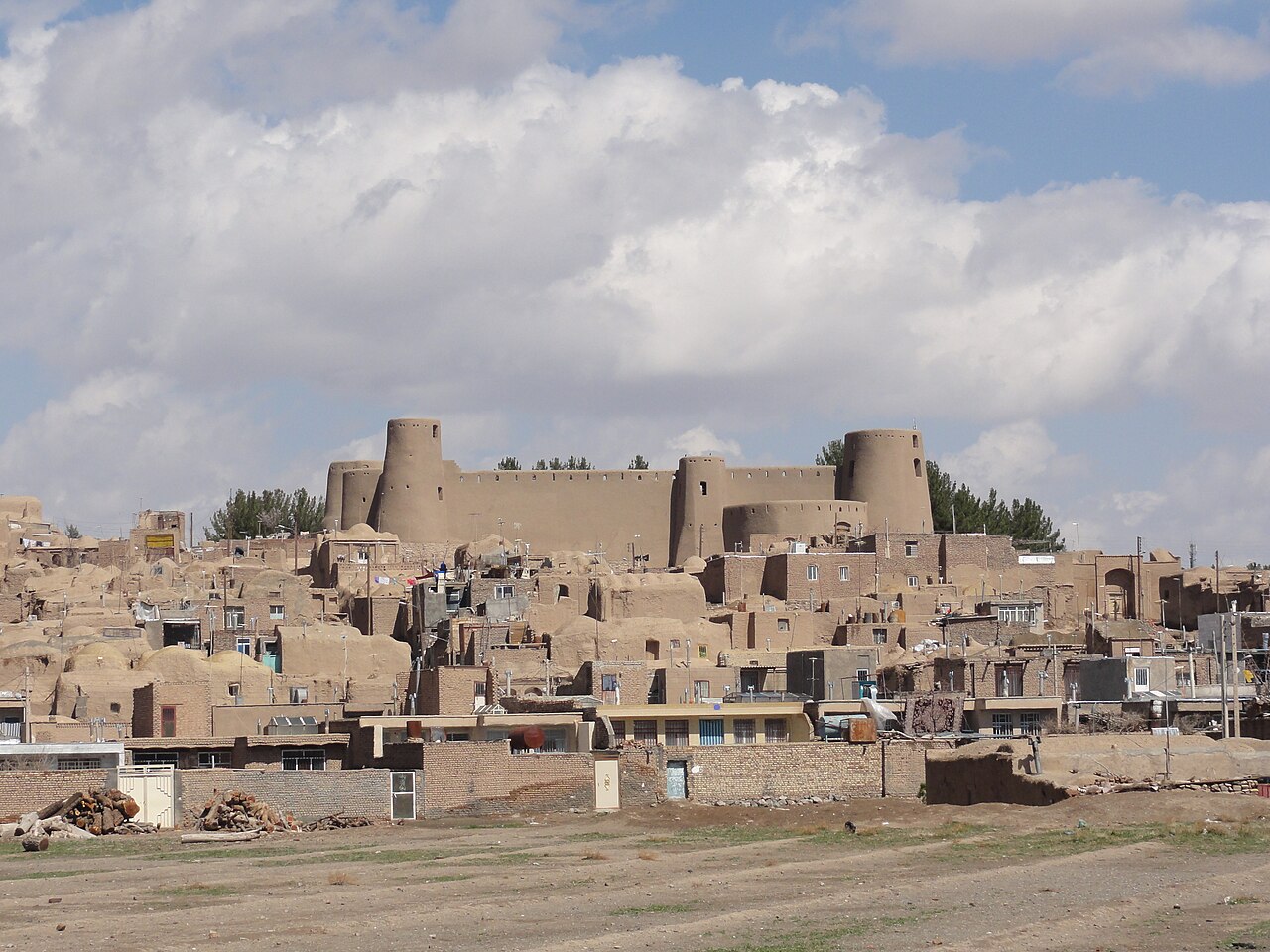
The mud-brick castle of Birjand (قلعه بیرجند) stands on a rise above the older part of the city. Its round towers and thick walls have been rebuilt many times, and its exact date of foundation is uncertain; what survives reflects Safavid and Qajar work. Around it lie lanes of flat-roofed houses, a covered bazaar, and the Jameh Mosque. Many older houses in Birjand were built with domed or vaulted roofs and thick mud walls that keep rooms cool in summer and hold heat in winter, the same desert logic found in Yazd.
Akbariyeh and the other gardens
The Akbariyeh Garden (باغ اکبریه) is the city’s best-known monument. It was laid out by the Alam family in the Qajar period on a slope south of the town, with a long central water channel, rows of pines and cypresses, and a two-storey pavilion with a residence behind it. In 2011 it was one of nine gardens inscribed together by UNESCO as “The Persian Garden”, alongside gardens such as Eram in Shiraz and Fin in Kashan. The pavilion now holds a museum.
Birjand has other Qajar gardens built by the same family, among them Rahimabad, known for its stucco and mirror work, and Shokatabad. Their shared feature is the struggle for water: each garden depends on a qanat, an underground channel carrying water from the hills, and the layout follows the flow. Our page on the Qanat of Gonabad, further north in Khorasan, explains how these channels work.
Saffron, barberry and carpets
South Khorasan is one of Iran’s main saffron (زعفران, za’farân) regions, second only to neighbouring Razavi Khorasan. The crocus flowers are picked by hand in a few weeks of late autumn, and the red stigmas are separated and dried in family homes. The province, especially the districts around Qaen and Birjand, also grows most of Iran’s barberry (زرشک, zereshk), the small sour red berry that goes into zereshk polo, rice with barberries and saffron. Jujube and pomegranate are other local crops.
Towns around Birjand, such as Mud in Sarbisheh county, have long traditions of hand-knotted carpets, known for their curvilinear designs. These are part of the wider Khorasan carpet tradition described on our page on Iranian handicrafts.
A border province
South Khorasan was formed in 2004 when the old province of Khorasan was divided in three, with Mashhad as capital of Razavi Khorasan and Bojnurd of North Khorasan. Birjand’s province is large, dry and thinly populated, with long stretches of the Lut desert in its south and west. Its eastern edge runs along Afghanistan, and trade and migration across that border have shaped the city: Afghan workers and families have lived in the region for decades.
Visitors usually come through Mashhad or Kerman. Roads and flights connect Birjand with both. Opening hours for the castle and gardens change, so check current local information before going, and read your own government’s travel advice for eastern Iran.
Persian words from this page
| بیرجند | Birjand | Birjand |
| خراسان جنوبی | Khorâsân-e Jonubi | South Khorasan |
| قلعه | ghal’e | castle, fort |
| باغ | bâgh | garden |
| زعفران | za’farân | saffron |
| زرشک | zereshk | barberry |
| قنات | ghanât | qanat, underground water channel |
Sources and further reading
- UNESCO World Heritage List, The Persian Garden (inscribed 2011), including Akbariyeh Garden.
- Encyclopaedia Iranica, “Birjand”.
- Encyclopaedia Iranica, “Alam, Asadollah”.
- Statistical Centre of Iran, National Population and Housing Census 2016 (1395).
Want to learn Persian? Get the free Starter Pack
Get the 14-page printable Starter Pack (all 32 letters, a 7-day reading plan, 100 core words and 20 survival phrases) and a short 5-email course. Free.
More in Cities of Iran
- Tehran: Iran’s Capital
- Mashhad
- Isfahan
- Shiraz
- Tabriz
- Yazd
- Kashan
- Kerman
- Hamadan
- Qom
- Ahvaz
- Rasht
- Kermanshah
- Urmia
- Ardabil
- Zanjan
- Qazvin
- Sanandaj
- Khorramabad
- Bandar Abbas
- Bushehr
- Zahedan
- Birjand
- Gorgan
- Sari
- Semnan
- Arak
- Ilam
- Yasuj
- Shahr-e Kord
- Bojnurd
- Karaj
- Abadan and Khorramshahr
- Kish Island
- Qeshm Island
- Hormuz Island
- Masuleh
- Abyaneh
- Kandovan
- Bam
- Neyshabur (Nishapur)
- Shush (Susa) Today