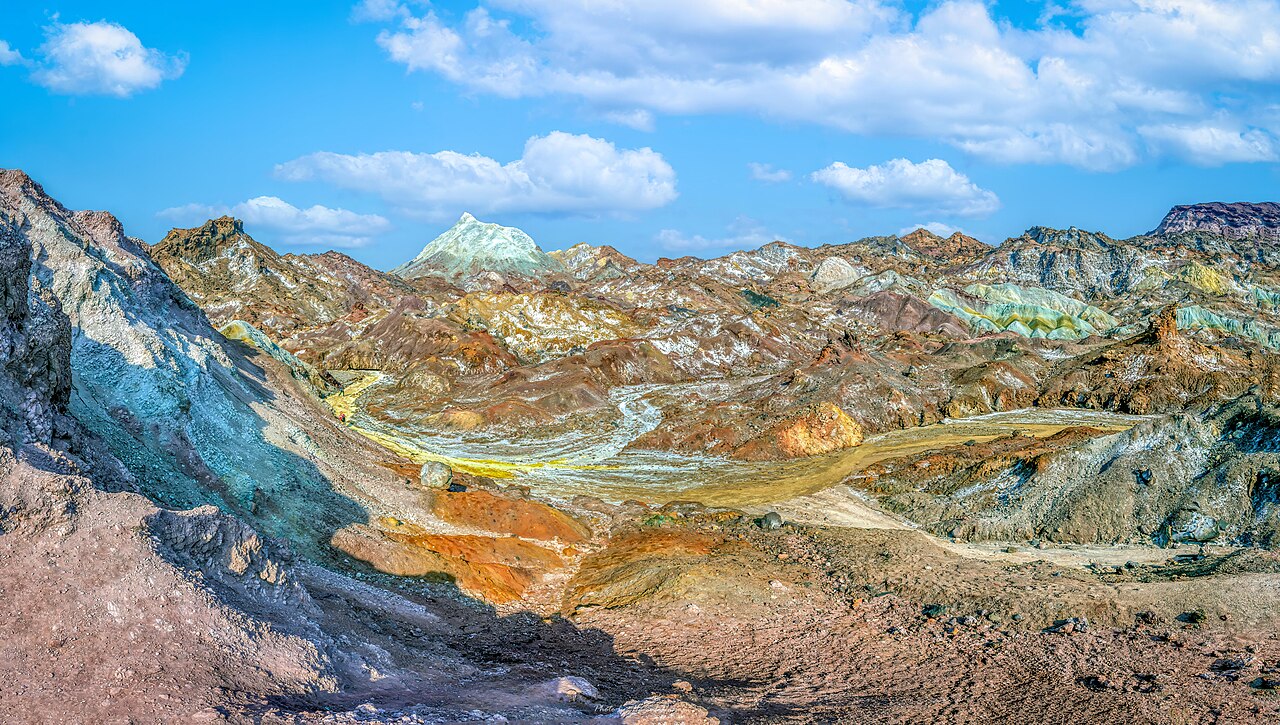
Hormuz Island, 8 km off Bandar Abbas in the Strait of Hormuz, is a salt dome whose rocks come in red, ochre, yellow, purple, grey and white, which is why it is called the “rainbow island”. Its best-known landscape is Rainbow Valley (دره رنگینکمان), where these colours lie side by side in small hills, and the island’s red earth, called golak, even stains its beaches and waves.
| Location | Strait of Hormuz, Hormozgan province, about 8 km from the mainland |
|---|---|
| Area | About 42 km² |
| Geology | Salt diapir (salt dome) of the Hormuz Series, late Precambrian to early Cambrian |
| Main colour sites | Rainbow Valley, Red Beach, Valley of Statues, Salt Mountain and cave, Silence Valley |
| Local red earth | Golak, an iron-rich ochre |
| Best season | November to March |

Why the island is so colourful
More than 500 million years ago, at the end of the Precambrian, shallow seas over what is now the Persian Gulf evaporated again and again, leaving thick beds of salt and gypsum. Volcanoes erupted at the same time, and iron-rich sediments and volcanic rocks were laid down between the salt layers. Geologists call this mixed package the Hormuz Series.
Later, kilometres of younger sediment buried it. Salt is lighter than the rock above it and flows slowly under pressure, like very stiff toothpaste. Over millions of years it pushed upwards in columns called diapirs, or salt domes, and in places broke through to the surface. Hormuz is one of these: from space it appears as a roughly round island with concentric rings of rock, the core of a salt column that has risen out of the sea.
As the salt rose it carried fragments of the other Hormuz Series rocks with it, torn up and jumbled. Rain is scarce here, so salt that would dissolve in a wetter climate survives at the surface, and erosion exposes all the pieces at once. The colours come from different minerals:
- Red and purple: iron oxides, above all hematite, the source of golak.
- Ochre and yellow: other iron minerals and weathered, sulphur-bearing rock.
- White and pink: rock salt and gypsum.
- Grey, green and black: volcanic rocks and shales from the old seafloor.
That is why colours change over a few metres: you are walking across fragments from very different rocks that the salt brought up together.
The sites
Rainbow Valley
A small area of low hills and gullies inland, where red, ochre, yellow and grey soils lie in bands and patches. It is the place most photographs of Hormuz are taken. Walk the gullies in the early morning or late afternoon, when the colours are richest and the heat bearable.
Red Beach
On the coast, iron-rich earth washes from the cliffs into the sea and turns the sand and the breaking waves red. Look at the sand closely and you may see it sparkle with tiny mineral flakes.
Valley of Statues and Silence Valley
Wind and salt weathering have carved the soft rock into shapes, and visitors find faces, animals and figures in them. Silence Valley, inland, is a quieter maze of eroded salt and clay hills.
Salt Mountain and salt cave
Where the salt itself reaches the surface it forms white and pinkish walls. A cave in the salt, sometimes called the cave of the Salt Goddess, has glittering salt walls and crystals.
Golak: the edible earth
Hormuz islanders use golak as a pigment and in cooking, including a well-known local sauce served with bread, and artists in recent years have used the island’s soils for painting and sculpture. Our Hormuz Island page describes this local culture, along with the history of the medieval kingdom of Hormuz and its Portuguese fort.
The colours are not endless. Heavy extraction of ochre for trade has damaged parts of the island, and Iran’s Department of Environment has acted to protect it. Do not take soil or rocks away, and avoid driving off tracks, which scars the soft hills for years.
Practical notes
- Hormuz is reached by passenger boat from Bandar Abbas; check current schedules locally.
- A ring road circles the island. Local drivers offer tours by tuk-tuk or car; cycling is possible in the cool season.
- Come between November and March. Summer heat and humidity are severe, and there is little shade in the valleys.
- Carry water and a hat, and wear shoes that can get stained red.
- Dress modestly in the village, ask before photographing people, and follow your own government’s travel advice for Iran.
Hormuz is often combined with Qeshm Geopark, whose Namakdan salt dome belongs to the same family of salt domes, and with a stay in Bandar Abbas. The Safavid capture of the island from the Portuguese is told on The capture of Hormuz (1622).
Persian words from this page
| رنگینکمان | rangin-kamân | rainbow |
| گلک | golak | the red earth of Hormuz |
| خاک | khâk | soil, earth |
| قرمز | qermez | red |
| ساحل | sâhel | beach, coast |
| نمک | namak | salt |
Sources and further reading
- Encyclopaedia Iranica, “Hormuz” (history of the island and kingdom).
- C. J. Talbot and M. Alavi, “The past of a future syntaxis across the Zagros”, and other work by Talbot on Hormuz salt diapirs, in Geological Society Special Publications 100 (1996).
- “Hormuz Island”, Wikipedia, consulted 2026, as a pointer to geological sources.
Want to learn Persian? Get the free Starter Pack
Get the 14-page printable Starter Pack (all 32 letters, a 7-day reading plan, 100 core words and 20 survival phrases) and a short 5-email course. Free.
More in Top Places to Visit in Iran
- Naqsh-e Jahan Square
- Shah (Imam) Mosque, Isfahan
- Sheikh Lotfollah Mosque
- Ali Qapu Palace
- Jameh Mosque of Isfahan
- Si-o-se Pol and Khaju Bridge
- Vank Cathedral
- Hasht Behesht Palace
- Naqsh-e Rostam
- Eram Garden, Shiraz
- Nasir al-Molk (Pink) Mosque
- Tomb of Hafez (Hafezieh)
- Tomb of Saadi (Saadieh)
- Shah Cheragh Shrine
- Arg of Karim Khan
- Fin Garden, Kashan
- Historic Houses of Kashan
- Jameh Mosque of Yazd
- Yazd Fire Temple and Towers of Silence
- Dowlatabad Garden and Windcatcher
- Amir Chakhmaq Complex
- Golestan Palace
- National Museum of Iran
- Treasury of National Jewels
- Tehran Grand Bazaar
- Milad Tower
- Imam Reza Shrine, Mashhad
- Tomb of Ferdowsi, Tus
- Tomb of Omar Khayyam, Neyshabur
- Tomb of Avicenna, Hamadan
- Ganjnameh Inscriptions, Hamadan
- Behistun (Bisotun): Visiting the Site
- Taq-e Bostan: Visiting the Site
- Tabriz Historic Bazaar
- Takht-e Soleyman
- Armenian Monastic Ensembles of Iran
- Sheikh Safi al-Din Shrine, Ardabil
- Dome of Soltaniyeh
- Alamut Castle
- Falak-ol-Aflak Castle
- Shushtar Historical Hydraulic System
- Chogha Zanbil: Visiting the Ziggurat
- Susa Archaeological Site
- Arg-e Bam
- Ganjali Khan Complex, Kerman
- Shazdeh Garden, Mahan
- Rayen Castle
- Dasht-e Lut (Lut Desert)
- Maranjab Desert and Caravanserai
- Varzaneh Desert
- Mount Damavand
- Hyrcanian Forests
- Lake Urmia
- Badab-e Surt Springs
- Ali Sadr Cave
- The Kaluts of Shahdad
- Qeshm Geopark
- Hormuz Island Colours
- Visiting Persepolis: A Day Trip from Shiraz
- Visiting Pasargadae
- Persian Caravanserais
- The Qanat of Gonabad
- Meymand Village
- Sasanian Sites of Fars: Firuzabad, Bishapur and Sarvestan
- Gonbad-e Qabus: Visiting the Tower
- Zayandeh Rud and Isfahan’s Bridges
- Tochal and Darband: Hiking Above Tehran
- Mount Sabalan
- Skiing in Iran: Dizin and Shemshak
- Golestan National Park