The Hyrcanian forests (جنگلهای هیرکانی) are the broadleaf forests that cover the northern slopes of the Alborz mountains along the Caspian Sea, from Golestan in the east to Gilan and into Azerbaijan in the west. Their history goes back 25 to 50 million years, they survived the ice ages that wiped out similar forests elsewhere, and UNESCO inscribed them as a World Heritage Site in 2019.
| Persian name | Jangal-hâ-ye Hirkâni, also called the Caspian forests |
|---|---|
| Extent | About 55,000 km² as an ecoregion, in Iran and south-eastern Azerbaijan |
| Iranian provinces | Golestan, Mazandaran, Gilan, with edges in North Khorasan and Ardabil |
| UNESCO | World Heritage Site 2019 (Iran); extended to Azerbaijan 2023 |
| Biodiversity | Over 3,200 vascular plants, about 180 forest bird species, 58 mammal species (UNESCO) |
| Typical trees | Oriental beech, chestnut-leaved oak, Persian ironwood, hornbeam, Caucasian zelkova, box |
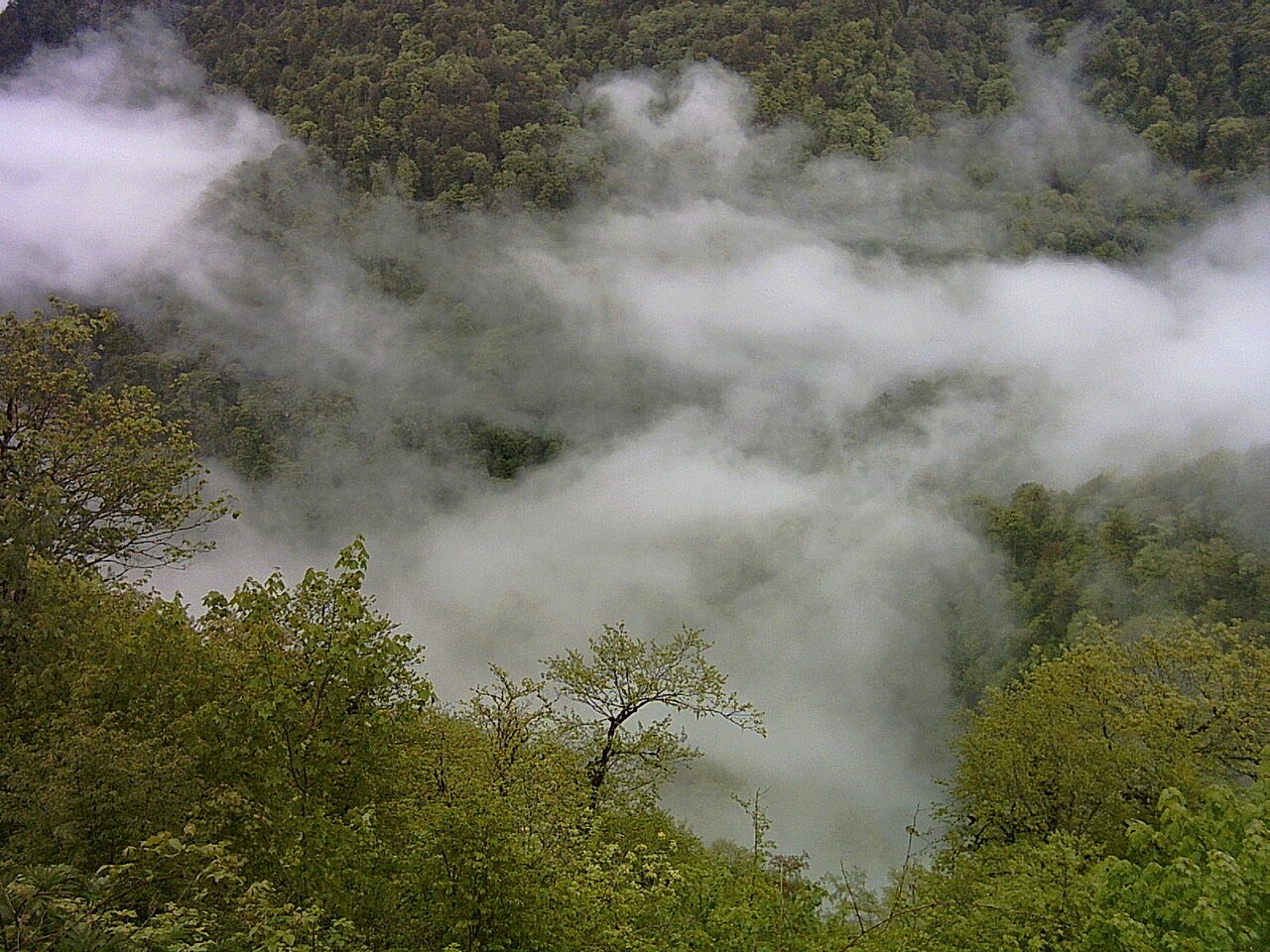

Why a rainforest grows next to a desert country
Most visitors expect Iran to be dry, and most of it is. The north is the exception. Moist air from the Caspian is pushed up against the Alborz, a wall of mountains rising to more than 4,000 metres within a few dozen kilometres of the shore. As the air rises it cools and drops its water as rain and mist, so the seaward slopes are green and dripping while the far side, towards Tehran and Semnan, is semi-desert. Annual rainfall on the western Caspian coast, around Gilan, is among the highest in Iran.
The name comes from Hyrcania, the ancient province south-east of the Caspian, centred on the Gorgan plain. Old Persian Varkâna, “land of wolves”, survives in the name of the city of Gorgan.
A forest from before the ice ages
Tens of millions of years ago, warm-temperate broadleaf forest of this kind covered much of the northern hemisphere. Ice-age cold destroyed most of it in Europe and western Asia. The southern Caspian, sheltered by mountains and moderated by the sea, stayed mild and wet enough for the forest to survive. That is why UNESCO describes the Hyrcanian forests as a relict: they keep species and whole plant communities whose relatives elsewhere are known only as fossils.
The best-known example is the Persian ironwood, Parrotia persica (انجیلی, anjili), a tree found almost only here. Its wood is very hard, its trunks fuse where branches touch, and in autumn its leaves turn yellow, red and purple, giving the lower forest its famous autumn colours.
Forest zones from shore to treeline
Lowlands, below about 700 m
The coastal plain was once covered by chestnut-leaved oak, box, alder and ironwood, with figs, date-plum, Persian silk trees and climbers. Most of it has been cleared for rice paddies, tea gardens, citrus orchards and towns, so lowland forest now survives mainly in patches and parks.
Middle slopes, about 700 to 1,500 m
This is the cloud belt and the heart of the forest. Oriental beech (راش, râsh) dominates, alone or with hornbeam, maple, oak and elm, and accounts for about a third of the forest’s timber volume. Mist hangs here for days at a time.
Upper slopes and the treeline
Higher up the trees shrink to Caucasian oak, hornbeam and shrubland, and then open into mountain meadows and steppe. Relict conifers are rare: yew, juniper and a little cypress are almost the only ones.
Animals
The forest still holds a full set of large predators, which is rare in the Middle East: the Persian leopard, wolf, brown bear and lynx, alongside wild boar, jungle cat, badger and otter. Red deer and roe deer live in the eastern forests around Golestan National Park, Iran’s oldest national park. You are unlikely to see the big mammals, but birds are easy to hear: woodpeckers, owls and birds of prey.
Pressures on the forest
The Hyrcanian belt has shrunk greatly over the last century. Clearance for farming and villas, roads cut through the hills, overgrazing, wildfires and decades of logging have all taken a share. Box trees, a key understorey species, have been badly hit by blight and the box tree moth in the 2010s. The UNESCO listing covers selected protected areas rather than the whole belt, and its value depends on the land between them being kept too.
Where to see the forest
- Golestan National Park in the east, on the road between Gorgan and Mashhad, for the most intact forest and wildlife.
- Abr forest (جنگل ابر, “cloud forest”) near Shahrud, where mist pours over the ridge from the Caspian side.
- The Chalus road and Kandovan pass from Tehran to the coast, for a cross-section from bare mountains to dense forest.
- Sisangan and Noor on the Mazandaran coast, lowland forest parks near the sea.
- Masuleh and Gilan’s hills in the west, for forest, rain and tea gardens. See Masuleh and Rasht.
Practical notes
Spring and autumn are the best seasons: April to June for fresh green and wildflowers, October and November for autumn colour. Summer is humid and the coast is crowded with holidaymakers from Tehran. Trails are often unmarked and mist can come down fast, so walk with a local guide or stay on known paths, and carry rain gear in any season. Never light fires in the forest. Check current conditions locally and follow your own government’s travel advice for Iran.
For the region as a whole, its towns, food and roads, read our guide to Shomal, the north of Iran. The mountain that towers over these forests is Mount Damavand, and the nearby travertine springs of Badab-e Surt sit on the forest’s dry southern edge.
Persian words from this page
| جنگل | jangal | forest |
| راش | râsh | beech |
| بلوط | balut | oak |
| انجیلی | anjili | Persian ironwood |
| شمشاد | shemshâd | box tree |
| پلنگ | palang | leopard |
| مه | meh | mist, fog |
Sources and further reading
- UNESCO World Heritage Centre, “Hyrcanian Forests”, whc.unesco.org/en/list/1584.
- Encyclopaedia Iranica, “Hyrcania”, for the ancient province and its name.
- M. R. Marvie Mohadjer, Silviculture (University of Tehran Press), the standard Persian textbook on the Caspian forests.
- “Hyrcanian forests”, Wikipedia, consulted 2026, as a pointer to the botanical literature.
Want to learn Persian? Get the free Starter Pack
Get the 14-page printable Starter Pack (all 32 letters, a 7-day reading plan, 100 core words and 20 survival phrases) and a short 5-email course. Free.
More in Top Places to Visit in Iran
- Naqsh-e Jahan Square
- Shah (Imam) Mosque, Isfahan
- Sheikh Lotfollah Mosque
- Ali Qapu Palace
- Jameh Mosque of Isfahan
- Si-o-se Pol and Khaju Bridge
- Vank Cathedral
- Hasht Behesht Palace
- Naqsh-e Rostam
- Eram Garden, Shiraz
- Nasir al-Molk (Pink) Mosque
- Tomb of Hafez (Hafezieh)
- Tomb of Saadi (Saadieh)
- Shah Cheragh Shrine
- Arg of Karim Khan
- Fin Garden, Kashan
- Historic Houses of Kashan
- Jameh Mosque of Yazd
- Yazd Fire Temple and Towers of Silence
- Dowlatabad Garden and Windcatcher
- Amir Chakhmaq Complex
- Golestan Palace
- National Museum of Iran
- Treasury of National Jewels
- Tehran Grand Bazaar
- Milad Tower
- Imam Reza Shrine, Mashhad
- Tomb of Ferdowsi, Tus
- Tomb of Omar Khayyam, Neyshabur
- Tomb of Avicenna, Hamadan
- Ganjnameh Inscriptions, Hamadan
- Behistun (Bisotun): Visiting the Site
- Taq-e Bostan: Visiting the Site
- Tabriz Historic Bazaar
- Takht-e Soleyman
- Armenian Monastic Ensembles of Iran
- Sheikh Safi al-Din Shrine, Ardabil
- Dome of Soltaniyeh
- Alamut Castle
- Falak-ol-Aflak Castle
- Shushtar Historical Hydraulic System
- Chogha Zanbil: Visiting the Ziggurat
- Susa Archaeological Site
- Arg-e Bam
- Ganjali Khan Complex, Kerman
- Shazdeh Garden, Mahan
- Rayen Castle
- Dasht-e Lut (Lut Desert)
- Maranjab Desert and Caravanserai
- Varzaneh Desert
- Mount Damavand
- Hyrcanian Forests
- Lake Urmia
- Badab-e Surt Springs
- Ali Sadr Cave
- The Kaluts of Shahdad
- Qeshm Geopark
- Hormuz Island Colours
- Visiting Persepolis: A Day Trip from Shiraz
- Visiting Pasargadae
- Persian Caravanserais
- The Qanat of Gonabad
- Meymand Village
- Sasanian Sites of Fars: Firuzabad, Bishapur and Sarvestan
- Gonbad-e Qabus: Visiting the Tower
- Zayandeh Rud and Isfahan’s Bridges
- Tochal and Darband: Hiking Above Tehran
- Mount Sabalan
- Skiing in Iran: Dizin and Shemshak
- Golestan National Park