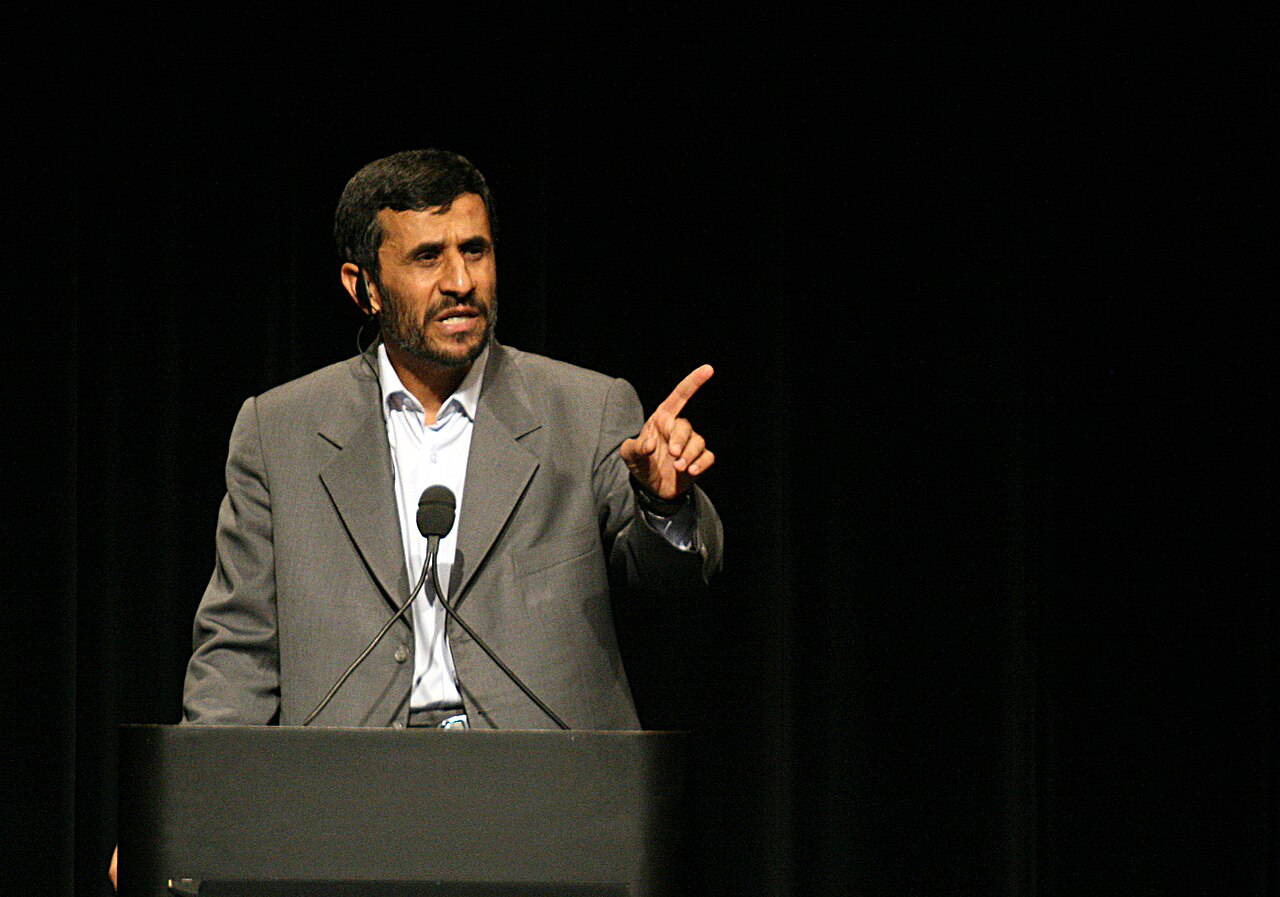
Mahmoud Ahmadinejad, a former mayor of Tehran and son of a blacksmith, was president of Iran from August 2005 to August 2013. He came to power promising to share Iran’s oil wealth with ordinary people, and his years in office combined record oil income, populist spending, open defiance over the nuclear programme and the toughest international sanctions Iran had yet faced. His disputed re-election in 2009 led to the largest protests since the revolution.
| Born | 28 October 1956, Aradan, near Garmsar (Semnan province) |
|---|---|
| Before the presidency | Lecturer in civil engineering; governor of Ardabil province; mayor of Tehran 2003–2005 |
| Elections | June 2005 (run-off win over Rafsanjani, about 62%); June 2009 (official 63%, disputed) |
| Key policies | Mehr housing, Justice Shares, cash transfers replacing fuel subsidies (2010) |
| Successor | Hassan Rouhani (2013) |

An outsider’s victory in 2005
Ahmadinejad was little known outside Tehran when he entered the 2005 race. He campaigned in a plain jacket, spoke of corruption and the gap between rich and poor, and promised to “bring the oil money to people’s tables”. He was supported by parts of the Basij militia and the Revolutionary Guards and by the new conservative “principlist” (اصولگرا, osulgara) camp. In the run-off on 24 June he beat former president Akbar Hashemi Rafsanjani, who for many voters stood for the privileged elite of the 1990s. Defeated candidates, among them Mehdi Karroubi, complained of irregularities in the first round.
Oil money and the economy
Ahmadinejad governed during an oil boom. Iran’s oil export income over his two terms is often estimated at more than 600 billion dollars. His government spent it widely:
- Provincial trips. The president and cabinet toured every province, taking requests and approving local projects on the spot.
- Mehr housing (مسکن مهر, maskan-e Mehr), a scheme to build millions of cheap homes on state land, many of them far from jobs and services.
- Justice Shares, shares in state companies handed to low-income families.
- Cheap credit, ordered through lower bank interest rates and loans for small firms.
He also dissolved the Management and Planning Organisation, the state’s main economic planning body, in 2007. Economists, including some conservatives, warned that the spending fed inflation and imports. Inflation and the cost of housing rose sharply, and when oil revenue fell under sanctions the weaknesses were exposed.
Subsidy reform
His most lasting economic act was the Targeted Subsidies Reform of December 2010. Prices of petrol, diesel, electricity, water and bread were raised towards market levels, and in return almost every Iranian received a monthly cash payment, initially 455,000 rials (45,500 tomans) per person. The IMF praised the reform as bold; critics said the cash payments were too large to sustain and worsened inflation. A version of the payments, called یارانه (yarane, subsidy), still exists.
Nuclear defiance and sanctions
In August 2005 Iran resumed uranium conversion at Isfahan, ending the suspension agreed under Khatami, and in 2006 it began enrichment at Natanz. Ahmadinejad made the programme a matter of national pride and dismissed UN resolutions as “torn paper”. The UN Security Council passed four sanctions resolutions between 2006 and 2010 (1737, 1747, 1803 and 1929). In 2012 the EU banned imports of Iranian oil and Iranian banks were cut off from the SWIFT payments system. The rial lost more than half its value in 2012, and inflation passed 30 per cent. These events are covered on Iran’s nuclear programme and sanctions on Iran.
Words that travelled: Israel and the Holocaust
In October 2005 Ahmadinejad told a conference in Tehran that Israel should be removed, quoting Khomeini. His words were widely translated as a call for Israel to be “wiped off the map”; some translators argued a closer rendering was that the regime “must vanish from the page of time”, though both readings were understood as calling for an end to the Israeli state. He also called the Holocaust a “myth”, and in December 2006 his government hosted a conference that gave a platform to Holocaust deniers. These statements drew condemnation from the UN Secretary-General and many governments, and some Iranian politicians said they had damaged the country’s interests. His 2007 speech at Columbia University in New York, where the university’s president introduced him with sharp criticism, showed how polarising he had become.
The 2009 election
Ahmadinejad was declared the winner of the presidential election of 12 June 2009 with about 63 per cent of the vote. His main challenger, Mir-Hossein Mousavi, and millions of supporters rejected the result, and the mass protests that followed are described on the page about the Green Movement. Leader Ali Khamenei endorsed the result and the protests were suppressed.
Falling out with the Leader
Ahmadinejad’s second term was marked by conflict inside the conservative camp. In April 2011 he tried to dismiss the intelligence minister, Heydar Moslehi; Khamenei reinstated him, and the president stayed away from his office for about eleven days. His allies, grouped around his chief of staff Esfandiar Rahim Mashaei, were attacked by clerics as a “deviant current” for their nationalism and unorthodox religious ideas. In 2012 he became the first president to be summoned for questioning by the Majlis. Several of his officials, including first vice-president Mohammad-Reza Rahimi, were later convicted of corruption.
After 2013
The Guardian Council rejected Ahmadinejad’s candidacy for the presidency in 2017, 2021 and 2024. Out of office he reinvented himself as a critic of the judiciary and the system’s elite, which surprised many who remembered his presidency.
Assessments
Supporters remember Ahmadinejad as a president who lived simply, visited forgotten towns and gave poor families cash, homes and shares. Critics, from reformists to many conservatives, blame him for wasting the oil boom, high inflation, undermining state institutions and a foreign policy that helped unite the world behind sanctions. Historians such as Ali Ansari and Kasra Naji have studied how his populism drew on both revolutionary and nationalist traditions.
Persian words from this page
| احمدینژاد | Ahmadi-nezhâd | Ahmadinejad |
| اصولگرایان | osul-garâyân | principlists (conservatives) |
| مسکن مهر | maskan-e Mehr | Mehr housing |
| یارانه | yârâne | subsidy, cash transfer |
| سهام عدالت | sahâm-e edâlat | Justice Shares |
| تورم | tavarrom | inflation |
Sources and further reading
- Kasra Naji, Ahmadinejad: The Secret History of Iran’s Radical Leader (I.B. Tauris, 2008).
- Ali M. Ansari, Iran under Ahmadinejad: The Politics of Confrontation (Routledge for IISS, Adelphi Paper, 2007).
- Kevan Harris, A Social Revolution: Politics and the Welfare State in Iran (University of California Press, 2017).
- International Monetary Fund, country reports on the Islamic Republic of Iran (2011–2014).
- UN Security Council Resolutions 1737 (2006), 1747 (2007), 1803 (2008) and 1929 (2010).
Want to learn Persian? Get the free Starter Pack
Get the 14-page printable Starter Pack (all 32 letters, a 7-day reading plan, 100 core words and 20 survival phrases) and a short 5-email course. Free.
More in The Islamic Revolution and the Islamic Republic (1979–present)
- Causes of the 1979 Revolution
- Khomeini’s Return and the Fall of the Monarchy
- Ruhollah Khomeini
- The 1979 Referendum and the New Constitution
- The Iran Hostage Crisis (1979–1981)
- Power Struggles after the Revolution
- The Cultural Revolution and University Closures
- The Iran–Iraq War: Causes and Iraqi Invasion
- Khorramshahr: Fall and Liberation
- The Iran–Iraq War, 1982–1986
- The Basij and Child Soldiers in the Iran–Iraq War
- Chemical Weapons in the Iran–Iraq War
- The Tanker War and Iran Air Flight 655
- The Iran–Contra Affair
- The End of the Iran–Iraq War (1988)
- The 1988 Executions of Political Prisoners
- The Death of Khomeini and the Succession of Khamenei (1989)
- Ali Khamenei
- Rafsanjani and Post-War Reconstruction (1989–1997)
- Khatami and the Reform Era (1997–2005)
- The 1999 Student Protests (18 Tir)
- The Ahmadinejad Presidency (2005–2013)
- The 2009 Election and the Green Movement
- Iran’s Nuclear Program
- Sanctions on Iran
- Rouhani and the Nuclear Deal (JCPOA)
- The Protests of 2017–2018 and November 2019
- The Killing of Soleimani and Flight 752 (January 2020)
- Iran and the COVID-19 Pandemic
- The Raisi Presidency and His Death (2021–2024)
- The 2022 Mahsa Amini Protests: “Woman, Life, Freedom”
- Iran and Israel: From Allies to Open Conflict
- The Pezeshkian Presidency
- The Twelve-Day War of June 2025
- The Protests of Late 2025 and January 2026
- The 2026 War with the United States and Israel
- The Killing of Ali Khamenei (28 February 2026)
- Mojtaba Khamenei and the 2026 Succession
- The Iranian Diaspora
- Iran and Hezbollah
- Major Earthquakes in Modern Iran
- Iranian Cinema after 1979