Iran is one of the most earthquake-prone countries in the world, because the Arabian plate is pushing north-east into Eurasia across its territory. Since the 1979 revolution, the deadliest disasters have been the Rudbar–Manjil earthquake of June 1990 in Gilan, which killed between about 35,000 and 50,000 people, and the Bam earthquake of December 2003, which killed 26,271 according to the Statistical Centre of Iran. Both exposed how fragile traditional mud-brick and poorly built modern houses can be.
| Why | Collision of the Arabian and Eurasian plates; thousands of active faults across the Zagros, Alborz and eastern Iran |
|---|---|
| Deadliest since 1979 | Rudbar–Manjil, 21 June 1990 (Mw 7.4); Bam, 26 December 2003 (Mw 6.6) |
| Other major quakes | Qaen (Zirkuh) 1997; Ahar–Varzaqan 2012; Kermanshah 2017 |
| Building code | Iranian Standard 2800, first issued in 1988 |
A country on the move
Iran sits in a broad zone where the Arabian plate pushes into Eurasia by a little over two centimetres a year. The squeeze has raised the Zagros and Alborz ranges and broken the plateau into many faults. Large earthquakes are recorded throughout Iranian history, from ancient Rey to medieval Tabriz and Nishapur, and the seismologist Nicholas Ambraseys and the Iranian geologist Manuel Berberian compiled long catalogues of them from chronicles and inscriptions. Before the revolution, the Buin Zahra earthquake of 1962 west of Tehran killed about 12,000 people, and the Tabas earthquake of September 1978, in the last months of the monarchy, destroyed the desert town of Tabas and killed between about 15,000 and 25,000. For the geography behind this, see the geography of Iran.
Rudbar and Manjil, 1990
Just after midnight on 21 June 1990, a magnitude 7.4 earthquake struck the hills of Gilan and Zanjan provinces south of the Caspian Sea. Because it came at 00:30, when most people were asleep indoors, and because many villages were built of heavy unreinforced masonry, the death toll was enormous. The towns of Rudbar and Manjil, on the road from Qazvin to Rasht, were largely flattened, and landslides buried villages in the valleys of the Sefid Rud. Estimates of the dead range from about 35,000 to 50,000, with tens of thousands injured and several hundred thousand left homeless.
The disaster came less than two years after the end of the Iran–Iraq War, when the country’s finances were exhausted. The government of President Rafsanjani accepted international help, including aid from American relief organisations, at a time when the two countries had no diplomatic relations. Reconstruction was slow, and the experience prompted stronger enforcement of the national seismic building code, Standard 2800, issued two years earlier.

Bam, 2003
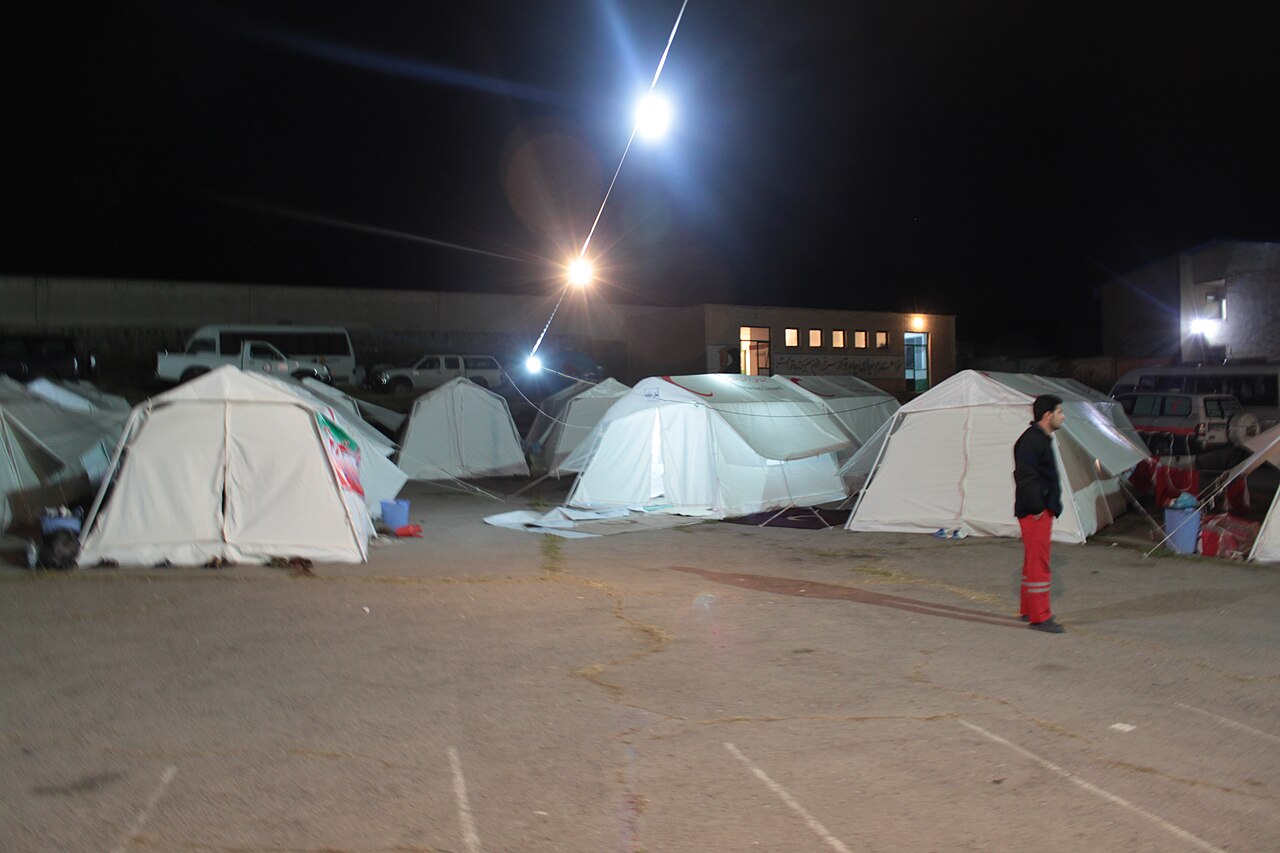
At 5:26 in the morning on 26 December 2003, a magnitude 6.6 earthquake struck directly beneath the city of Bam in Kerman province. The fault ran under the town itself, and the shaking destroyed most of its adobe and brick buildings, including much of the Arg-e Bam, the vast mud-brick citadel that was one of Iran’s most famous monuments. The Statistical Centre of Iran later put the death toll at 26,271; around 30,000 people were injured and most survivors lost their homes.
The response was international. Rescue teams and aid arrived from dozens of countries, and American military transport planes landed in Kerman with relief supplies, the first such US flights to Iran in decades. In 2004 UNESCO inscribed Bam and its cultural landscape on the World Heritage List and on the List of World Heritage in Danger, and restoration of the citadel continued for years. The city, the earthquake and the rebuilding are covered in detail on the page on Bam, and the citadel on Arg-e Bam.
Other earthquakes since 1979
- 1981 Two earthquakes near Golbaf and Sirch in Kerman province kill several thousand people.
- 1997 The Qaen (Zirkuh) earthquake in South Khorasan, magnitude 7.3, kills about 1,500.
- 2002 The Changureh (Avaj) earthquake in Qazvin province kills more than 200.
- 2005 The Zarand earthquake in Kerman province kills several hundred.
- 2012 Twin earthquakes of magnitude 6.4 and 6.2 near Ahar and Varzaqan in East Azerbaijan kill at least 306.
- 2017 A magnitude 7.3 earthquake on the Iran–Iraq border on 12 November kills more than 600 people, most of them in Kermanshah province, with Sarpol-e Zahab hit hardest.
The Kermanshah earthquake caused a political argument. Many of the buildings that collapsed in Sarpol-e Zahab were new apartment blocks built under the Mehr housing programme of the Ahmadinejad years, and critics, including officials, blamed poor construction and weak supervision; supporters of the programme said the problem lay with individual contractors.
Tehran’s risk
The greatest fear is a large earthquake under Tehran, a city of about nine million people built against the Alborz mountains and crossed by several active faults, including the North Tehran, Mosha and Ray faults. Tehran was badly damaged by earthquakes in past centuries, including the destruction of nearby Rey. A seismic study carried out with the Japan International Cooperation Agency in 2000 estimated that a strong earthquake on the Ray fault could kill several hundred thousand people. Iranian officials have at times discussed moving parts of the government or the capital itself; others argue that strengthening buildings, especially older brick houses and unregulated new construction, is the only realistic answer.
Living with earthquakes
Iran has built up considerable expertise. The Red Crescent Society (هلال احمر, helâl-e ahmar) runs search-and-rescue teams and stockpiles, schools hold earthquake drills, and the International Institute of Earthquake Engineering and Seismology in Tehran monitors seismic activity. Yet each disaster shows the same gap between the rules and how buildings are actually built.
Persian words from this page
| زلزله | zelzele | earthquake (everyday word) |
| زمینلرزه | zamin-larze | earthquake (formal word) |
| گسل | gosal | fault (geology) |
| آوار | âvâr | rubble |
| ارگ | arg | citadel |
| هلال احمر | helâl-e ahmar | Red Crescent |
Sources and further reading
- N. N. Ambraseys and C. P. Melville, A History of Persian Earthquakes (Cambridge University Press, 1982).
- Manuel Berberian, Earthquakes and Coseismic Surface Faulting on the Iranian Plateau (Elsevier, 2014).
- UNESCO World Heritage Centre, Bam and its Cultural Landscape.
- United States Geological Survey, event summaries for the 1990 Manjil–Rudbar, 2003 Bam and 2017 Iran–Iraq border earthquakes.
- Statistical Centre of Iran, figures for deaths in the Bam earthquake.
Want to learn Persian? Get the free Starter Pack
Get the 14-page printable Starter Pack (all 32 letters, a 7-day reading plan, 100 core words and 20 survival phrases) and a short 5-email course. Free.
More in The Islamic Revolution and the Islamic Republic (1979–present)
- Causes of the 1979 Revolution
- Khomeini’s Return and the Fall of the Monarchy
- Ruhollah Khomeini
- The 1979 Referendum and the New Constitution
- The Iran Hostage Crisis (1979–1981)
- Power Struggles after the Revolution
- The Cultural Revolution and University Closures
- The Iran–Iraq War: Causes and Iraqi Invasion
- Khorramshahr: Fall and Liberation
- The Iran–Iraq War, 1982–1986
- The Basij and Child Soldiers in the Iran–Iraq War
- Chemical Weapons in the Iran–Iraq War
- The Tanker War and Iran Air Flight 655
- The Iran–Contra Affair
- The End of the Iran–Iraq War (1988)
- The 1988 Executions of Political Prisoners
- The Death of Khomeini and the Succession of Khamenei (1989)
- Ali Khamenei
- Rafsanjani and Post-War Reconstruction (1989–1997)
- Khatami and the Reform Era (1997–2005)
- The 1999 Student Protests (18 Tir)
- The Ahmadinejad Presidency (2005–2013)
- The 2009 Election and the Green Movement
- Iran’s Nuclear Program
- Sanctions on Iran
- Rouhani and the Nuclear Deal (JCPOA)
- The Protests of 2017–2018 and November 2019
- The Killing of Soleimani and Flight 752 (January 2020)
- Iran and the COVID-19 Pandemic
- The Raisi Presidency and His Death (2021–2024)
- The 2022 Mahsa Amini Protests: “Woman, Life, Freedom”
- Iran and Israel: From Allies to Open Conflict
- The Pezeshkian Presidency
- The Twelve-Day War of June 2025
- The Protests of Late 2025 and January 2026
- The 2026 War with the United States and Israel
- The Killing of Ali Khamenei (28 February 2026)
- Mojtaba Khamenei and the 2026 Succession
- The Iranian Diaspora
- Iran and Hezbollah
- Major Earthquakes in Modern Iran
- Iranian Cinema after 1979