After recapturing Khorramshahr in May 1982, Iran carried the war into Iraq, aiming to overthrow Saddam Hussein. From 1982 to 1986 it launched a series of massive offensives towards Basra and across the southern marshes, relying heavily on waves of Revolutionary Guard and Basij volunteers. The fighting cost both sides enormous losses, saw Iraq’s systematic use of chemical weapons, and ended in a bloody stalemate broken only by Iran’s capture of the Fao peninsula in February 1986.
| Period | July 1982 to the end of 1986 |
|---|---|
| Main fronts | East of Basra; the Hoveyzeh marshes; the central and northern borderlands; the Fao peninsula |
| Key Iranian offensives | Ramadan (July 1982), Dawn (Valfajr) series (1983), Kheibar (February 1984), Badr (March 1985), Dawn 8 (February 1986) |
| Iranian slogan | “War, war until victory” |
| Result | Stalemate; Iran held the Majnoon islands and Fao but could not break through to Basra |
The decision to invade Iraq
In June 1982, with his army pushed back to the border, Saddam Hussein offered a ceasefire and announced a withdrawal from Iranian territory. Iran’s leaders demanded more: the removal of Saddam, reparations and the return of Iraqi refugees. Khomeini, backed by most of the clerical leadership and the Revolutionary Guards, decided to fight on. Some officials and army commanders had doubts, but the mood after the liberation of Khorramshahr favoured a decisive blow.
On 13 July 1982 Iran launched Operation Ramadan, its first major offensive on Iraqi soil, east of Basra. The Iraqi army, now defending its own country, fought far harder than it had in Khuzestan. Behind prepared earthworks, minefields and artillery, it threw back the attack with heavy Iranian losses. The pattern for the next four years was set.
How Iran fought: volunteers and human waves
Iran had more people, but Iraq had more tanks, aircraft and artillery and, increasingly, the money and weapons of the Arab Gulf states, the Soviet Union and France. The United States, which had broken relations with Iran, shared intelligence with Iraq from the mid-1980s. Iran, under an arms embargo, bought what it could on the black market and from countries such as Syria, Libya, North Korea and China, and secretly from the United States and Israel (see the Iran–Contra affair).
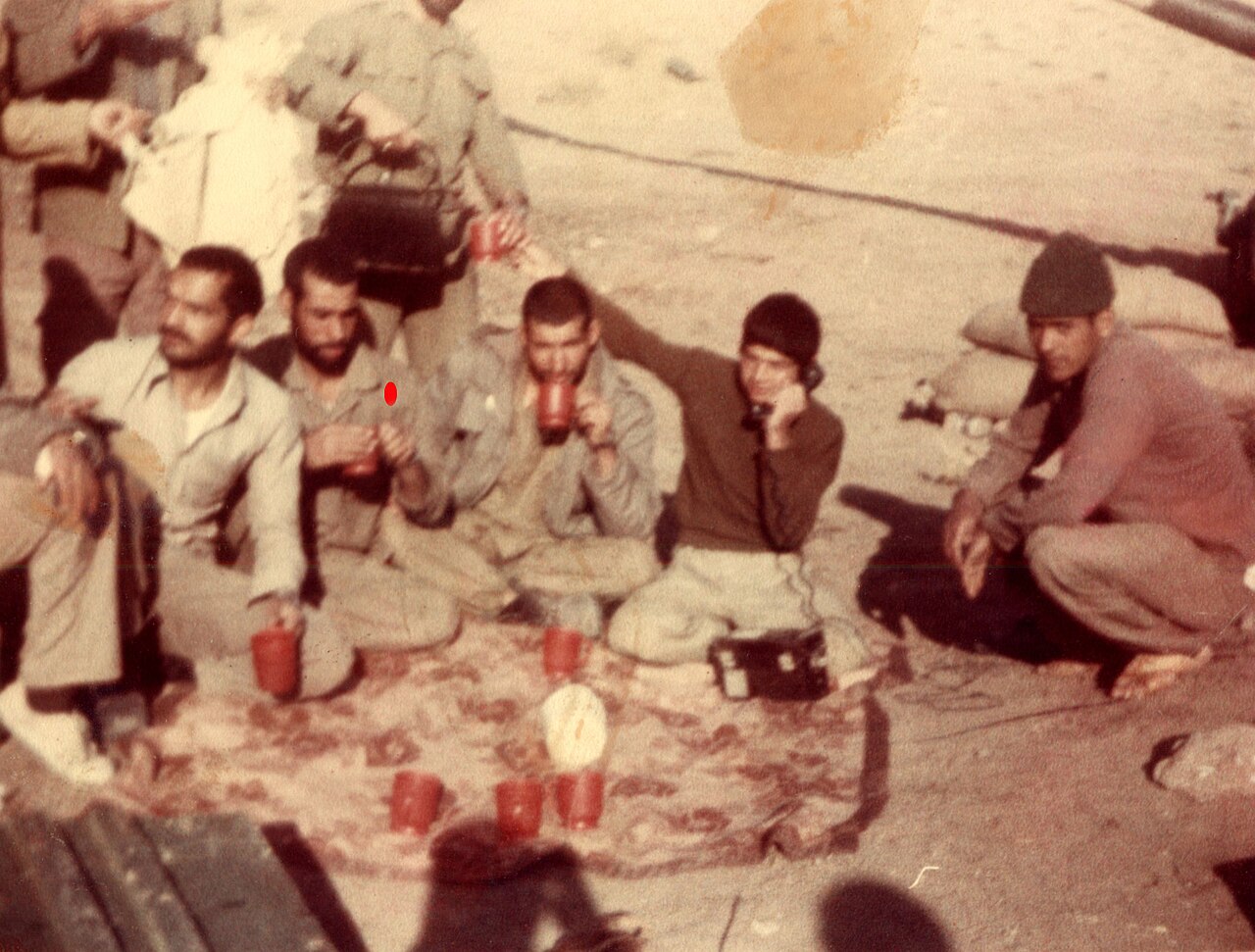
To make up for its lack of armour, Iran depended on infantry assaults by the Revolutionary Guards and the Basij, a volunteer militia that drew in young men, older men and boys. Wearing headbands with religious slogans, they attacked in dense formations, often at night, sometimes clearing minefields by advancing across them. Western reporters called these “human wave” attacks; military historians note that Iranian tactics grew more sophisticated after 1984, with infiltration, night attacks and amphibious crossings. The role of very young volunteers is discussed in the Basij and child soldiers in the Iran–Iraq War.
The Basij and the Guards drew their strength from a culture of martyrdom rooted in the story of Imam Hossein at Karbala. Front-line units were named after Shi’a imams, and the operations were given religious code names such as Karbala, Kheibar and Badr, battles from early Islamic history.

The great offensives, 1983–1985
The Dawn offensives, 1983
Through 1983 Iran launched a series of operations named Valfajr (Dawn) along the central and northern fronts, gaining some ground in the Kurdish mountains but no strategic breakthrough. Iraq began using mustard gas in this period, the start of the chemical warfare described on the page chemical weapons in the Iran–Iraq War.
Kheibar and the battle of the marshes, 1984
In February 1984 Iran tried a new approach: Operation Kheibar sent forces by boat and on foot through the Hoveyzeh marshes north of Basra, where Iraqi armour could not easily operate. Iranian troops captured the Majnoon islands, artificial islands built on a major oilfield, and held them for the rest of the war. Their attempt to cut the Basra–Baghdad road failed, and Iraq used nerve gas, tabun, against Iranian troops for the first time. United Nations experts sent to Iran in March 1984 confirmed the use of chemical weapons.
The war of the cities and Badr, 1984–1985
In February 1984 Iraq began air and missile strikes on Iranian cities, and Iran replied with artillery and later missiles against Baghdad and Basra. These “wars of the cities” came in several rounds and brought the fighting into the homes of civilians far from the front. In March 1985 Iran’s Operation Badr crossed the marshes again and briefly reached the Tigris, before Iraqi counter-attacks drove it back with very heavy losses.
- 13 July 1982 Operation Ramadan, Iran’s first offensive into Iraq, fails east of Basra
- 1983 Valfajr (Dawn) offensives; first Iraqi use of mustard gas
- February 1984 Operation Kheibar; Majnoon islands taken; Iraq uses tabun
- February 1984 First “war of the cities”
- March 1985 Operation Badr reaches the Tigris and is driven back
- 9 February 1986 Operation Dawn 8: Iran crosses the Shatt al-Arab and takes Fao
- Mid-1986 Iraq takes and loses the border town of Mehran
The capture of Fao, 1986
Iran’s most successful offensive of the period came on the night of 9 February 1986. In Operation Valfajr 8 (Dawn 8), Iranian forces, many of them trained frogmen, crossed the wide Shatt al-Arab in rain and darkness and took the Fao peninsula, Iraq’s only coastline on the Persian Gulf. The operation surprised Iraq, whose commanders had expected an attack further north, and brought Iranian forces within sight of Kuwait. Iraqi counter-attacks with heavy use of chemical weapons failed to dislodge them. Iran held Fao until April 1988.
The fall of Fao alarmed the Arab Gulf states and the West, and pushed them closer to Iraq. Later in 1986 Iraq briefly took the Iranian border town of Mehran, which Iran recovered within weeks. At the end of the year Iran was preparing a final offensive against Basra, which it launched as Karbala-5 in January 1987 (see the end of the Iran–Iraq War).
The cost of the stalemate
No reliable totals exist for these years, and every figure is disputed. The heaviest Iranian losses of the war came between 1982 and 1987. Iranian official figures for the whole war put Iranian military dead at around 200,000; an internal Iraqi intelligence estimate from August 1986 put Iranian dead at 228,000 to 258,000 by that date, while Iraqi public claims were far higher. Western estimates of total deaths on both sides over the whole war run from about 500,000 upwards, with many more wounded, as Britannica and most military historians note.
At home the war shaped everyday life: rationing coupons, blackout drills, funerals for young men, and the walls of the martyrs’ section at Tehran’s Behesht-e Zahra cemetery. Supporters of the decision to fight on present these years as a heroic defence that kept Iran independent. Critics, including some later officials and historians such as Pierre Razoux and Michael Axworthy, argue that the leadership’s refusal to accept a ceasefire after 1982 prolonged an unwinnable war at a terrible human price.
Persian words from this page
| جبهه | jebheh | front line |
| رزمنده | razmandeh | combatant, fighter |
| شهید | shahid | martyr |
| والفجر | Valfajr | “by the dawn”, name of the offensives |
| فاو | Fâv | Fao peninsula |
| جنگ | jang | war |
Sources and further reading
- Pierre Razoux, The Iran–Iraq War (Harvard University Press, 2015)
- Williamson Murray and Kevin M. Woods, The Iran–Iraq War: A Military and Strategic History (Cambridge University Press, 2014)
- Dilip Hiro, The Longest War: The Iran–Iraq Military Conflict (Routledge, 1989)
- Anthony H. Cordesman and Abraham R. Wagner, The Lessons of Modern War, Volume II: The Iran–Iraq War (Westview Press, 1990)
- Michael Axworthy, Revolutionary Iran: A History of the Islamic Republic (Allen Lane, 2013)
Want to learn Persian? Get the free Starter Pack
Get the 14-page printable Starter Pack (all 32 letters, a 7-day reading plan, 100 core words and 20 survival phrases) and a short 5-email course. Free.
More in The Islamic Revolution and the Islamic Republic (1979–present)
- Causes of the 1979 Revolution
- Khomeini’s Return and the Fall of the Monarchy
- Ruhollah Khomeini
- The 1979 Referendum and the New Constitution
- The Iran Hostage Crisis (1979–1981)
- Power Struggles after the Revolution
- The Cultural Revolution and University Closures
- The Iran–Iraq War: Causes and Iraqi Invasion
- Khorramshahr: Fall and Liberation
- The Iran–Iraq War, 1982–1986
- The Basij and Child Soldiers in the Iran–Iraq War
- Chemical Weapons in the Iran–Iraq War
- The Tanker War and Iran Air Flight 655
- The Iran–Contra Affair
- The End of the Iran–Iraq War (1988)
- The 1988 Executions of Political Prisoners
- The Death of Khomeini and the Succession of Khamenei (1989)
- Ali Khamenei
- Rafsanjani and Post-War Reconstruction (1989–1997)
- Khatami and the Reform Era (1997–2005)
- The 1999 Student Protests (18 Tir)
- The Ahmadinejad Presidency (2005–2013)
- The 2009 Election and the Green Movement
- Iran’s Nuclear Program
- Sanctions on Iran
- Rouhani and the Nuclear Deal (JCPOA)
- The Protests of 2017–2018 and November 2019
- The Killing of Soleimani and Flight 752 (January 2020)
- Iran and the COVID-19 Pandemic
- The Raisi Presidency and His Death (2021–2024)
- The 2022 Mahsa Amini Protests: “Woman, Life, Freedom”
- Iran and Israel: From Allies to Open Conflict
- The Pezeshkian Presidency
- The Twelve-Day War of June 2025
- The Protests of Late 2025 and January 2026
- The 2026 War with the United States and Israel
- The Killing of Ali Khamenei (28 February 2026)
- Mojtaba Khamenei and the 2026 Succession
- The Iranian Diaspora
- Iran and Hezbollah
- Major Earthquakes in Modern Iran
- Iranian Cinema after 1979