The Iran–Contra affair was the secret sale of American weapons to Iran in 1985–86, while Iran was at war with Iraq and under a US arms embargo, in the hope of freeing American hostages held in Lebanon. Some of the profits were diverted to the Contra rebels in Nicaragua, against a ban by the US Congress. Revealed in November 1986 by a Lebanese magazine, it became the gravest scandal of Ronald Reagan’s presidency and an embarrassment for the leadership in Tehran.
| Dates | Arms deliveries August 1985 to October 1986; revealed 3 November 1986 |
|---|---|
| What was sold | About 2,000 TOW anti-tank missiles and spare parts for HAWK anti-aircraft missiles, partly via Israel |
| US figures | Robert McFarlane, John Poindexter, Oliver North, William Casey |
| Iranian side | Intermediary Manucher Ghorbanifar; officials around Majlis Speaker Akbar Hashemi Rafsanjani |
| Hostages freed | Benjamin Weir (1985), Lawrence Jenco and David Jacobsen (1986); others were seized |
| Investigations | Tower Commission (1987), joint congressional hearings (1987), Independent Counsel Lawrence Walsh (1986–1993) |
Two problems, one secret solution
In the mid-1980s the Reagan administration faced two problems it could not solve in public. In Lebanon, groups linked to Hezbollah, which Iran had helped to found (see Iran and Hezbollah), held several American hostages, among them the CIA station chief William Buckley, who died in captivity. In Central America the administration backed the Contras fighting Nicaragua’s left-wing Sandinista government, but Congress had banned military aid to them through the Boland Amendment.
Officially the United States was pressing other countries not to sell arms to Iran, which it listed as a sponsor of terrorism. Iran, meanwhile, desperately needed weapons and spare parts for its American-made equipment in the war with Iraq (see the Iran–Iraq War, 1982–1986).
The arms deals
In 1985 Israeli officials and an Iranian businessman, Manucher Ghorbanifar, proposed that weapons sales could open a channel to supposedly moderate figures in Tehran and win the hostages’ release. National Security Adviser Robert McFarlane backed the idea, and Reagan approved it. In August and September 1985 Israel shipped American-made TOW missiles to Iran, and the Reverend Benjamin Weir was released soon after. More shipments followed, including HAWK missile parts, and from January 1986 the United States sold arms to Iran directly through the CIA.
In May 1986 McFarlane, by then out of office, flew secretly to Tehran with Oliver North, a Marine officer on the National Security Council staff, carrying spare parts. Later accounts, confirmed by Rafsanjani, said the group brought a cake and a Bible signed by Reagan as gifts. The talks achieved little: the Iranian side insisted on more weapons before any hostages were freed, and the officials they met were not the senior leaders the Americans had hoped to see. Two more hostages, Father Lawrence Jenco and David Jacobsen, were released in 1986, but other Americans were kidnapped in Beirut in the same period.

The diversion to the Contras
The arms were sold to Iran at a large mark-up. North, with the knowledge of National Security Adviser John Poindexter, arranged for part of the profits to be passed through Swiss bank accounts to the Contras. This was the “Contra” half of the affair, and the part that broke US law most directly. Investigators later found that only a few million dollars of the money reached the Contras; much of the rest stayed with the middlemen.
Exposure in November 1986
On 3 November 1986 the Beirut magazine Ash-Shiraa reported McFarlane’s visit to Tehran. Who leaked the story is still debated: many accounts trace it to supporters of Mehdi Hashemi, a radical cleric linked to Ayatollah Hossein-Ali Montazeri’s office who opposed any opening to America, while the journalist Patrick Seale attributed it to Syrian intelligence. In Tehran, Rafsanjani confirmed the visit the next day, presenting it as an American approach that Iran had controlled.
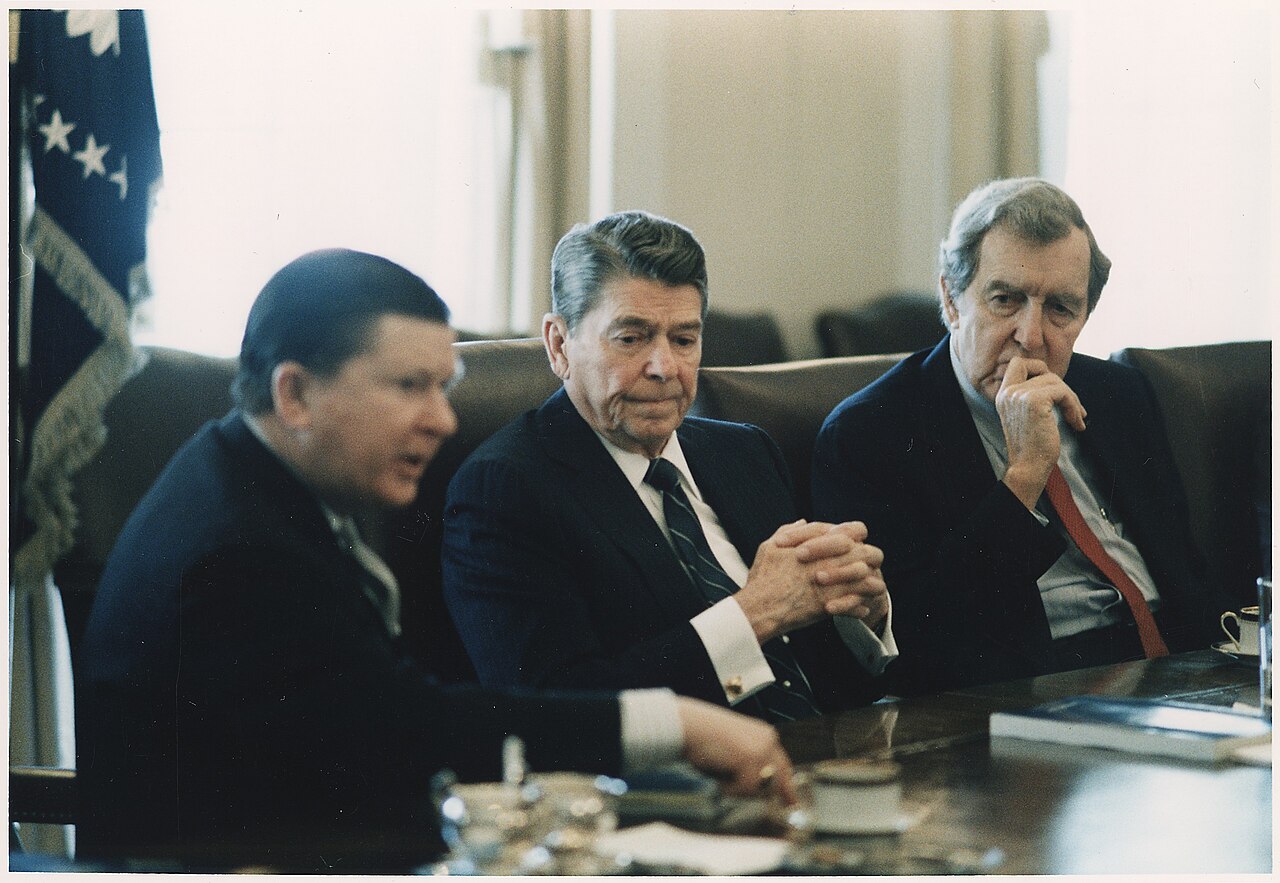
In Washington, Reagan at first denied trading arms for hostages, then admitted the sales in a televised address in March 1987. Attorney General Edwin Meese announced the diversion of funds on 25 November 1986. Poindexter resigned and North was dismissed. The Tower Commission, reporting in February 1987, criticised Reagan’s detached management style. Congressional hearings that summer made North a household name.
- August–September 1985 First Israeli shipments of TOW missiles to Iran; Benjamin Weir freed
- January 1986 Reagan authorises direct US sales to Iran
- May 1986 McFarlane and North in Tehran
- 3 November 1986 Ash-Shiraa reveals the dealings
- 25 November 1986 Diversion of profits to the Contras announced
- February 1987 Tower Commission report
- 1987 Mehdi Hashemi executed in Iran
- December 1992 President George H. W. Bush pardons six officials
Consequences in Iran
The affair caused division in Tehran. Hardliners who rejected any contact with the “Great Satan” attacked those involved, and Khomeini stepped in to stop parliamentary questioning of the government. Mehdi Hashemi, already under arrest, was tried for murder and other crimes and executed in 1987. Historians such as Baqer Moin link the case to the growing rift between Khomeini and Montazeri, which ended with Montazeri’s dismissal as successor in 1989.
For Iran’s leaders the sales showed that Washington would deal with them in secret while condemning them in public. Many historians argue that the episode reinforced a belief in Tehran that pragmatic bargaining with the United States was possible but could never be trusted. For Gulf Arab states, the revelation was a shock, and the United States moved quickly to reassure them, including by escorting Kuwaiti tankers in 1987 (see the Tanker War).
Consequences in the United States
Independent Counsel Lawrence Walsh charged fourteen people. North and Poindexter were convicted, but their convictions were overturned on appeal because their immunised congressional testimony had been used against them. In December 1992 President George H. W. Bush pardoned six officials, including former Defence Secretary Caspar Weinberger. Walsh’s final report concluded that Reagan had set the conditions for the crimes but found no credible evidence that he knew of the diversion.
The affair remains a case study in secret diplomacy and its costs. The longer story of contacts and confrontations between the two states is told in Iran and the United States.
Persian words from this page
| موشک | mushak | missile |
| سلاح | selâh | weapon |
| مذاکره | mozâkereh | negotiation |
| شیطان بزرگ | sheytân-e bozorg | “Great Satan”, a name for the United States |
| رسوایی | rosvâi | scandal |
Sources and further reading
- Report of the President’s Special Review Board (Tower Commission Report), February 1987
- Lawrence E. Walsh, Final Report of the Independent Counsel for Iran/Contra Matters (1993)
- Malcolm Byrne, Iran-Contra: Reagan’s Scandal and the Unchecked Abuse of Presidential Power (University Press of Kansas, 2014)
- Theodore Draper, A Very Thin Line: The Iran-Contra Affairs (Hill and Wang, 1991)
- Baqer Moin, Khomeini: Life of the Ayatollah (I.B. Tauris, 1999)
- Ray Takeyh, Guardians of the Revolution: Iran and the World in the Age of the Ayatollahs (Oxford University Press, 2009)
Want to learn Persian? Get the free Starter Pack
Get the 14-page printable Starter Pack (all 32 letters, a 7-day reading plan, 100 core words and 20 survival phrases) and a short 5-email course. Free.
More in The Islamic Revolution and the Islamic Republic (1979–present)
- Causes of the 1979 Revolution
- Khomeini’s Return and the Fall of the Monarchy
- Ruhollah Khomeini
- The 1979 Referendum and the New Constitution
- The Iran Hostage Crisis (1979–1981)
- Power Struggles after the Revolution
- The Cultural Revolution and University Closures
- The Iran–Iraq War: Causes and Iraqi Invasion
- Khorramshahr: Fall and Liberation
- The Iran–Iraq War, 1982–1986
- The Basij and Child Soldiers in the Iran–Iraq War
- Chemical Weapons in the Iran–Iraq War
- The Tanker War and Iran Air Flight 655
- The Iran–Contra Affair
- The End of the Iran–Iraq War (1988)
- The 1988 Executions of Political Prisoners
- The Death of Khomeini and the Succession of Khamenei (1989)
- Ali Khamenei
- Rafsanjani and Post-War Reconstruction (1989–1997)
- Khatami and the Reform Era (1997–2005)
- The 1999 Student Protests (18 Tir)
- The Ahmadinejad Presidency (2005–2013)
- The 2009 Election and the Green Movement
- Iran’s Nuclear Program
- Sanctions on Iran
- Rouhani and the Nuclear Deal (JCPOA)
- The Protests of 2017–2018 and November 2019
- The Killing of Soleimani and Flight 752 (January 2020)
- Iran and the COVID-19 Pandemic
- The Raisi Presidency and His Death (2021–2024)
- The 2022 Mahsa Amini Protests: “Woman, Life, Freedom”
- Iran and Israel: From Allies to Open Conflict
- The Pezeshkian Presidency
- The Twelve-Day War of June 2025
- The Protests of Late 2025 and January 2026
- The 2026 War with the United States and Israel
- The Killing of Ali Khamenei (28 February 2026)
- Mojtaba Khamenei and the 2026 Succession
- The Iranian Diaspora
- Iran and Hezbollah
- Major Earthquakes in Modern Iran
- Iranian Cinema after 1979