During the Iran–Iraq War (1980–1988), hundreds of thousands of Iranians volunteered for the Basij, a militia under the Revolutionary Guards, and many of them were teenagers. Boys as young as 12 or 13 went to the front, some without their parents’ consent, and took part in mass infantry assaults and the clearing of minefields. In Iran they are honoured as martyrs of the “Sacred Defence”; human rights groups and many historians count them among the war’s child soldiers.
| Organisation | Basij-e Mostaz’afin (“Mobilisation of the Oppressed”), under the Revolutionary Guards |
|---|---|
| Founded | Khomeini’s call of November 1979; formally organised in 1980 |
| Ages | Mostly young men; some volunteers as young as 12, and old men in their seventies and eighties |
| Best-known figure | Mohammad Hossein Fahmideh, 13, killed at Khorramshahr, 30 October 1980 |
| Numbers | Not reliably known; estimates of under-18s at the front range from thousands to tens of thousands |
“An army of twenty million”
In November 1979, weeks after the seizure of the US embassy, Ayatollah Khomeini called for an “army of twenty million” to defend the revolution. The result was the Basij, a volunteer force recruited through mosques, schools, workplaces and villages. It was meant as a reserve of loyal citizens, and when Iraq invaded in September 1980 it became the channel through which ordinary people, many of them poor and religious, went to war.
Basij volunteers usually served short tours of a few months, then went home to school, work or farm and often came back for another stint. They received a few weeks of basic training, much of it ideological and religious, and were placed under Revolutionary Guards commanders. The regular army, purged and distrusted after the revolution, generally saw the Basij as brave but poorly prepared.
Who went, and why
The volunteers came overwhelmingly from working-class and rural families, and from small-town religious networks. Writers on the war, among them Mehran Riazaty and Saskia Gieling, describe the pull of a powerful martyrdom culture rooted in the story of Imam Hussein’s death at Karbala, the patriotic atmosphere of a country invaded, and the social status that service brought. Mosques organised dispatch ceremonies; schools hosted recruiters; families of martyrs were honoured publicly.
Regulations required minors to have their parents’ permission. In practice the rules were loosely applied: some boys forged signatures or lied about their age, others persuaded reluctant parents, and some families encouraged them. Memoirs by former volunteers describe headbands printed with religious slogans, written wills addressed to mothers, and the hope of dying as a martyr (شهید, shahid).
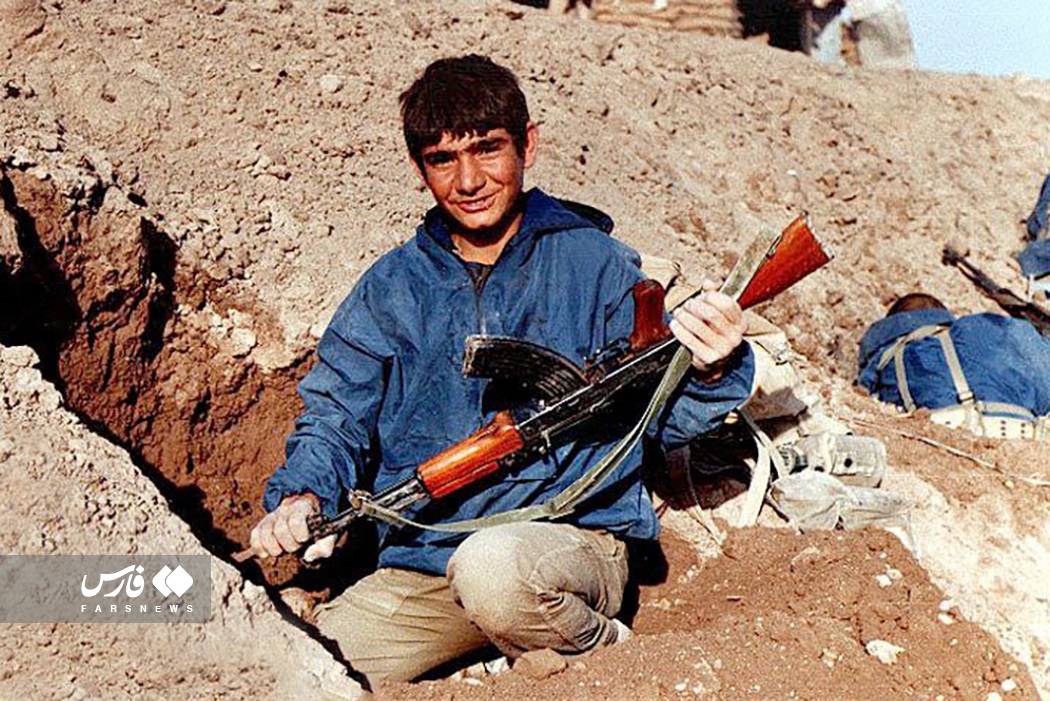

Fahmideh and the cult of the boy martyr
The most famous teenage fighter was Mohammad Hossein Fahmideh, a 13-year-old from Qom who went to the front at Khorramshahr without telling his family. According to the official account, on 30 October 1980 he strapped grenades to his body and blew himself up under an Iraqi tank, halting its advance. Khomeini praised him in a speech: “Our leader is that thirteen-year-old child.” Fahmideh’s face appeared on a postage stamp in 1986, and streets, schools and a stadium bear his name. The anniversary of his death is marked as Student Basij Day. The defence of the city is described on the page on Khorramshahr.
Human waves and minefields
From 1982, when Iran went on the offensive inside Iraq, Basij units were used in mass assaults against fortified Iraqi lines, often at night and with little artillery or air support. These “human wave” attacks overwhelmed defences at times but at enormous cost. Volunteers were also sent across minefields ahead of armoured and Revolutionary Guards units, effectively clearing a path with their bodies when there was no time or equipment for mine-clearing.
Some details of these tactics are contested. Foreign journalists in the 1980s reported that young volunteers wore small keys around their necks, said to be keys to paradise; the story was widely repeated abroad, but Iranian veterans and some researchers dismiss it as exaggerated or invented, and it is hard to verify. What is not disputed is that very young volunteers died in large numbers, and that Iraq captured many teenage prisoners, whose presence in its camps it publicised. The wider course of the fighting is told on the page on the Iran–Iraq War, 1982–1986.
Counting the young dead
There is no agreed count of how many under-18s served or died. Iranian institutions such as the Foundation of Martyrs keep detailed records of the war dead and commemorate school students among them, but do not separate a clear figure for minors that outside researchers accept. Western estimates of child soldiers at the front run from several thousand to tens of thousands, depending on the definition of “child” and the year. At the time, international humanitarian law set 15 as the minimum age for taking direct part in hostilities, in the Additional Protocols to the Geneva Conventions of 1977; the UN Convention on the Rights of the Child came only in 1989, after the war.
Memory and debate in Iran
In the Islamic Republic, teenage volunteers are central to the memory of the war, called the “Sacred Defence” (دفاع مقدس, defâ’-e moghaddas). Their photographs line the walls of schools and mosques, and organised pilgrimages called Rahian-e Nur take students to the former battlefields in Khuzestan. Critics, including some former volunteers and Iranian writers, have questioned how freely children chose to go and whether commanders used them as expendable troops; they point out that the war continued for six years after Iran had recovered its territory in 1982. Supporters reply that the volunteers were defending an invaded country and that their sacrifice deserves respect, not judgement. The Basij itself survived the war and became a large domestic force, later used to police dress codes and suppress protests. For how the war ended, see the end of the Iran–Iraq War; for Iraq’s use of gas against these same troops, chemical weapons in the war.
Persian words from this page
| بسیج | basij | mobilisation |
| بسیجی | basiji | a Basij volunteer |
| شهید | shahid | martyr |
| جبهه | jebhe | the front |
| دفاع مقدس | defâ’-e moghaddas | Sacred Defence (the official name of the war) |
| فهمیده | Fahmide | Fahmideh |
Sources and further reading
- Saeid Golkar, Captive Society: The Basij Militia and Social Control in Iran (Columbia University Press, 2015).
- Pierre Razoux, The Iran–Iraq War (Harvard University Press, 2015).
- Dilip Hiro, The Longest War: The Iran–Iraq Military Conflict (Routledge, 1989).
- Saskia Gieling, Religion and War in Revolutionary Iran (I.B. Tauris, 1999).
- International Committee of the Red Cross, Protocol I Additional to the Geneva Conventions (1977), article 77.
Want to learn Persian? Get the free Starter Pack
Get the 14-page printable Starter Pack (all 32 letters, a 7-day reading plan, 100 core words and 20 survival phrases) and a short 5-email course. Free.
More in The Islamic Revolution and the Islamic Republic (1979–present)
- Causes of the 1979 Revolution
- Khomeini’s Return and the Fall of the Monarchy
- Ruhollah Khomeini
- The 1979 Referendum and the New Constitution
- The Iran Hostage Crisis (1979–1981)
- Power Struggles after the Revolution
- The Cultural Revolution and University Closures
- The Iran–Iraq War: Causes and Iraqi Invasion
- Khorramshahr: Fall and Liberation
- The Iran–Iraq War, 1982–1986
- The Basij and Child Soldiers in the Iran–Iraq War
- Chemical Weapons in the Iran–Iraq War
- The Tanker War and Iran Air Flight 655
- The Iran–Contra Affair
- The End of the Iran–Iraq War (1988)
- The 1988 Executions of Political Prisoners
- The Death of Khomeini and the Succession of Khamenei (1989)
- Ali Khamenei
- Rafsanjani and Post-War Reconstruction (1989–1997)
- Khatami and the Reform Era (1997–2005)
- The 1999 Student Protests (18 Tir)
- The Ahmadinejad Presidency (2005–2013)
- The 2009 Election and the Green Movement
- Iran’s Nuclear Program
- Sanctions on Iran
- Rouhani and the Nuclear Deal (JCPOA)
- The Protests of 2017–2018 and November 2019
- The Killing of Soleimani and Flight 752 (January 2020)
- Iran and the COVID-19 Pandemic
- The Raisi Presidency and His Death (2021–2024)
- The 2022 Mahsa Amini Protests: “Woman, Life, Freedom”
- Iran and Israel: From Allies to Open Conflict
- The Pezeshkian Presidency
- The Twelve-Day War of June 2025
- The Protests of Late 2025 and January 2026
- The 2026 War with the United States and Israel
- The Killing of Ali Khamenei (28 February 2026)
- Mojtaba Khamenei and the 2026 Succession
- The Iranian Diaspora
- Iran and Hezbollah
- Major Earthquakes in Modern Iran
- Iranian Cinema after 1979