The 2026 war began on 28 February 2026, when the United States and Israel launched hundreds of air strikes on Iran, killing the Supreme Leader, Ali Khamenei, on the first day. Iran answered with missiles and drones against Israel and US bases across the Persian Gulf and closed the Strait of Hormuz to most shipping. A ceasefire in April and an interim agreement in June both broke down, and by October 2026 the conflict had settled into intermittent strikes, a US naval blockade and attacks on shipping, with talks continuing through mediators.
| Began | 28 February 2026 |
|---|---|
| Parties | United States and Israel against Iran; Hezbollah joined from 2 March |
| Operation names | Epic Fury (US), Roaring Lion (Israel), True Promise IV (Iran) |
| Main truces | Ceasefire from 7–8 April; interim agreement signed 17 June; collapsed 8 July |
| Deaths in Iran | About 3,500 (Iranian officials); about 3,600 by early April (HRANA) |
| US military deaths | 23, with 865 wounded (Pentagon, October 2026) |

The road to war
The war followed the Twelve-Day War of June 2025, the restoration of UN sanctions in September 2025 and the mass killing of protesters in January 2026 (see the protests of 2025–2026). In January and February 2026 the United States built up its forces in the region while talks on Iran’s nuclear programme continued. When the attack came, UN Secretary-General António Guterres told the Security Council he regretted that an opportunity for diplomacy had been “squandered”.
28 February: decapitation strikes
The first strikes hit targets in 24 provinces. Ali Khamenei was killed at his office compound in Tehran together with several members of his family and other senior officials; Iranian state media confirmed his death on 1 March (see the killing of Ali Khamenei). The Iranian Red Crescent reported at least 201 dead on the first day. Among them, according to Iranian reports, were more than 100 people killed at the Shajareh Tayyebeh girls’ primary school in Minab, in the south; which force fired the munition that hit the school was disputed.
The parties explained the war in different terms. President Donald Trump called on Iranians to “take back” their country and on the Revolutionary Guards to stand aside. The US ambassador to the UN, Mike Waltz, said the action was lawful and that “Iran cannot have a nuclear weapon”. Prime Minister Benjamin Netanyahu said Israel had killed Revolutionary Guard commanders and nuclear officials and would continue. Iran’s UN ambassador, Amir Saeid Iravani, called the attack “unprovoked and premeditated aggression” and a war crime. Russia condemned the strikes and China said it was very concerned; many governments and legal scholars said the attack breached the UN Charter.
Iran’s response and the Strait of Hormuz
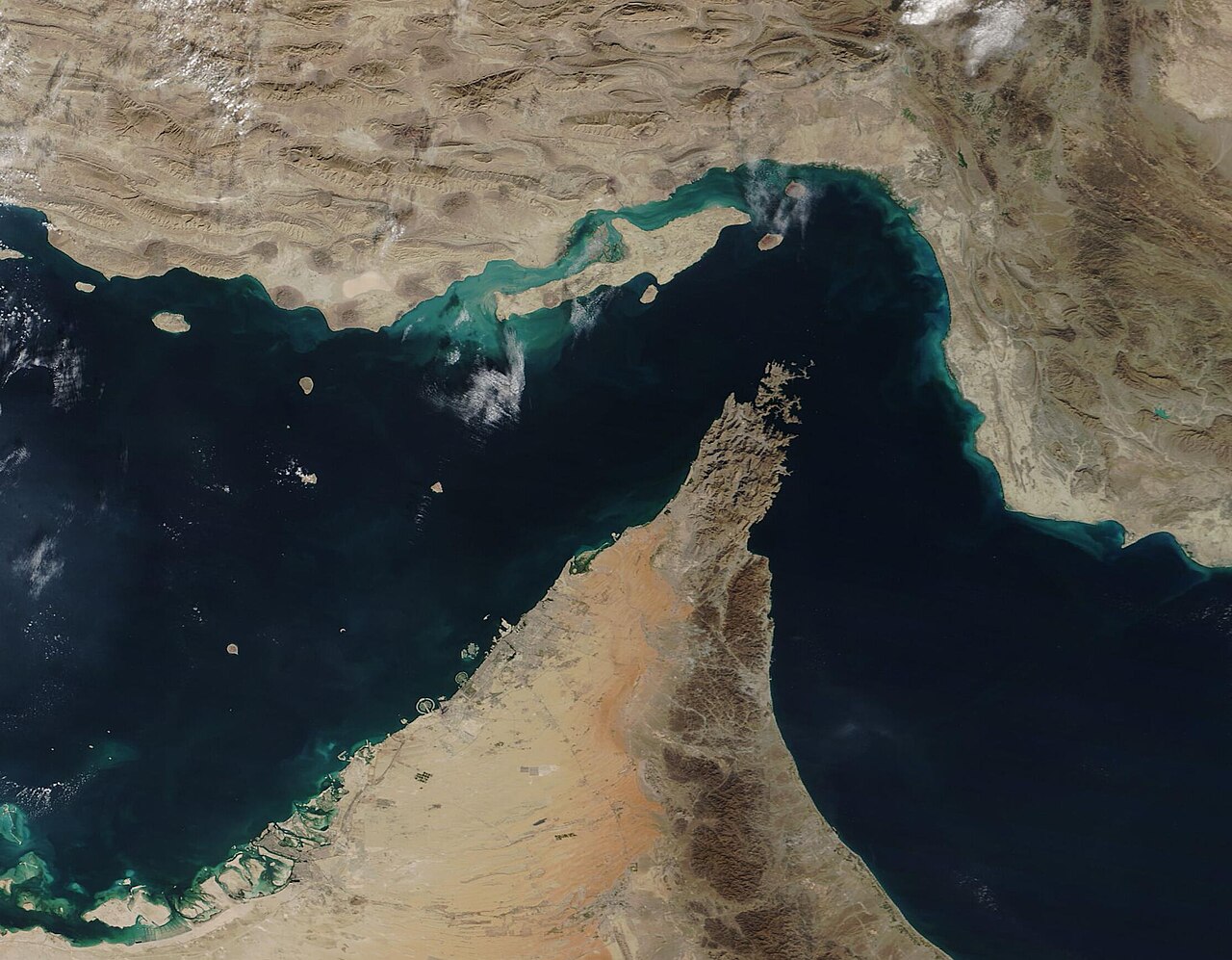
Iran fired missiles and drones at Israel and at Gulf states that host US forces, including Kuwait, Qatar, the United Arab Emirates and Bahrain, and declared control over the Strait of Hormuz. Within days shipping through the strait had almost stopped, tankers were hit off Oman and Qatar’s gas plant at Ras Laffan was struck, sending energy prices sharply higher. On 2 March Hezbollah began firing at Israel from Lebanon, and Israel answered with a ground invasion that occupied large parts of southern Lebanon.
The air war went on through March. On 8 March Iran named Khamenei’s son as the new Supreme Leader (see Mojtaba Khamenei and the 2026 succession), and in mid-March Israel killed Ali Larijani, secretary of the Supreme National Security Council and one of the country’s most influential politicians. By 19 March, according to the UN human rights office, the Iranian Red Crescent had recorded strikes on more than 67,000 civilian sites, including 498 schools and 236 health facilities. The UN High Commissioner for Human Rights, Volker Türk, warned that attacks on civilian objects by any party, including Iranian strikes and Hezbollah rockets on Israeli residential areas, could amount to war crimes.
Ceasefire, talks and a double blockade
On 7 April a two-week ceasefire was agreed through Pakistani mediation, under which Iran was to reopen the strait. It was strained at once by a dispute over whether it covered Lebanon, where Israel kept up heavy strikes. On 11 and 12 April US and Iranian delegations, the US side led by Vice President JD Vance, held the highest-level direct talks between the two countries since 1979, in Islamabad, but failed to agree. From 13 April the US Navy blockaded Iranian ports, while Iran kept restricting the strait; the Guardian called it a “dual blockade”. On 21 April Trump extended the ceasefire indefinitely.
After an exchange of fire between Iran and Israel in early June, the two sides reached an interim deal. Trump signed it on 17 June; it provided for Iran to dilute its stock of highly enriched uranium and for a waiver of US sanctions on Iranian oil, and on 18 June US Central Command said the blockade had been lifted. Further talks were held in Switzerland and Qatar.
Breakdown in July
On 7 July Iran was accused of striking three ships in the strait. The United States hit dozens of targets in Iran and reinstated sanctions on Iranian oil, and on 8 July Trump declared the ceasefire “over”. Days of attacks followed, including Iranian strikes on Arab states and an attack in Jordan that killed three US service members. The US reimposed its naval blockade.
Autumn 2026: a war without a front line
Another round of US strikes ended around the start of September. In October, according to the UK Maritime Trade Operations agency, attacks on ships in and near the strait reached their highest level of the war, with at least twelve in a single week; the US commander in the region, Admiral Brad Cooper, said the blockade had cost Iran 25 billion dollars in oil income. Messages continued to pass between Washington and Tehran through Pakistan, Qatar and other mediators, but Iran made the lifting of the blockade, the release of frozen funds and an end to the fighting on all fronts its conditions for a settlement, and no breakthrough was reached.
- 28 February 2026 US and Israeli strikes begin; Ali Khamenei killed
- 2 March Hezbollah enters the war; Israel invades southern Lebanon
- 8 March Mojtaba Khamenei named Supreme Leader
- 7 April Two-week ceasefire agreed through Pakistan
- 11–12 April US–Iran talks in Islamabad end without agreement
- 13 April US naval blockade of Iranian ports begins
- 17 June Interim agreement signed; blockade lifted next day
- 4 July Funeral of Ali Khamenei begins
- 8 July Trump declares the ceasefire over after attacks on shipping
- October Attacks on ships in the strait reach their peak
Casualties
All figures are contested and incomplete. Iranian officials gave tolls of about 3,500 dead. HRANA, the US-based rights group, had recorded at least 3,636 deaths by 7 April, including 1,701 civilians, among them at least 254 children, and 1,221 military personnel. The Pentagon listed 23 US service members dead and 865 wounded by late October 2026. Israel, Lebanon and the Gulf states also suffered deaths from missiles, drones and the fighting in Lebanon.
For what the war meant for the nuclear dispute, see Iran’s nuclear programme; for its economic background, the economy of Iran.
Persian words from this page
| تنگه هرمز | tange-ye Hormoz | Strait of Hormuz |
| خلیج فارس | khalij-e Fârs | Persian Gulf |
| محاصره | mohâsere | blockade, siege |
| آتشبس | âtash-bas | ceasefire |
| مذاکره | mozâkere | negotiation |
| وعده صادق | va’de-ye sâdeq | “True Promise”, Iran’s name for its operations |
This page describes events up to October 2026. The war had not formally ended when it was written.
Sources and further reading
- Associated Press, “A timeline of the Iran war and talks aimed at ending it”, July 2026
- Al Jazeera, “Iran confirms Supreme Leader Ali Khamenei dead after US-Israeli attacks” (with the Security Council debate)
- UN Office of the High Commissioner for Human Rights, “Civilians bear brunt of reckless war in the Middle East, says Türk”, 19 March 2026
- Al Jazeera, “US and Iran both claim control of Strait of Hormuz amid attacks on vessels”, 17 October 2026
- HRANA, Day 39 report on casualties, April 2026
- Stars and Stripes, “Pentagon raises official death toll from Iran war to 23”, 29 October 2026
Want to learn Persian? Get the free Starter Pack
Get the 14-page printable Starter Pack (all 32 letters, a 7-day reading plan, 100 core words and 20 survival phrases) and a short 5-email course. Free.
More in The Islamic Revolution and the Islamic Republic (1979–present)
- Causes of the 1979 Revolution
- Khomeini’s Return and the Fall of the Monarchy
- Ruhollah Khomeini
- The 1979 Referendum and the New Constitution
- The Iran Hostage Crisis (1979–1981)
- Power Struggles after the Revolution
- The Cultural Revolution and University Closures
- The Iran–Iraq War: Causes and Iraqi Invasion
- Khorramshahr: Fall and Liberation
- The Iran–Iraq War, 1982–1986
- The Basij and Child Soldiers in the Iran–Iraq War
- Chemical Weapons in the Iran–Iraq War
- The Tanker War and Iran Air Flight 655
- The Iran–Contra Affair
- The End of the Iran–Iraq War (1988)
- The 1988 Executions of Political Prisoners
- The Death of Khomeini and the Succession of Khamenei (1989)
- Ali Khamenei
- Rafsanjani and Post-War Reconstruction (1989–1997)
- Khatami and the Reform Era (1997–2005)
- The 1999 Student Protests (18 Tir)
- The Ahmadinejad Presidency (2005–2013)
- The 2009 Election and the Green Movement
- Iran’s Nuclear Program
- Sanctions on Iran
- Rouhani and the Nuclear Deal (JCPOA)
- The Protests of 2017–2018 and November 2019
- The Killing of Soleimani and Flight 752 (January 2020)
- Iran and the COVID-19 Pandemic
- The Raisi Presidency and His Death (2021–2024)
- The 2022 Mahsa Amini Protests: “Woman, Life, Freedom”
- Iran and Israel: From Allies to Open Conflict
- The Pezeshkian Presidency
- The Twelve-Day War of June 2025
- The Protests of Late 2025 and January 2026
- The 2026 War with the United States and Israel
- The Killing of Ali Khamenei (28 February 2026)
- Mojtaba Khamenei and the 2026 Succession
- The Iranian Diaspora
- Iran and Hezbollah
- Major Earthquakes in Modern Iran
- Iranian Cinema after 1979