The Tanker War was the campaign of attacks on merchant ships in the Persian Gulf during the Iran–Iraq War, which escalated sharply from 1984 and drew the United States Navy into direct clashes with Iran in 1987–88. It ended in tragedy on 3 July 1988, when the USS Vincennes shot down Iran Air Flight 655, a civilian airliner, killing all 290 people on board.
| Period | 1981–1988; most intense 1984–1988 |
|---|---|
| Area | Persian Gulf and the Strait of Hormuz |
| Ships attacked | More than 400 merchant vessels by most counts, a majority of them by Iraq |
| US operations | Earnest Will (convoys, from July 1987); Nimble Archer (October 1987); Praying Mantis (18 April 1988) |
| Iran Air Flight 655 | 3 July 1988, Airbus A300 from Bandar Abbas to Dubai; 290 killed, including 66 children |
| Settlement | 1996: US pays US$61.8 million to victims’ families, without admitting liability |
Why the war moved to the sea
By 1984 the land war had settled into a stalemate (see the Iran–Iraq War, 1982–1986). Iraq’s own oil exports through the Gulf had been cut early in the war, and it sent its oil through pipelines across Turkey and Saudi Arabia. Iran, by contrast, depended on tankers loading at Kharg Island, its main oil terminal, to pay for the war. Iraq reasoned that by attacking Iranian oil exports it could starve Iran of money and, perhaps, provoke Iran into actions that would bring the great powers in against it.
Iraq had attacked shipping near Iranian ports since 1981, but in 1984, with French-supplied Super Étendard aircraft and Exocet anti-ship missiles, it began striking tankers at and around Kharg on a large scale. Iran answered by attacking ships trading with Kuwait and Saudi Arabia, which were financing Iraq’s war effort. Iran used aircraft, then speedboats of the Revolutionary Guards navy armed with rockets and machine guns, and later sea mines.
Kuwait asks for protection
Kuwaiti tankers were among Iran’s main targets. In late 1986 Kuwait asked both the Soviet Union and the United States to protect its ships. The Reagan administration, partly to keep the Soviets out of the Gulf and partly to repair its standing with Arab states after the Iran–Contra affair had become public, agreed to put eleven Kuwaiti tankers under the American flag and escort them with warships. The operation, called Earnest Will, began in July 1987 and became the largest US naval convoy operation since the Second World War.
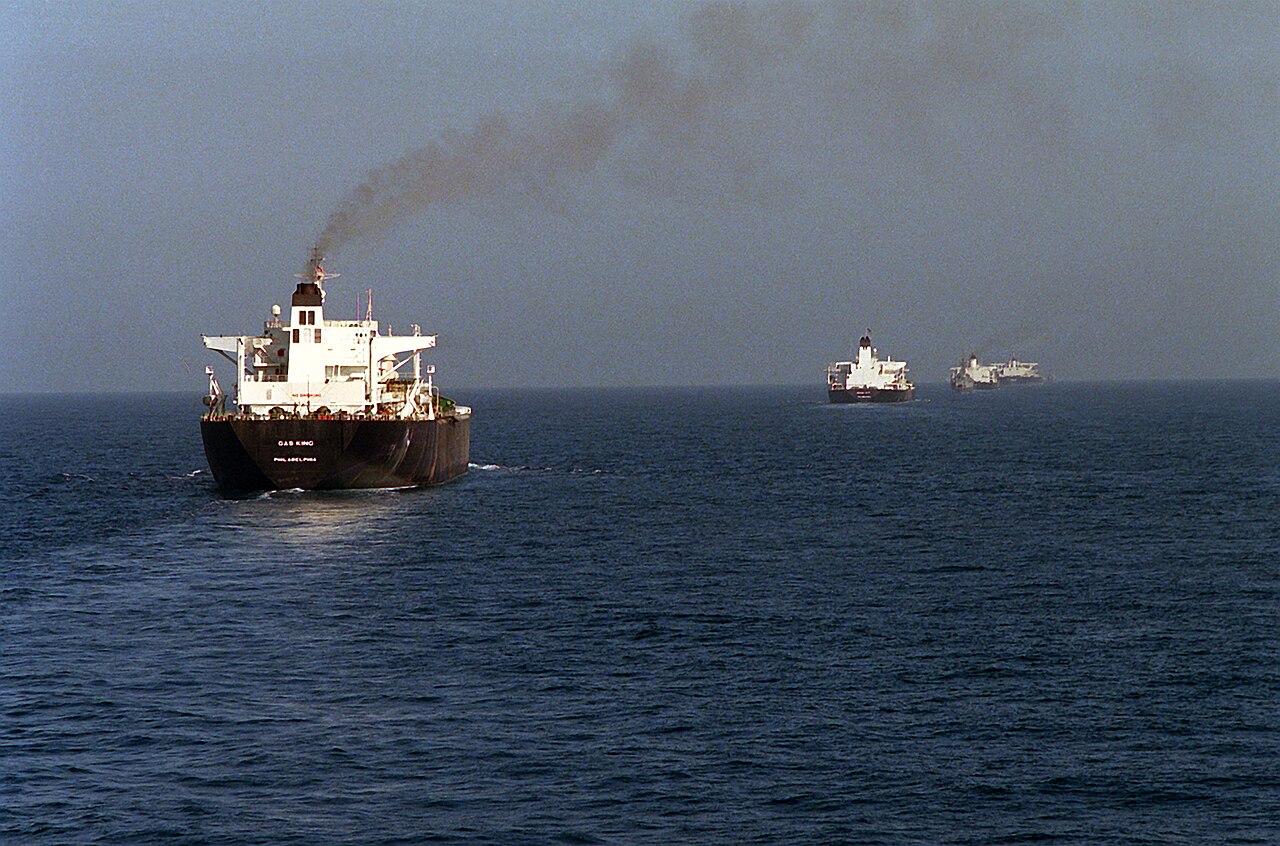

The first convoy ran into trouble at once: on 24 July 1987 the reflagged supertanker Bridgeton struck an Iranian mine. Two months earlier, on 17 May, an Iraqi aircraft had fired two Exocet missiles into the US frigate Stark, killing 37 American sailors. Iraq called it a mistake and apologised, and the United States accepted the explanation, which deepened Iranian suspicions that Washington had taken Iraq’s side.
Direct clashes between Iran and the United States
From the second half of 1987 Iranian and American forces fought a series of short, sharp battles at sea. In September 1987 US helicopters attacked the Iranian ship Iran Ajr as it laid mines, and the ship was captured. In October, after an Iranian missile struck a reflagged tanker off Kuwait, US warships shelled Iranian oil platforms in Operation Nimble Archer.
On 14 April 1988 the US frigate Samuel B. Roberts was badly damaged by an Iranian mine. Four days later, on 18 April, the US Navy launched Operation Praying Mantis, its largest surface battle since 1945. American forces destroyed two Iranian oil platforms, sank the frigate Sahand and the missile boat Joshan, and damaged the frigate Sabalan. Dozens of Iranian sailors were killed. On the same day Iraq retook the Fao peninsula, and many Iranians concluded that the United States and Iraq were now acting together.
- 1984 Iraq escalates attacks on tankers at Kharg Island; Iran retaliates against Gulf Arab shipping
- 17 May 1987 Iraqi missiles strike USS Stark, killing 37
- July 1987 Operation Earnest Will begins; Bridgeton hits a mine
- September 1987 US forces capture the minelayer Iran Ajr
- 14 April 1988 USS Samuel B. Roberts hits a mine
- 18 April 1988 Operation Praying Mantis
- 3 July 1988 USS Vincennes shoots down Iran Air Flight 655
- 18 July 1988 Iran accepts UN Resolution 598
Iran Air Flight 655
On the morning of 3 July 1988 the cruiser USS Vincennes was in action against Iranian gunboats in the Strait of Hormuz and had entered Iranian territorial waters. Shortly after ten in the morning Iran Air Flight 655, an Airbus A300 on its regular 28-minute route from Bandar Abbas to Dubai, took off from Bandar Abbas, which served both civilian and military aircraft. The crew of the Vincennes identified the airliner as an attacking Iranian F-14 fighter and fired two surface-to-air missiles. All 290 people on board, 274 passengers and 16 crew, were killed, among them 66 children.
The United States called the shooting a tragic accident, caused by the stress of combat and errors in reading the ship’s radar data. Investigations later found that the aircraft had been climbing within its civilian air corridor and transmitting a civilian signal, and that the Vincennes was inside Iranian waters at the time. Its captain, Will Rogers III, was not disciplined and later received a routine service award for his tour of duty, which caused lasting anger in Iran. Iran called the shooting a deliberate crime and took the case to the International Court of Justice. In 1996 the two governments settled: the United States paid US$61.8 million to the families of the victims on an ex gratia basis, without admitting legal responsibility.
How the Tanker War ended and how it is remembered
The clashes at sea, the loss of Fao and other ground in the spring of 1988, Iraqi missile attacks on Tehran, and the shooting down of Flight 655 all weighed on Iran’s leaders. Two weeks later, on 18 July 1988, Iran accepted UN Security Council Resolution 598, and a ceasefire took effect on 20 August (see the end of the Iran–Iraq War). Rafsanjani, then acting commander-in-chief, argued that Iran could not fight both Iraq and the United States.
Many historians, Pierre Razoux among them, see the Tanker War as the point at which the United States moved from tilting towards Iraq to fighting Iran directly. In Iran, the destruction of Flight 655 is remembered every 3 July with ceremonies at sea off Bandar Abbas, and is cited by officials as proof of American hostility. In 2003 the International Court of Justice ruled on Iran’s separate claim over the oil platforms, finding that the US attacks could not be justified as self-defence but rejecting Iran’s claim for reparation. The page Iran and the United States places these events in the longer relationship.
Persian words from this page
| نفتکش | naftkesh | oil tanker |
| خلیج فارس | Khalij-e Fârs | Persian Gulf |
| تنگه هرمز | Tangeh-ye Hormoz | Strait of Hormuz |
| جزیره خارک | Jazireh-ye Khârk | Kharg Island |
| بندرعباس | Bandar Abbâs | port city on the Strait of Hormuz |
| مین | min | sea mine |
Sources and further reading
- Pierre Razoux, The Iran–Iraq War (Harvard University Press, 2015)
- David Crist, The Twilight War: The Secret History of America’s Thirty-Year Conflict with Iran (Penguin Press, 2012)
- Ronald O’Rourke, “The Tanker War”, Proceedings of the US Naval Institute (May 1988)
- International Court of Justice, Aerial Incident of 3 July 1988 (Iran v. United States), settlement 1996; Oil Platforms (Iran v. United States), judgment of 6 November 2003
- Ray Takeyh, Guardians of the Revolution: Iran and the World in the Age of the Ayatollahs (Oxford University Press, 2009)
Want to learn Persian? Get the free Starter Pack
Get the 14-page printable Starter Pack (all 32 letters, a 7-day reading plan, 100 core words and 20 survival phrases) and a short 5-email course. Free.
More in The Islamic Revolution and the Islamic Republic (1979–present)
- Causes of the 1979 Revolution
- Khomeini’s Return and the Fall of the Monarchy
- Ruhollah Khomeini
- The 1979 Referendum and the New Constitution
- The Iran Hostage Crisis (1979–1981)
- Power Struggles after the Revolution
- The Cultural Revolution and University Closures
- The Iran–Iraq War: Causes and Iraqi Invasion
- Khorramshahr: Fall and Liberation
- The Iran–Iraq War, 1982–1986
- The Basij and Child Soldiers in the Iran–Iraq War
- Chemical Weapons in the Iran–Iraq War
- The Tanker War and Iran Air Flight 655
- The Iran–Contra Affair
- The End of the Iran–Iraq War (1988)
- The 1988 Executions of Political Prisoners
- The Death of Khomeini and the Succession of Khamenei (1989)
- Ali Khamenei
- Rafsanjani and Post-War Reconstruction (1989–1997)
- Khatami and the Reform Era (1997–2005)
- The 1999 Student Protests (18 Tir)
- The Ahmadinejad Presidency (2005–2013)
- The 2009 Election and the Green Movement
- Iran’s Nuclear Program
- Sanctions on Iran
- Rouhani and the Nuclear Deal (JCPOA)
- The Protests of 2017–2018 and November 2019
- The Killing of Soleimani and Flight 752 (January 2020)
- Iran and the COVID-19 Pandemic
- The Raisi Presidency and His Death (2021–2024)
- The 2022 Mahsa Amini Protests: “Woman, Life, Freedom”
- Iran and Israel: From Allies to Open Conflict
- The Pezeshkian Presidency
- The Twelve-Day War of June 2025
- The Protests of Late 2025 and January 2026
- The 2026 War with the United States and Israel
- The Killing of Ali Khamenei (28 February 2026)
- Mojtaba Khamenei and the 2026 Succession
- The Iranian Diaspora
- Iran and Hezbollah
- Major Earthquakes in Modern Iran
- Iranian Cinema after 1979