The reform era is the name Iranians give to the presidency of Mohammad Khatami, a soft-spoken cleric who won a surprise landslide on 23 May 1997 and governed until 2005. He promised the rule of law, a freer press and “civil society”, and abroad he proposed a “Dialogue Among Civilizations”. Unelected institutions blocked much of his programme, and the movement’s rise and stalling still frames debates about whether the Islamic Republic can change from within.
| President | Seyyed Mohammad Khatami, born 1943 in Ardakan, Yazd province |
|---|---|
| Terms | August 1997 to August 2005 |
| 1997 result | About 69% of the vote (about 20 million votes), turnout about 80% |
| 2001 result | About 77% of the vote |
| Movement name | Dovvom-e Khordad (2 Khordad), the Persian date of the 1997 election |

The surprise of 2 Khordad
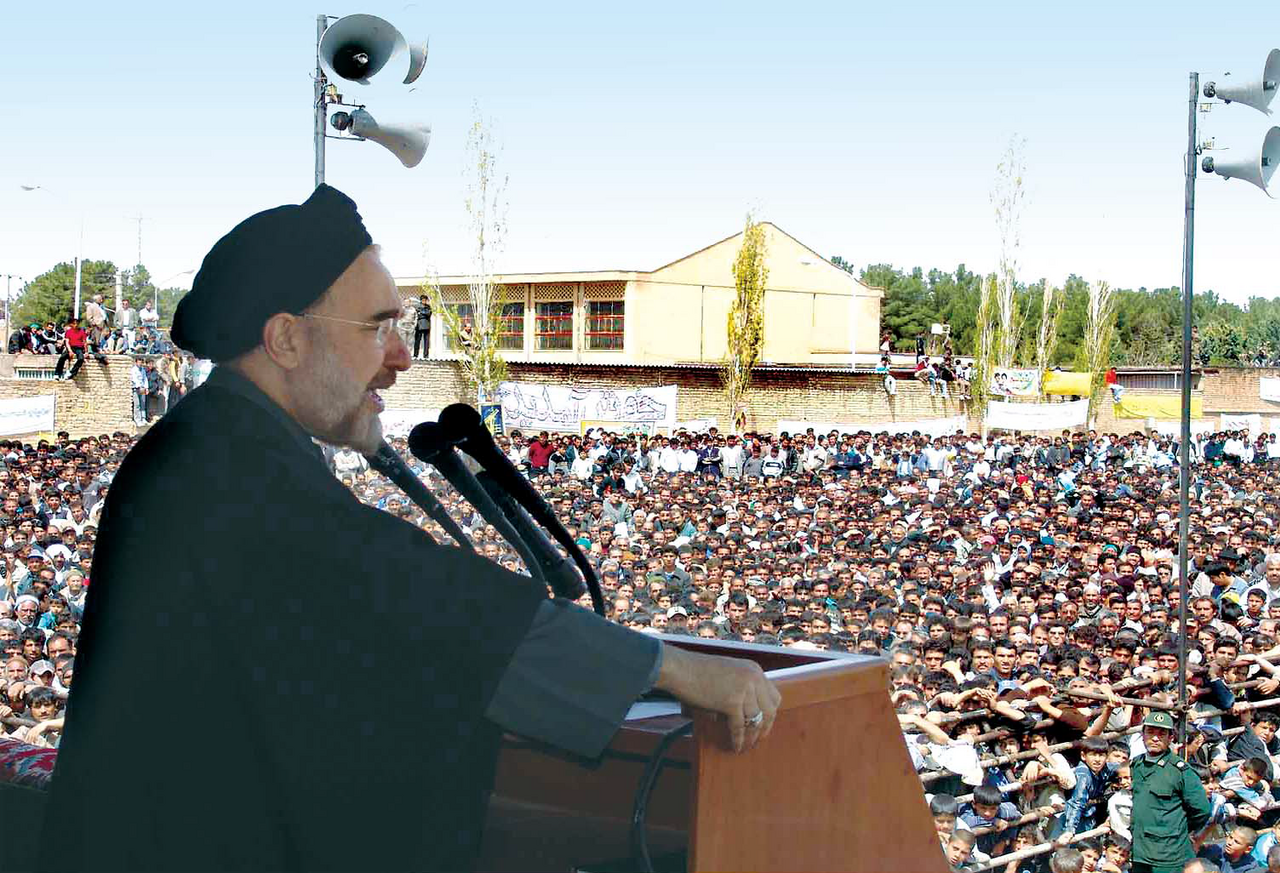
Khatami was a former minister of culture who had resigned in 1992 under pressure from conservatives, and then ran the National Library. In 1997 the establishment favourite was the parliamentary speaker, Ali-Akbar Nateq-Nouri. Khatami campaigned in a bus, talked about law, tolerance and the rights of women and young people, and drew huge support from students, women, the middle class and the generation born after the revolution. His victory, on 2 Khordad 1376 in the Iranian calendar, gave the reform movement its name.
What the reformists wanted
The reformists were a coalition rather than a party: former radicals of the 1980s who had moved towards pluralism, technocrats close to Rafsanjani, religious intellectuals such as Abdolkarim Soroush, and student groups. Their keywords were جامعه مدنی (jame’e-ye madani, civil society), rule of law and “religious democracy”. They did not seek to overthrow the Islamic Republic but to give its elected parts, the president and parliament, more weight against the Leader’s office, the Guardian Council and the judiciary.
A short spring for the press
The most visible change was in the newspapers. Dozens of new dailies, such as Jame’e, Neshat and Khordad, sold in huge numbers, published investigations, and debated questions that had been taboo. The judiciary and the Press Court answered by closing papers one after another. In April 2000, after Leader Ali Khamenei described some newspapers as bases of the enemy, more than a dozen were shut within days. When the new reformist parliament tried to loosen the press law that summer, Khamenei sent a letter halting the bill.
The chain murders
In late 1998 several dissident writers and politicians were murdered in Tehran, among them the veteran nationalist Dariush Forouhar and his wife Parvaneh, and the writers Mohammad Mokhtari and Mohammad-Jafar Pouyandeh. Pressure from Khatami’s government led the Ministry of Intelligence to make an unprecedented admission in January 1999 that “rogue” agents inside the ministry had carried out the killings. The alleged ringleader, Saeed Emami, died in prison in what officials called suicide. The reformist journalist Akbar Ganji, who wrote that the killings went higher, was jailed. These قتلهای زنجیرهای (qatl-ha-ye zanjire’i, chain murders) remain one of the most discussed episodes of the period.
Victories and backlash, 1999–2004
- February 1999 First nationwide elections for city and village councils, promised in the constitution since 1979.
- July 1999 A raid on Tehran University dormitories sets off the 18 Tir student protests.
- February 2000 Reformists win a large majority in the sixth Majlis.
- March 2000 Saeed Hajjarian, a leading reform strategist, is shot and badly wounded.
- June 2001 Khatami is re-elected with about 77 per cent of the vote.
- 2002–2003 Two bills to limit the Guardian Council’s vetting of candidates and strengthen the president are rejected by the Guardian Council, and Khatami withdraws them.
- February 2004 The Guardian Council disqualifies thousands of candidates for the Majlis, including about 80 sitting deputies; conservatives win.
Dialogue Among Civilizations
Abroad, Khatami tried to ease Iran’s isolation. In a 1998 interview with CNN he spoke warmly of the American people and expressed regret for the hostage crisis while still criticising US policy. His call for a گفتگوی تمدنها (goftegu-ye tamaddon-ha, Dialogue Among Civilizations) was a reply to Samuel Huntington’s theory of a “clash of civilisations”, and the UN General Assembly declared 2001 the United Nations Year of Dialogue among Civilizations. Relations with Europe and the Persian Gulf states improved markedly.
With the United States the results were mixed. After 11 September 2001 Iran helped at the Bonn conference that set up Afghanistan’s new government, but in January 2002 President George W. Bush named Iran in an “axis of evil”. In August 2002 an exile opposition group revealed the enrichment site at Natanz. Khatami’s government, with Hassan Rouhani as chief negotiator, agreed with Britain, France and Germany in 2003 and 2004 to suspend enrichment while talks went on (see Iran’s nuclear programme).
Why reform stalled
By 2005 many of Khatami’s voters were disillusioned, and turnout fell. Explanations differ. Conservatives argued that the reformists had threatened the foundations of the system and had rightly been checked. Many reformists blamed the veto power of unelected bodies, the courts and violent vigilante groups. Others, including some former supporters, said Khatami had been too cautious and unwilling to use popular pressure. Economic issues also mattered: reform had brought freer debate more than better jobs for the young, a gap that Mahmoud Ahmadinejad exploited in the 2005 election.
Legacy
The reform era changed Iranian society more than its institutions. Dress codes relaxed, Iranian cinema and publishing flourished, the internet and blogs spread, and a generation learned to vote as a form of pressure. Khatami remained a reference point for reformists; Iranian media were later instructed not to publish his image or quote him, a ban reported from 2015. Reformists re-emerged in the 2009 election, in the campaign that elected Hassan Rouhani in 2013, and in the Pezeshkian presidency.
Persian words from this page
| اصلاحطلبان | eslâh-talabân | reformists |
| دوم خرداد | dovvom-e Khordâd | 2 Khordad (the 1997 election date) |
| جامعه مدنی | jâme’e-ye madani | civil society |
| گفتگوی تمدنها | goftegu-ye tamaddon-hâ | Dialogue Among Civilizations |
| قتلهای زنجیرهای | qatl-hâ-ye zanjire’i | the chain murders |
| روزنامه | ruznâme | newspaper |
Sources and further reading
- Ali M. Ansari, Iran, Islam and Democracy: The Politics of Managing Change (Royal Institute of International Affairs, 2000; 2nd ed. 2006).
- Ghoncheh Tazmini, Khatami’s Iran: The Islamic Republic and the Turbulent Path to Reform (I.B. Tauris, 2009).
- Mohammad Khatami, Islam, Liberty and Development (Institute of Global Cultural Studies, 1998).
- Michael Axworthy, Revolutionary Iran: A History of the Islamic Republic (Penguin, 2013).
- Human Rights Watch, reports on press closures and the chain murders (1999–2001).
Want to learn Persian? Get the free Starter Pack
Get the 14-page printable Starter Pack (all 32 letters, a 7-day reading plan, 100 core words and 20 survival phrases) and a short 5-email course. Free.
More in The Islamic Revolution and the Islamic Republic (1979–present)
- Causes of the 1979 Revolution
- Khomeini’s Return and the Fall of the Monarchy
- Ruhollah Khomeini
- The 1979 Referendum and the New Constitution
- The Iran Hostage Crisis (1979–1981)
- Power Struggles after the Revolution
- The Cultural Revolution and University Closures
- The Iran–Iraq War: Causes and Iraqi Invasion
- Khorramshahr: Fall and Liberation
- The Iran–Iraq War, 1982–1986
- The Basij and Child Soldiers in the Iran–Iraq War
- Chemical Weapons in the Iran–Iraq War
- The Tanker War and Iran Air Flight 655
- The Iran–Contra Affair
- The End of the Iran–Iraq War (1988)
- The 1988 Executions of Political Prisoners
- The Death of Khomeini and the Succession of Khamenei (1989)
- Ali Khamenei
- Rafsanjani and Post-War Reconstruction (1989–1997)
- Khatami and the Reform Era (1997–2005)
- The 1999 Student Protests (18 Tir)
- The Ahmadinejad Presidency (2005–2013)
- The 2009 Election and the Green Movement
- Iran’s Nuclear Program
- Sanctions on Iran
- Rouhani and the Nuclear Deal (JCPOA)
- The Protests of 2017–2018 and November 2019
- The Killing of Soleimani and Flight 752 (January 2020)
- Iran and the COVID-19 Pandemic
- The Raisi Presidency and His Death (2021–2024)
- The 2022 Mahsa Amini Protests: “Woman, Life, Freedom”
- Iran and Israel: From Allies to Open Conflict
- The Pezeshkian Presidency
- The Twelve-Day War of June 2025
- The Protests of Late 2025 and January 2026
- The 2026 War with the United States and Israel
- The Killing of Ali Khamenei (28 February 2026)
- Mojtaba Khamenei and the 2026 Succession
- The Iranian Diaspora
- Iran and Hezbollah
- Major Earthquakes in Modern Iran
- Iranian Cinema after 1979