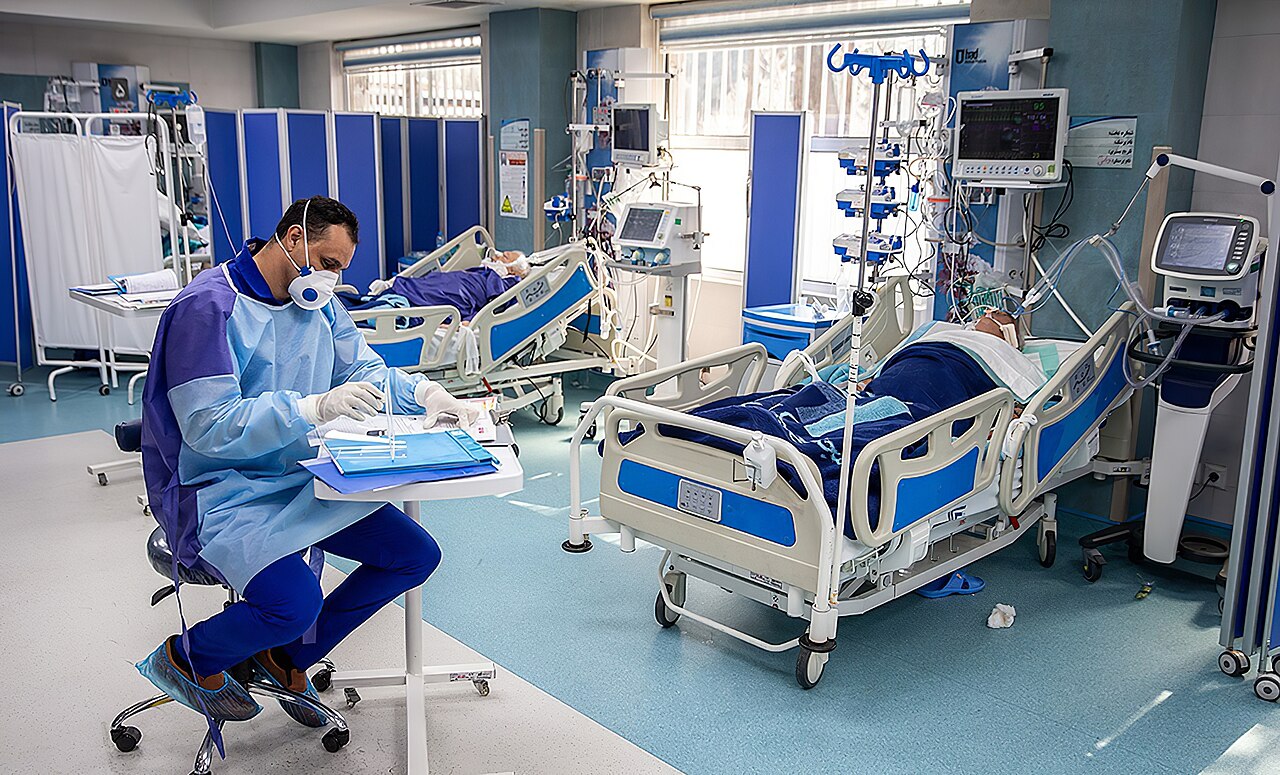
Iran was one of the first countries outside China to suffer a major COVID-19 outbreak. The government announced its first cases in the shrine city of Qom on 19 February 2020, and within weeks the virus had reached every province and infected senior officials. By the time the pandemic faded, Iran’s health ministry had recorded about 146,800 deaths, the highest official toll in the Middle East, and researchers believe the real figure was higher.
| First cases announced | 19 February 2020, Qom |
|---|---|
| President at the time | Hassan Rouhani (to August 2021), then Ebrahim Raisi |
| Official deaths | About 146,800 (Iranian Ministry of Health figures reported to WHO) |
| Official cases | About 7.6 million |
| Vaccines used | Mainly Sinopharm (China), plus Iranian-made COVIran Barekat and others |

An outbreak announced in Qom
On 19 February 2020 the health ministry confirmed two cases of the new coronavirus in Qom, the seminary city south of Tehran that draws millions of pilgrims to the shrine of Fatima Masumeh. Both patients had already died. Because the first known cases were fatal, epidemiologists concluded that the virus had probably been spreading unnoticed for weeks. Officials later suggested it had been brought in by a Qom merchant who had travelled to China.
The timing was awkward for the government. A parliamentary election was held two days later, on 21 February, and the authorities did not postpone it. Turnout was about 42 percent, the lowest for any parliamentary election since the revolution, a result that officials partly blamed on fear of the virus and critics attributed to disqualifications of candidates and wider disillusionment. Iran was also still recovering from the events of January 2020, when the killing of Qasem Soleimani and the shooting down of Ukraine International Airlines Flight 752 had shaken public trust (see the Soleimani killing and Flight 752).
A virus that reached the top of government
Within a week the outbreak had become a political story. On 24 February the deputy health minister, Iraj Harirchi, appeared at a televised press conference to play down the danger; he looked unwell and announced the next day that he had tested positive. Vice President for Women and Family Affairs Masoumeh Ebtekar, several members of parliament and senior clerics were also infected, and some older officials died, among them Mohammad Mirmohammadi, a member of the Expediency Council, in early March.
The government’s early response mixed restrictions with reluctance. Schools and universities closed, Friday prayers were cancelled in many cities, and travel over the Nowruz holiday in March 2020 was discouraged and later restricted. Closing religious sites was the most sensitive step. The shrines in Qom and the Imam Reza shrine in Mashhad were shut in mid-March 2020, a decision that drew small protests from worshippers who forced their way into the courtyards. Iran never imposed a full national lockdown of the kind seen in Italy or China; officials argued that a weakened economy could not survive one.
Sanctions, medicine and money
Iran met the pandemic under the “maximum pressure” sanctions the United States had reimposed after leaving the nuclear deal in 2018. Humanitarian goods such as medicine and medical equipment were formally exempt, but Iranian officials, doctors and independent researchers said that restrictions on banking and shipping made it hard to pay for imports and caused shortages. A 2019 Human Rights Watch report had already described the effect of sanctions on access to medicine, and a 2020 article in The Lancet Public Health by Iranian and British researchers argued that sanctions had weakened the country’s capacity to respond. The US government said it was not blocking humanitarian trade and pointed to the exemptions. In March 2020 Iran asked the International Monetary Fund for a 5 billion dollar emergency loan, its first IMF request in decades; it was not approved. The wider story is told on the page on sanctions on Iran.
Waves of infection and false cures
Iran went through several distinct waves. After the first peak in spring 2020, cases rose again in the summer and autumn, and the “fifth wave” of summer 2021, driven by the Delta variant, was the deadliest: in August 2021 the health ministry was reporting around 700 deaths a day, and hospitals in Tehran and other cities ran short of beds and oxygen.
Misinformation caused its own deaths. Rumours that drinking alcohol could kill the virus led many people to drink bootleg spirits contaminated with methanol. By April 2020 Iranian health officials said more than 700 people had died of methanol poisoning, and thousands more had been hospitalised, some losing their sight. Alcohol is illegal in Iran, which meant victims often delayed seeking treatment.
The vaccine controversy
Vaccination started late. On 8 January 2021 Supreme Leader Ali Khamenei banned the import of American and British vaccines, saying he did not trust them. A planned shipment of 150,000 Pfizer doses arranged through a US charity was cancelled. Iran relied instead on imports, mainly the Chinese Sinopharm vaccine and Russia’s Sputnik V, and on domestic projects. The first Iranian vaccine to receive emergency approval was COVIran Barekat, developed by a company linked to the Execution of Imam Khomeini’s Order (Setad) foundation, in June 2021; Pasteurcovac, made with Cuba, followed.
By the summer of 2021 only a small share of the population had been vaccinated, and the Delta wave hit hard. After Ebrahim Raisi took office in August 2021, his government stepped up imports, mostly of Sinopharm, and the campaign accelerated sharply in the autumn. Officials of the previous government and their critics argued afterwards over how much of the delay was due to sanctions, to the ban on Western vaccines, or to slow purchasing decisions.
Counting the dead
Official statistics recorded about 7.6 million cases and roughly 146,800 deaths. From early in the pandemic, however, there were doubts. In July 2020 President Rouhani himself said that as many as 25 million Iranians might already have been infected, many times the confirmed count. In 2020 some Iranian doctors and members of parliament said the toll in their provinces was higher than the national count, and studies of excess deaths based on Iran’s civil registration data found that far more people died in 2020 and 2021 than in a normal year, more than the official COVID-19 figures could explain. The health ministry said its figures counted only deaths confirmed by testing, which were limited in the first months. Because estimates rest on different methods, the safest summary is that the official figure is a minimum.
Legacy
The pandemic deepened the economic strain Iran was already under and added to the frustration that later fed protest movements, including the 2022 “Woman, Life, Freedom” protests. It also left a lasting argument about trust: between citizens and officials over the numbers, and between Iran and Western countries over sanctions and vaccines. For the city where it began, see Qom.
Persian words from this page
| کرونا | korona | coronavirus (the everyday word for COVID-19) |
| قرنطینه | gharantine | quarantine |
| واکسن | vâksan | vaccine |
| بیمارستان | bimârestân | hospital |
| ماسک | mâsk | face mask |
| قم | Qom | Qom |
Sources and further reading
- World Health Organization, COVID-19 dashboard: Iran (Islamic Republic of), country data reported by the Ministry of Health and Medical Education.
- Murphy, A., Abdi, Z., Harirchi, I., McKee, M. and Ahmadnezhad, E., “Economic sanctions and Iran’s capacity to respond to COVID-19”, The Lancet Public Health 5 (2020).
- Human Rights Watch, “Maximum Pressure”: US Economic Sanctions Harm Iranians’ Right to Health (October 2019).
- International Monetary Fund, statements on Iran’s request for Rapid Financing Instrument support (March 2020).
Want to learn Persian? Get the free Starter Pack
Get the 14-page printable Starter Pack (all 32 letters, a 7-day reading plan, 100 core words and 20 survival phrases) and a short 5-email course. Free.
More in The Islamic Revolution and the Islamic Republic (1979–present)
- Causes of the 1979 Revolution
- Khomeini’s Return and the Fall of the Monarchy
- Ruhollah Khomeini
- The 1979 Referendum and the New Constitution
- The Iran Hostage Crisis (1979–1981)
- Power Struggles after the Revolution
- The Cultural Revolution and University Closures
- The Iran–Iraq War: Causes and Iraqi Invasion
- Khorramshahr: Fall and Liberation
- The Iran–Iraq War, 1982–1986
- The Basij and Child Soldiers in the Iran–Iraq War
- Chemical Weapons in the Iran–Iraq War
- The Tanker War and Iran Air Flight 655
- The Iran–Contra Affair
- The End of the Iran–Iraq War (1988)
- The 1988 Executions of Political Prisoners
- The Death of Khomeini and the Succession of Khamenei (1989)
- Ali Khamenei
- Rafsanjani and Post-War Reconstruction (1989–1997)
- Khatami and the Reform Era (1997–2005)
- The 1999 Student Protests (18 Tir)
- The Ahmadinejad Presidency (2005–2013)
- The 2009 Election and the Green Movement
- Iran’s Nuclear Program
- Sanctions on Iran
- Rouhani and the Nuclear Deal (JCPOA)
- The Protests of 2017–2018 and November 2019
- The Killing of Soleimani and Flight 752 (January 2020)
- Iran and the COVID-19 Pandemic
- The Raisi Presidency and His Death (2021–2024)
- The 2022 Mahsa Amini Protests: “Woman, Life, Freedom”
- Iran and Israel: From Allies to Open Conflict
- The Pezeshkian Presidency
- The Twelve-Day War of June 2025
- The Protests of Late 2025 and January 2026
- The 2026 War with the United States and Israel
- The Killing of Ali Khamenei (28 February 2026)
- Mojtaba Khamenei and the 2026 Succession
- The Iranian Diaspora
- Iran and Hezbollah
- Major Earthquakes in Modern Iran
- Iranian Cinema after 1979