Akbar Hashemi Rafsanjani was president of Iran from August 1989 to August 1997, the eight years after the war with Iraq. His governments, known as the “construction” (sazandegi) era, rebuilt war-damaged cities and infrastructure, opened the economy to markets and foreign loans, and backed a family planning programme that changed Iran’s population. The period also brought high inflation, a debt crisis and growing tension with the West.
| Born | 25 August 1934, Bahreman, near Rafsanjan (Kerman province) |
|---|---|
| Died | 8 January 2017, Tehran |
| Presidency | 1989–1997 (elected July 1989, re-elected June 1993) |
| Earlier posts | Speaker of the Majlis 1980–1989; acting commander-in-chief 1988 |
| Nickname | Sardar-e sazandegi, “commander of construction” |
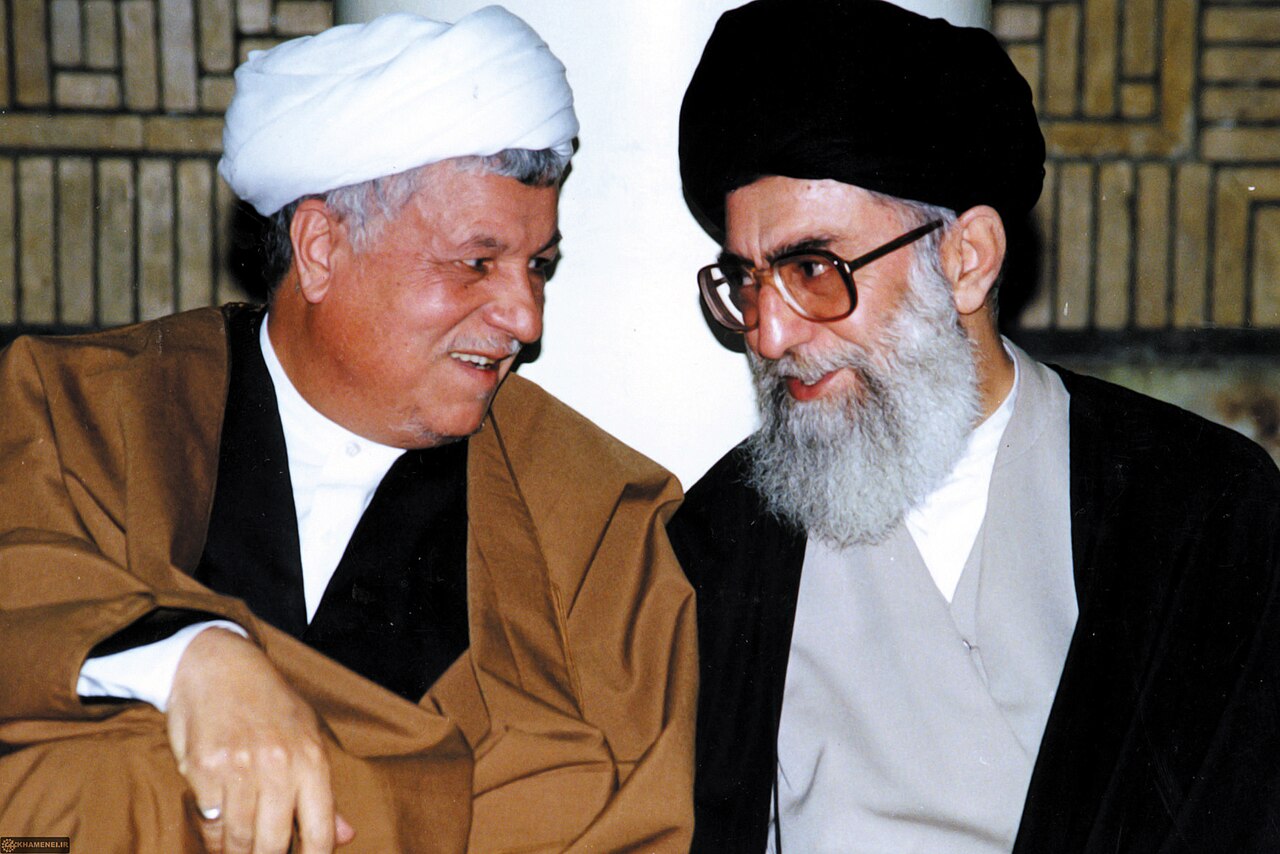

The man from the pistachio country
Rafsanjani grew up in a family of pistachio farmers in Kerman province. He studied in Qom under Khomeini, was jailed several times under the shah, and after 1979 became one of the most powerful figures of the new state: a founder of the Islamic Republican Party, speaker of parliament for nine years and, in the war’s last year, acting commander of the armed forces. He played a central part in Iran’s acceptance of the 1988 ceasefire (see the end of the Iran–Iraq War) and in the choice of Ali Khamenei as Leader in 1989.
A country to rebuild
Iran in 1989 had a population growing by over three per cent a year, wrecked border cities, a large public sector, rationing, and an oil industry hit by the war. Rafsanjani won the presidency in July 1989 with about 94 per cent of the official vote against a token opponent. His cabinet was full of technocrats, many trained in the West, and he promised to put economics ahead of revolutionary slogans.
The First Development Plan
The First Five-Year Development Plan (1989–1994) followed policies that critics on the left called “economic adjustment” (تعدیل اقتصادی, ta’dil-e eqtesadi), in line with advice from the IMF and World Bank. Its main elements were:
- reconstruction of Khuzestan and the other war provinces, including the ports and refineries of Abadan and Khorramshahr;
- large spending on dams, power stations, roads, gas pipelines and telephone lines;
- gradual removal of price controls and subsidies, and a plan to unify Iran’s several exchange rates;
- selling some state companies and inviting foreign investment, including free trade zones on Kish and Qeshm islands and at Chabahar;
- borrowing abroad, much of it in short-term trade credits.
Growth was strong in the first years. Then oil prices fell, imports rose, and in 1993–1994 Iran could not pay its short-term foreign debts on time and had to reschedule them. The attempt to unify exchange rates in 1993 failed as the rial fell. Official inflation reached about 49 per cent in 1995, the highest since the revolution, and riots broke out in poorer districts of several cities, including Mashhad, Qazvin and Islamshahr, between 1992 and 1995.
Tehran gets a new face
Much of the visible change was in the capital. The mayor appointed in 1989, Gholamhossein Karbaschi, a Rafsanjani ally, built highways, parks and cultural centres, and paid for them partly by selling building permits. Work on the Tehran Metro, planned before the revolution, resumed, and its first lines opened at the end of the 1990s. Karbaschi’s trial and conviction for corruption in 1998, which his supporters called political, became one of the great factional battles of the next presidency.
Fewer children: the family planning programme
After the revolution the state had encouraged large families. In 1989 the government reversed course. Senior clerics issued rulings permitting contraception; health workers in villages handed out free contraceptives; couples had to attend a class before marriage; and a 1993 law limited some benefits for families with more than three children. Iran’s fertility rate fell from about six children per woman in the mid-1980s to about two by 2000, one of the fastest falls recorded anywhere. Demographers credit both the programme and wider social changes, such as rising education among girls.
Politics: pragmatists and conservatives
Rafsanjani was called a pragmatist. He wanted to rebuild ties with the Persian Gulf states and Europe and kept Iran neutral in the Gulf War of 1991. At home, however, he had little interest in political opening. Leftist rivals were pushed out of parliament in 1992, partly through Guardian Council vetting, but the conservatives who replaced them soon opposed his economic reforms. Khamenei, meanwhile, was building up his own power and distanced himself from unpopular policies.
Relations with the West stayed difficult. Iranian dissidents were killed in Europe, most notably at the Mykonos restaurant in Berlin in 1992; in 1997 a German court ruled that the killing had been ordered at the top of the Iranian state, which Tehran denied. The United States, citing Iran’s nuclear work and support for armed groups, banned American trade with Iran in 1995 and passed the Iran and Libya Sanctions Act in 1996 (see sanctions on Iran).
After the presidency
Barred by term limits in 1997, Rafsanjani’s allies formed the Executives of Construction party and backed the reformist Mohammad Khatami. Rafsanjani himself chaired the Expediency Council until his death. He lost the 2005 presidential run-off to Mahmoud Ahmadinejad, spoke sympathetically of the protesters in a Friday sermon in July 2009, and was disqualified from the 2013 election by the Guardian Council, after which he supported Hassan Rouhani. He died of a heart attack in January 2017.
How the era is judged
Admirers credit Rafsanjani with rebuilding a shattered country, connecting villages to electricity, water and roads, and steering Iran away from revolutionary isolation. Critics on the left say his reforms widened inequality and created a new class of politically connected rich, while liberal critics point to the repression of dissidents and writers during his presidency. Historians such as Ali Ansari and Kevan Harris see these years as the start of the mixed economy, part state, part semi-private and part run by foundations and the Revolutionary Guards, that still shapes Iran.
Persian words from this page
| سازندگی | sâzandegi | construction, reconstruction |
| سردار سازندگی | sardâr-e sâzandegi | commander of construction |
| تعدیل اقتصادی | ta’dil-e eqtesâdi | economic adjustment |
| برنامه پنجساله | barnâme-ye panj-sâle | five-year plan |
| تنظیم خانواده | tanzim-e khânevâde | family planning |
| پسته | peste | pistachio |
Sources and further reading
- Anoushiravan Ehteshami, After Khomeini: The Iranian Second Republic (Routledge, 1995).
- Kevan Harris, A Social Revolution: Politics and the Welfare State in Iran (University of California Press, 2017).
- Ali M. Ansari, Iran, Islam and Democracy: The Politics of Managing Change (Royal Institute of International Affairs, 2000).
- Mohammad Jalal Abbasi-Shavazi, Peter McDonald and Meimanat Hosseini-Chavoshi, The Fertility Transition in Iran: Revolution and Reproduction (Springer, 2009).
- Ervand Abrahamian, A History of Modern Iran (Cambridge University Press, 2008).
Want to learn Persian? Get the free Starter Pack
Get the 14-page printable Starter Pack (all 32 letters, a 7-day reading plan, 100 core words and 20 survival phrases) and a short 5-email course. Free.
More in The Islamic Revolution and the Islamic Republic (1979–present)
- Causes of the 1979 Revolution
- Khomeini’s Return and the Fall of the Monarchy
- Ruhollah Khomeini
- The 1979 Referendum and the New Constitution
- The Iran Hostage Crisis (1979–1981)
- Power Struggles after the Revolution
- The Cultural Revolution and University Closures
- The Iran–Iraq War: Causes and Iraqi Invasion
- Khorramshahr: Fall and Liberation
- The Iran–Iraq War, 1982–1986
- The Basij and Child Soldiers in the Iran–Iraq War
- Chemical Weapons in the Iran–Iraq War
- The Tanker War and Iran Air Flight 655
- The Iran–Contra Affair
- The End of the Iran–Iraq War (1988)
- The 1988 Executions of Political Prisoners
- The Death of Khomeini and the Succession of Khamenei (1989)
- Ali Khamenei
- Rafsanjani and Post-War Reconstruction (1989–1997)
- Khatami and the Reform Era (1997–2005)
- The 1999 Student Protests (18 Tir)
- The Ahmadinejad Presidency (2005–2013)
- The 2009 Election and the Green Movement
- Iran’s Nuclear Program
- Sanctions on Iran
- Rouhani and the Nuclear Deal (JCPOA)
- The Protests of 2017–2018 and November 2019
- The Killing of Soleimani and Flight 752 (January 2020)
- Iran and the COVID-19 Pandemic
- The Raisi Presidency and His Death (2021–2024)
- The 2022 Mahsa Amini Protests: “Woman, Life, Freedom”
- Iran and Israel: From Allies to Open Conflict
- The Pezeshkian Presidency
- The Twelve-Day War of June 2025
- The Protests of Late 2025 and January 2026
- The 2026 War with the United States and Israel
- The Killing of Ali Khamenei (28 February 2026)
- Mojtaba Khamenei and the 2026 Succession
- The Iranian Diaspora
- Iran and Hezbollah
- Major Earthquakes in Modern Iran
- Iranian Cinema after 1979