Ebrahim Raisi, a conservative cleric who had spent four decades in Iran’s judiciary, was president of Iran from August 2021 until he was killed in a helicopter crash in north-western Iran on 19 May 2024. His three years in office brought a turn towards Russia and China, a stalled nuclear negotiation, high inflation, the 2022 “Woman, Life, Freedom” protests and the first direct Iranian attack on Israel. His death led to an early election won by the reformist Masoud Pezeshkian.
| Born | 14 December 1960, Mashhad |
|---|---|
| Died | 19 May 2024, near Varzaqan, East Azerbaijan province |
| President | 3 August 2021 – 19 May 2024 |
| Before | Chief Justice (2019–2021); custodian of the Imam Reza shrine foundation, Astan Quds Razavi (2016–2019) |
| Election | 18 June 2021: about 62% of ballots cast, turnout 48.8% |
| Successor | Mohammad Mokhber (acting), then Masoud Pezeshkian |
A career in the judiciary
Raisi was born in Mashhad and trained in the seminaries of Qom. After the revolution he rose quickly as a prosecutor: he was prosecutor of Karaj while still around twenty and deputy prosecutor of Tehran by 1985. In the summer of 1988 he sat on the Tehran panel that sent thousands of political prisoners to their deaths, a role human rights groups and many Iranians never forgot (see the 1988 executions). He later served as Tehran prosecutor, head of the General Inspection Organisation, first deputy chief justice and prosecutor-general.
In 2016 Ali Khamenei appointed him custodian of Astan Quds Razavi, the wealthy foundation that runs the Imam Reza shrine in Mashhad. He ran for president in 2017 and lost to Hassan Rouhani by 57 to 38 percent, then was appointed head of the judiciary in 2019. The same year the United States placed him under sanctions over human rights abuses.
The 2021 election
The 2021 presidential election was the least competitive in the Islamic Republic’s history. The Guardian Council disqualified most well-known rivals, including the former parliament speaker Ali Larijani and Rouhani’s first vice president, Eshaq Jahangiri. Raisi won outright on 18 June with nearly 18 million votes, about 62 percent of ballots cast. Turnout was 48.8 percent, the lowest for any presidential election since 1979, and about 3.7 million ballots were blank or invalid, more than the total for any defeated candidate. Supporters saw a mandate for a clean, pious administration; critics called the contest engineered.

Government and the economy
Raisi’s cabinet was drawn largely from the conservative camp and veterans of the Revolutionary Guards, and for the first time in years the presidency, parliament and judiciary were all in the hands of one faction. He promised to fight corruption and protect the poor, and in 2022 his government ended the subsidised exchange rate for imported basic goods, replacing it with cash support. Prices of staples rose sharply. Annual inflation stayed above 40 percent for most of his term according to the Statistical Centre of Iran, and the rial lost more than half its value on the open market. Despite US sanctions, oil exports recovered, mostly through sales to China.
A turn to the East
Abroad, Raisi’s government called its policy “look to the East”. Iran became a full member of the Shanghai Cooperation Organisation in July 2023 and joined the BRICS group in January 2024. It drew closer to Russia, and Western governments accused it of supplying Russia with Shahed drones for the war in Ukraine; Tehran at first denied this, then said it had sent a small number before the invasion. In March 2023, in a deal brokered by China, Iran and Saudi Arabia agreed to restore diplomatic relations broken off in 2016.
Talks in Vienna to revive the 2015 nuclear deal came close to agreement in 2022 but collapsed. Iran expanded enrichment to 60 percent purity and limited the access of International Atomic Energy Agency inspectors (see Iran’s nuclear program). After the Hamas attack on Israel in October 2023 and the Gaza war, tension with Israel escalated, and in April 2024 Iran launched its first direct missile and drone attack on Israeli territory (see Iran and Israel).
Hijab, protest and executions
At home Raisi’s government ordered stricter enforcement of the compulsory hijab. In September 2022 Mahsa Amini died after being detained by the morality police, and months of protests followed (see Woman, Life, Freedom). Security forces cracked down hard, and a UN fact-finding mission later concluded that some abuses amounted to crimes against humanity; the government rejected the mission. Executions rose steeply: Amnesty International recorded at least 853 in 2023, the highest number it had documented in Iran since 2015.
The helicopter crash
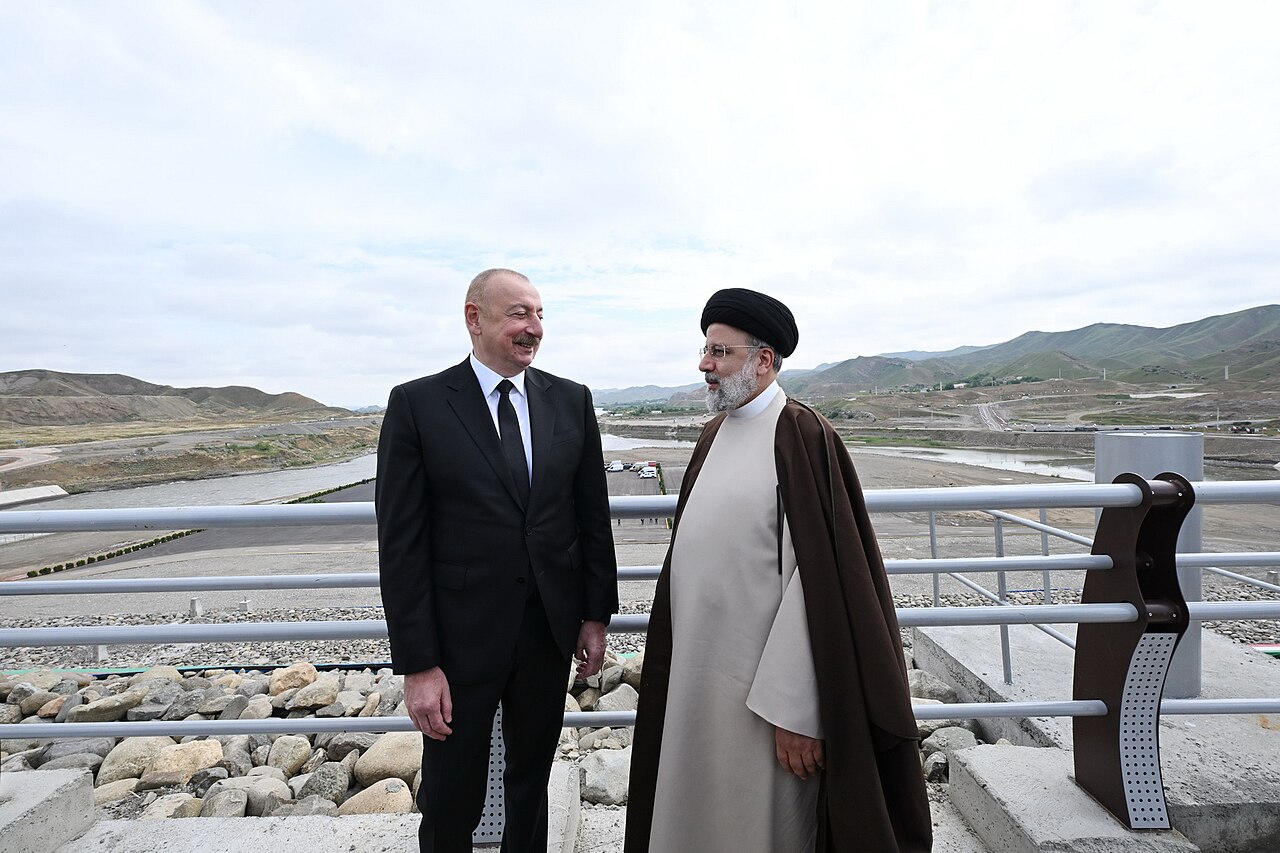
On 19 May 2024 Raisi travelled to the Aras river to open the Qiz Qalasi (Giz Galasi) dam with Ilham Aliyev. On the way back towards Tabriz his Bell 212 helicopter, one of a convoy of three, came down in fog in the forested mountains near the village of Uzi in Varzaqan county. The other two helicopters landed safely. Rescue teams searched through the night in bad weather and found the wreck on the morning of 20 May. All eight on board had died, among them Foreign Minister Hossein Amir-Abdollahian, the governor of East Azerbaijan Malek Rahmati, and the Supreme Leader’s representative in Tabriz, Mohammad Ali Al-e Hashem.
Iran’s armed forces general staff investigated and concluded in its final report that the crash was caused mainly by poor weather, including thick fog. Many observers also pointed out that the helicopter was an ageing American model that sanctions had made hard to maintain.
Death, mourning and succession
First Vice President Mohammad Mokhber became acting president, and the constitution required an election within fifty days. After funeral processions in Tabriz, Qom and Tehran, Raisi was buried at the Imam Reza shrine in Mashhad. The government declared national mourning; some opponents, including relatives of people executed in 1988, openly welcomed his death. Raisi had been widely discussed as a possible successor to Khamenei, and his death changed those calculations. The early election of June and July 2024 brought Masoud Pezeshkian to power.
Persian words from this page
| رئیسی | Raisi | Raisi |
| رئیسجمهور | rais-jomhur | president |
| قوه قضاییه | ghovve-ye ghazâiye | the judiciary |
| بالگرد | bâlgard | helicopter |
| ورزقان | Varzaqân | Varzaqan |
| آستان قدس رضوی | Âstân-e Ghods-e Razavi | the Imam Reza shrine foundation |
Sources and further reading
- Amnesty International, Death Sentences and Executions 2023 (2024).
- UN Human Rights Council, Report of the Independent International Fact-Finding Mission on the Islamic Republic of Iran (March 2024).
- Ervand Abrahamian, A History of Modern Iran, 2nd edition (Cambridge University Press, 2018).
- Michael Axworthy, Iran: What Everyone Needs to Know (Oxford University Press, 2017).
- Statistical Centre of Iran, consumer price index reports, 2021–2024.
Want to learn Persian? Get the free Starter Pack
Get the 14-page printable Starter Pack (all 32 letters, a 7-day reading plan, 100 core words and 20 survival phrases) and a short 5-email course. Free.
More in The Islamic Revolution and the Islamic Republic (1979–present)
- Causes of the 1979 Revolution
- Khomeini’s Return and the Fall of the Monarchy
- Ruhollah Khomeini
- The 1979 Referendum and the New Constitution
- The Iran Hostage Crisis (1979–1981)
- Power Struggles after the Revolution
- The Cultural Revolution and University Closures
- The Iran–Iraq War: Causes and Iraqi Invasion
- Khorramshahr: Fall and Liberation
- The Iran–Iraq War, 1982–1986
- The Basij and Child Soldiers in the Iran–Iraq War
- Chemical Weapons in the Iran–Iraq War
- The Tanker War and Iran Air Flight 655
- The Iran–Contra Affair
- The End of the Iran–Iraq War (1988)
- The 1988 Executions of Political Prisoners
- The Death of Khomeini and the Succession of Khamenei (1989)
- Ali Khamenei
- Rafsanjani and Post-War Reconstruction (1989–1997)
- Khatami and the Reform Era (1997–2005)
- The 1999 Student Protests (18 Tir)
- The Ahmadinejad Presidency (2005–2013)
- The 2009 Election and the Green Movement
- Iran’s Nuclear Program
- Sanctions on Iran
- Rouhani and the Nuclear Deal (JCPOA)
- The Protests of 2017–2018 and November 2019
- The Killing of Soleimani and Flight 752 (January 2020)
- Iran and the COVID-19 Pandemic
- The Raisi Presidency and His Death (2021–2024)
- The 2022 Mahsa Amini Protests: “Woman, Life, Freedom”
- Iran and Israel: From Allies to Open Conflict
- The Pezeshkian Presidency
- The Twelve-Day War of June 2025
- The Protests of Late 2025 and January 2026
- The 2026 War with the United States and Israel
- The Killing of Ali Khamenei (28 February 2026)
- Mojtaba Khamenei and the 2026 Succession
- The Iranian Diaspora
- Iran and Hezbollah
- Major Earthquakes in Modern Iran
- Iranian Cinema after 1979