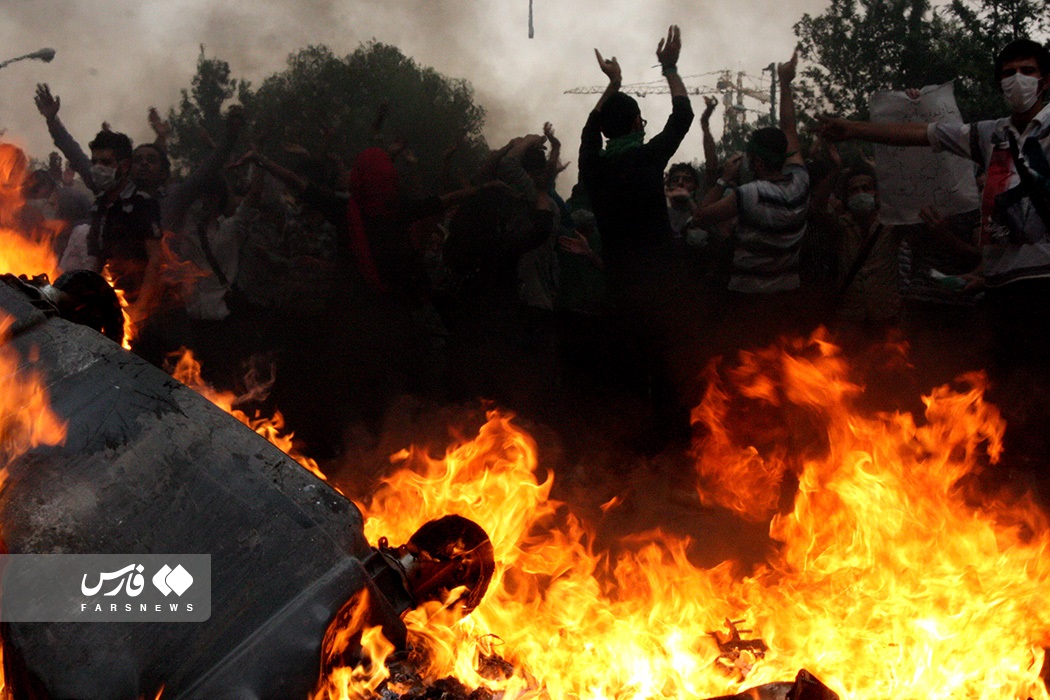
The Green Movement was the wave of protest that followed Iran’s presidential election of 12 June 2009, when the authorities declared Mahmoud Ahmadinejad the winner by a wide margin and his challengers said the vote had been rigged. Millions marched in Tehran and other cities in the largest demonstrations since 1979, asking “Where is my vote?”. The state put the movement down over the following months, and its leaders were placed under house arrest in 2011.
| Election day | 12 June 2009 (22 Khordad 1388) |
|---|---|
| Official result | Ahmadinejad about 62.6%, Mir-Hossein Mousavi about 33.8%, Mohsen Rezaee about 1.7%, Mehdi Karroubi about 0.9%; turnout about 85% |
| Main protests | June 2009 to February 2010 |
| Deaths | 36 according to the government; at least 72 according to lists compiled by opposition figures |
| Arrests | About 4,000 in the first months, according to Iranian officials |

A campaign in green
The 2009 campaign was the liveliest Iran had seen. For the first time, the candidates debated each other on television, and Ahmadinejad accused his rivals and Rafsanjani of corruption on air. Mir-Hossein Mousavi, prime minister during the war with Iraq, returned to politics after twenty years with the support of former president Khatami. His campaign adopted green, the colour of the Prophet’s family, and his wife Zahra Rahnavard, an artist and academic, campaigned beside him, unusually for Iranian politics. In the last days Tehran’s streets filled every night with young people in green wristbands.
The result and the first protests
The Interior Ministry announced Ahmadinejad’s victory within hours of the polls closing. Mousavi declared that he had won and that the result was fraudulent; Karroubi and Rezaee also complained. Critics pointed to the speed of the count, to results in which Ahmadinejad won in the home regions of his rivals, and to a series of statistical studies. The government and the Guardian Council rejected the claims, and some Western analysts and pollsters argued that Ahmadinejad could plausibly have won, given his support in rural areas and among poorer voters. No independent audit ever settled the question.
Spontaneous protests broke out on 13 June. On 15 June a silent march from Enqelab Square to Azadi Square in Tehran drew a crowd estimated in the hundreds of thousands, with some estimates far higher. Shots were fired at a Basij base near the route and several people were killed. The slogan رأی من کجاست؟ (ra’y-e man kojast, “where is my vote?”) appeared on placards, and at night people shouted “Allahu akbar” from the rooftops, as their parents had done in 1978.
The Leader’s sermon and Neda
On 19 June Leader Ali Khamenei used the Friday prayer at Tehran University to endorse the result, say the gap of 11 million votes could not have been faked, and warn protesters that they would be responsible for any bloodshed. The next day, 20 June, security forces and Basij volunteers broke up the marches. Among those killed was Neda Agha-Soltan, a 26-year-old music student shot in a side street. Bystanders filmed her death on their phones, and within hours the video had spread around the world, making her a symbol of the movement. Iranian officials denied responsibility and offered other explanations, including claims that foreign agents had killed her.
A movement and its methods
The Green Movement had no central organisation. Its supporters used the anniversaries and religious days of the Islamic Republic’s own calendar to come out: Qods Day in September, 13 Aban (the anniversary of the US embassy seizure) in November, and the mourning ceremonies for the death of Ayatollah Montazeri, a critic of the government, in December. Iranians used Twitter, Facebook, blogs and mobile phone video to get news out while foreign journalists were restricted. The slogans moved over time, from “where is my vote?” to chants against Khamenei himself, which split the movement between those who wanted reform and those who wanted more.
- 12 June 2009 Election; Ahmadinejad declared winner.
- 15 June The great silent march in Tehran.
- 19–20 June Khamenei’s sermon; violent dispersal of protests; death of Neda Agha-Soltan.
- July 2009 Deaths in the Kahrizak detention centre become public; Khamenei orders it closed.
- August 2009 Mass televised trials of reformists and protesters.
- 27 December 2009 Ashura protests; several killed, including Mousavi’s nephew.
- 11 February 2010 Heavy security prevents protests on the revolution anniversary.
- February 2011 Mousavi, Rahnavard and Karroubi placed under house arrest after calling a rally in support of the Arab uprisings.
The crackdown
The response was harsh. Thousands were detained; prominent reformist politicians, journalists and activists were tried in mass televised hearings, some making confessions that human rights organisations said were coerced. At the Kahrizak detention centre south of Tehran, at least three detainees died after abuse, among them Mohsen Rouholamini, the son of a conservative official, which caused outrage even among government supporters. Karroubi publicly accused guards of raping detainees, which officials denied. Amnesty International, Human Rights Watch and the International Campaign for Human Rights in Iran documented torture, sexual abuse and the executions of several people accused of links to armed opposition groups.
What the movement meant
The authorities called the protests a fetne (sedition) organised with foreign support, and that remains the official name. Supporters of the movement see it as a civic campaign for the right to have votes counted, and many historians see it as a turning point: the end of the belief that the reformists could change the system through elections alone, and the moment the Revolutionary Guards’ role in politics became plain. The networks, songs and slogans of 2009 resurfaced in later protests, including 2017–2019 and 2022. The movement also had a quieter afterlife at the ballot box, when many of its voters backed Hassan Rouhani in 2013. For the background, see the Ahmadinejad presidency and the reform era.
Persian words from this page
| جنبش سبز | jonbesh-e sabz | the Green Movement |
| رأی من کجاست؟ | ra’y-e man kojâst? | Where is my vote? |
| انتخابات | entekhâbât | election |
| میرحسین موسوی | Mir-Hoseyn Musavi | Mir-Hossein Mousavi |
| ندا | Nedâ | Neda (the name means “voice” or “call”) |
| فتنه | fetne | sedition (the official term) |
Sources and further reading
- Nader Hashemi and Danny Postel (eds.), The People Reloaded: The Green Movement and the Struggle for Iran’s Future (Melville House, 2010).
- Ali Ansari, Daniel Berman and Thomas Rintoul, Preliminary Analysis of the Voting Figures in Iran’s 2009 Presidential Election (Chatham House, 2009).
- Amnesty International, Iran: Election Contested, Repression Compounded (December 2009).
- Human Rights Watch, reports on the post-election crackdown in Iran (2009–2010).
- Michael Axworthy, Revolutionary Iran: A History of the Islamic Republic (Penguin, 2013).
Want to learn Persian? Get the free Starter Pack
Get the 14-page printable Starter Pack (all 32 letters, a 7-day reading plan, 100 core words and 20 survival phrases) and a short 5-email course. Free.
More in The Islamic Revolution and the Islamic Republic (1979–present)
- Causes of the 1979 Revolution
- Khomeini’s Return and the Fall of the Monarchy
- Ruhollah Khomeini
- The 1979 Referendum and the New Constitution
- The Iran Hostage Crisis (1979–1981)
- Power Struggles after the Revolution
- The Cultural Revolution and University Closures
- The Iran–Iraq War: Causes and Iraqi Invasion
- Khorramshahr: Fall and Liberation
- The Iran–Iraq War, 1982–1986
- The Basij and Child Soldiers in the Iran–Iraq War
- Chemical Weapons in the Iran–Iraq War
- The Tanker War and Iran Air Flight 655
- The Iran–Contra Affair
- The End of the Iran–Iraq War (1988)
- The 1988 Executions of Political Prisoners
- The Death of Khomeini and the Succession of Khamenei (1989)
- Ali Khamenei
- Rafsanjani and Post-War Reconstruction (1989–1997)
- Khatami and the Reform Era (1997–2005)
- The 1999 Student Protests (18 Tir)
- The Ahmadinejad Presidency (2005–2013)
- The 2009 Election and the Green Movement
- Iran’s Nuclear Program
- Sanctions on Iran
- Rouhani and the Nuclear Deal (JCPOA)
- The Protests of 2017–2018 and November 2019
- The Killing of Soleimani and Flight 752 (January 2020)
- Iran and the COVID-19 Pandemic
- The Raisi Presidency and His Death (2021–2024)
- The 2022 Mahsa Amini Protests: “Woman, Life, Freedom”
- Iran and Israel: From Allies to Open Conflict
- The Pezeshkian Presidency
- The Twelve-Day War of June 2025
- The Protests of Late 2025 and January 2026
- The 2026 War with the United States and Israel
- The Killing of Ali Khamenei (28 February 2026)
- Mojtaba Khamenei and the 2026 Succession
- The Iranian Diaspora
- Iran and Hezbollah
- Major Earthquakes in Modern Iran
- Iranian Cinema after 1979