Ayatollah Ruhollah Khomeini, founder of the Islamic Republic, died in Tehran on 3 June 1989 at the age of 86. The next day the Assembly of Experts chose President Ali Khamenei, a mid-ranking cleric, as the new Supreme Leader, and a referendum in July rewrote the constitution to fit the new order. Together these events closed the revolutionary decade and set up the system that governed Iran for the next 37 years.
| Death | 3 June 1989 (14 Khordad 1368), in hospital in north Tehran |
|---|---|
| Burial | 6 June 1989, near Behesht-e Zahra cemetery, south of Tehran |
| Successor | Ali Khamenei, elected by the Assembly of Experts on 4 June 1989 |
| Constitutional referendum | 28 July 1989, held on the same day as the presidential election won by Rafsanjani |
| Public holiday | 14 Khordad, the anniversary of his death |

The heir who fell from favour
For most of the 1980s the expected successor was Grand Ayatollah Hossein-Ali Montazeri. The Assembly of Experts named him in 1985. He was a senior religious authority (a marja’), as the 1979 constitution required the Leader to be, and he had been one of Khomeini’s closest students.
Montazeri, however, increasingly criticised the government. He objected to the treatment of prisoners, and in the summer of 1988 he wrote letters protesting the mass executions of political prisoners (see the 1988 executions). In March 1989 Khomeini wrote to him that he was no longer fit to lead, and Montazeri resigned as designated successor. He spent most of his remaining life under restriction in Qom and died in 2009. His removal left Iran without an heir only weeks before Khomeini fell ill.
Illness and death
Khomeini had suffered from heart trouble for years. In late May 1989 he had surgery for internal bleeding at a clinic near his home in Jamaran, in the north of Tehran. He died late on the evening of Saturday 3 June. State radio announced the death the next morning, and the government declared days of mourning.
The Assembly of Experts chooses Khamenei
The Assembly of Experts, a body of senior clerics, met on 4 June. Khamenei read Khomeini’s political and religious testament aloud. Rafsanjani, speaker of the Majlis, told the members that Khomeini had spoken of Khamenei as suitable for leadership. After discussion of a leadership council, which was rejected, the assembly voted for Khamenei by a large majority.
The choice was unusual. Khamenei was then a hojjat al-eslam, a middle clerical rank, not a marja’. The assembly therefore elected him on a provisional basis, pending the change in the constitution already under way. A recording of the session released in 2018 shows Khamenei himself raising doubts about his qualifications. Supporters saw his choice as continuity: he had been president since 1981 and was close to Khomeini. Critics, including some senior clerics, said the religious standard of the office had been lowered for political reasons.
Funeral and the crowds
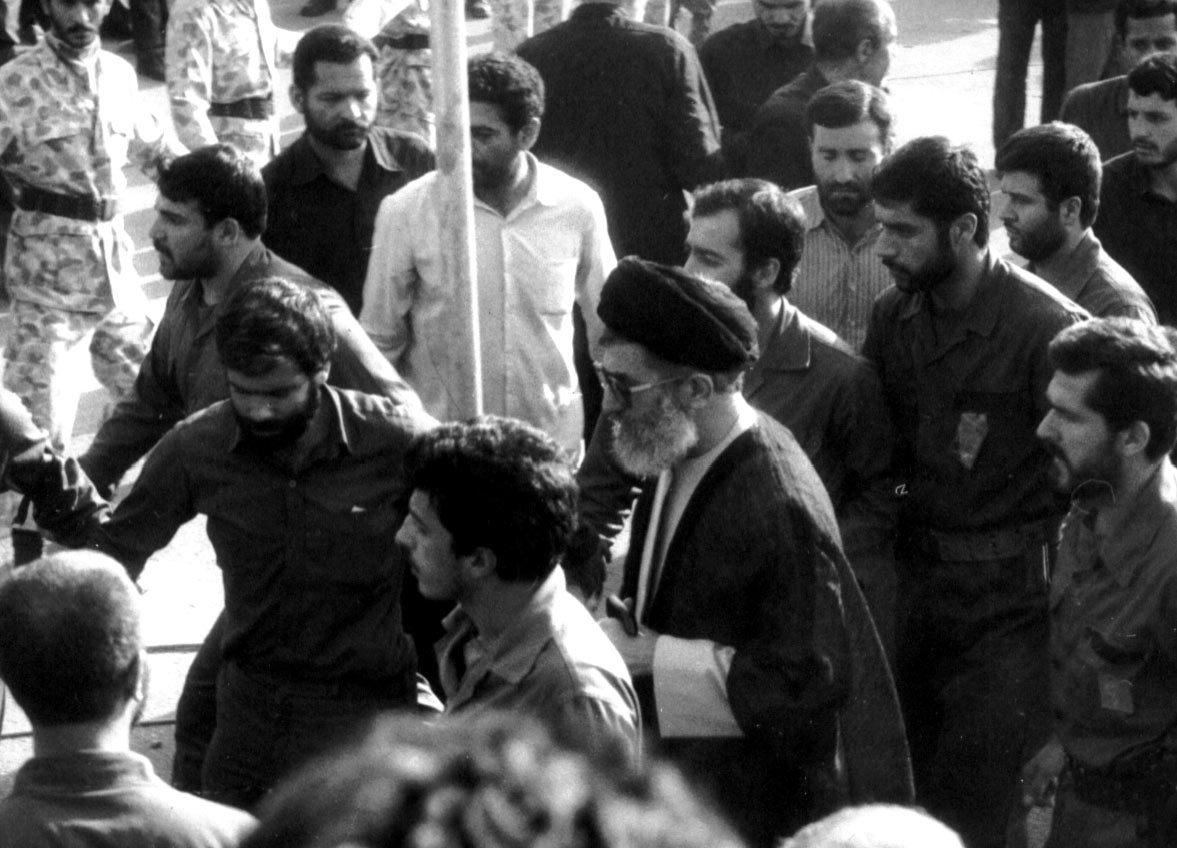
Khomeini’s body lay in an open, refrigerated glass case on a platform in north Tehran while very large crowds filed past. Estimates of the numbers who turned out over those days run into the millions. The burial on 6 June turned chaotic: mourners pressed around the vehicle and the shroud was torn as people tried to touch the body, and soldiers had to fly it away by helicopter. The burial was completed later that day. Iranian officials reported that several people died in the crush and hundreds were injured.
A large shrine was built over the grave, with golden domes and four minarets. It became a place of state ceremony, where every year on 14 Khordad the Leader gives a speech.
The 1989 constitutional changes
In April 1989 Khomeini had ordered a council to revise the constitution. Its proposals were put to a referendum on 28 July 1989 and approved by a large official majority. The main changes were:
- The Leader’s qualifications: the requirement to be a marja’ was removed. The Leader now needed scholarly competence in religious law plus “political and social insight”.
- “Absolute” guardianship: the phrase ولایت مطلقه فقیه (velayat-e motlaqe-ye faqih) entered the constitution, and the Leader was given the power to set the “general policies” of the system.
- No prime minister: the post was abolished and its powers passed to the president, who became head of the executive.
- New bodies: the Expediency Council, created by Khomeini in 1988 to settle disputes between parliament and the Guardian Council, was written into the constitution, as was a Supreme National Security Council.
- Judiciary: a single Head of the Judiciary, appointed by the Leader, replaced a five-member council.
After the referendum the Assembly of Experts confirmed Khamenei under the new rules on 6 August 1989. On the same day as the referendum, Rafsanjani was elected president.
A new partnership at the top
Many observers in 1989 expected Rafsanjani, the experienced politician, to be the real power and Khamenei the junior partner. The arrangement lasted for some years. Over the 1990s, however, Khamenei built his own base among the Revolutionary Guards, the security services and a network of representatives in state bodies, and the balance shifted towards the Leader’s office. Historians such as Said Amir Arjomand and Anoushiravan Ehteshami describe 1989 as the start of a “second republic”: less revolutionary, more focused on the state and the economy. How far that change went, and how much of Khomeini’s system it kept, remains debated. The story continues on the pages about Ali Khamenei and the Rafsanjani presidency; for Khomeini’s life and ideas, see Ruhollah Khomeini. For how the offices created in 1989 work today, see how Iran is governed.
Persian words from this page
| رهبر | rahbar | leader |
| مجلس خبرگان | majles-e khobregân | Assembly of Experts |
| مرجع تقلید | marja’-e taqlid | source of emulation (senior religious authority) |
| قانون اساسی | qânun-e asâsi | constitution |
| وصیتنامه | vasiyat-nâme | testament, will |
| بهشت زهرا | Behesht-e Zahrâ | Tehran’s main cemetery |
Sources and further reading
- Baqer Moin, Khomeini: Life of the Ayatollah (I.B. Tauris, 1999).
- Said Amir Arjomand, After Khomeini: Iran under His Successors (Oxford University Press, 2009).
- Anoushiravan Ehteshami, After Khomeini: The Iranian Second Republic (Routledge, 1995).
- Ervand Abrahamian, A History of Modern Iran (Cambridge University Press, 2008).
- Constitution of the Islamic Republic of Iran, as amended in 1989.
Want to learn Persian? Get the free Starter Pack
Get the 14-page printable Starter Pack (all 32 letters, a 7-day reading plan, 100 core words and 20 survival phrases) and a short 5-email course. Free.
More in The Islamic Revolution and the Islamic Republic (1979–present)
- Causes of the 1979 Revolution
- Khomeini’s Return and the Fall of the Monarchy
- Ruhollah Khomeini
- The 1979 Referendum and the New Constitution
- The Iran Hostage Crisis (1979–1981)
- Power Struggles after the Revolution
- The Cultural Revolution and University Closures
- The Iran–Iraq War: Causes and Iraqi Invasion
- Khorramshahr: Fall and Liberation
- The Iran–Iraq War, 1982–1986
- The Basij and Child Soldiers in the Iran–Iraq War
- Chemical Weapons in the Iran–Iraq War
- The Tanker War and Iran Air Flight 655
- The Iran–Contra Affair
- The End of the Iran–Iraq War (1988)
- The 1988 Executions of Political Prisoners
- The Death of Khomeini and the Succession of Khamenei (1989)
- Ali Khamenei
- Rafsanjani and Post-War Reconstruction (1989–1997)
- Khatami and the Reform Era (1997–2005)
- The 1999 Student Protests (18 Tir)
- The Ahmadinejad Presidency (2005–2013)
- The 2009 Election and the Green Movement
- Iran’s Nuclear Program
- Sanctions on Iran
- Rouhani and the Nuclear Deal (JCPOA)
- The Protests of 2017–2018 and November 2019
- The Killing of Soleimani and Flight 752 (January 2020)
- Iran and the COVID-19 Pandemic
- The Raisi Presidency and His Death (2021–2024)
- The 2022 Mahsa Amini Protests: “Woman, Life, Freedom”
- Iran and Israel: From Allies to Open Conflict
- The Pezeshkian Presidency
- The Twelve-Day War of June 2025
- The Protests of Late 2025 and January 2026
- The 2026 War with the United States and Israel
- The Killing of Ali Khamenei (28 February 2026)
- Mojtaba Khamenei and the 2026 Succession
- The Iranian Diaspora
- Iran and Hezbollah
- Major Earthquakes in Modern Iran
- Iranian Cinema after 1979