Iraq used chemical weapons on a large scale during the Iran–Iraq War, from 1983 until the ceasefire of 1988, first against Iranian soldiers and later against civilians in Iranian and Iraqi Kurdish towns. The best-known attacks were on Sardasht in Iran in June 1987 and on Halabja in Iraqi Kurdistan in March 1988, where 3,200 to 5,000 people were killed. Tens of thousands of Iranians still live with the effects of mustard gas.
| Period of use | 1983–1988 (scattered earlier use of irritant agents reported from 1981) |
|---|---|
| Agents | Mustard gas; the nerve agents tabun and sarin |
| Sardasht, Iran | 28 June 1987: about 130 killed, some 8,000 injured |
| Halabja, Iraq | 16 March 1988: 3,200–5,000 killed, 7,000–10,000 injured |
| Iranian casualties | Estimates range from about 50,000 to more than 100,000 people exposed; Iranian sources give the higher figures |
| Treaty breached | 1925 Geneva Protocol, to which Iraq was a party |
Why Iraq turned to gas
By 1983 Iraq was on the defensive. Iranian offensives (see the Iran–Iraq War, 1982–1986) relied on massed infantry, and Iraqi commanders found that chemical shells broke up these attacks far more effectively than conventional fire. Iraq had built production plants at Samarra and elsewhere, using equipment and precursor chemicals bought from companies in Western Europe and other countries. Mustard gas, which burns the skin, eyes and lungs, was used first. In 1984 Iraq began using tabun, a nerve agent, making this the first battlefield use of nerve agents in history; sarin followed later in the war.
Iraqi records studied after 2003, used by Williamson Murray and Kevin Woods, show that the weapons were integrated into Iraqi military planning, with the approval of the top leadership. Joost Hiltermann, in A Poisonous Affair (2007), shows that each use met so little international reaction that it encouraged the next.
Gas on the battlefield
The first well-documented attacks came in August 1983 near Piranshahr and Haj Omran in the Kurdish north. They grew in scale during Operation Kheibar in the Hoveyzeh marshes in February and March 1984, and in the defence of Basra and the counter-attacks against Fao in 1986. Iranian soldiers had few gas masks and little protective clothing at first; beards, common among the volunteers, stopped many masks from sealing. Wounded men were flown to hospitals in Tehran and some to Europe, where doctors confirmed the injuries.
In March 1984 a team of specialists sent by the UN Secretary-General examined casualties and evidence in Iran and confirmed that mustard gas and tabun had been used. Later UN missions in 1985, 1986, 1987 and 1988 reached similar conclusions. Yet Security Council statements at first condemned the use of chemical weapons without saying who had used them. Only in 1986 did a Council statement name Iraqi forces, and no sanctions followed. Iranians still point to this as evidence of Western and Arab support for Saddam Hussein.
Sardasht, June 1987
On 28 June 1987 Iraqi aircraft dropped mustard gas bombs on four residential areas of Sardasht, a Kurdish town in Iran’s West Azerbaijan province close to the Iraqi border. About 130 people were killed and some 8,000 injured. It was one of the first deliberate chemical attacks on a civilian town in the war. Many survivors developed chronic lung, eye and skin diseases, and the town’s survivors’ association has campaigned internationally for recognition, including at conferences of the Organisation for the Prohibition of Chemical Weapons (OPCW).
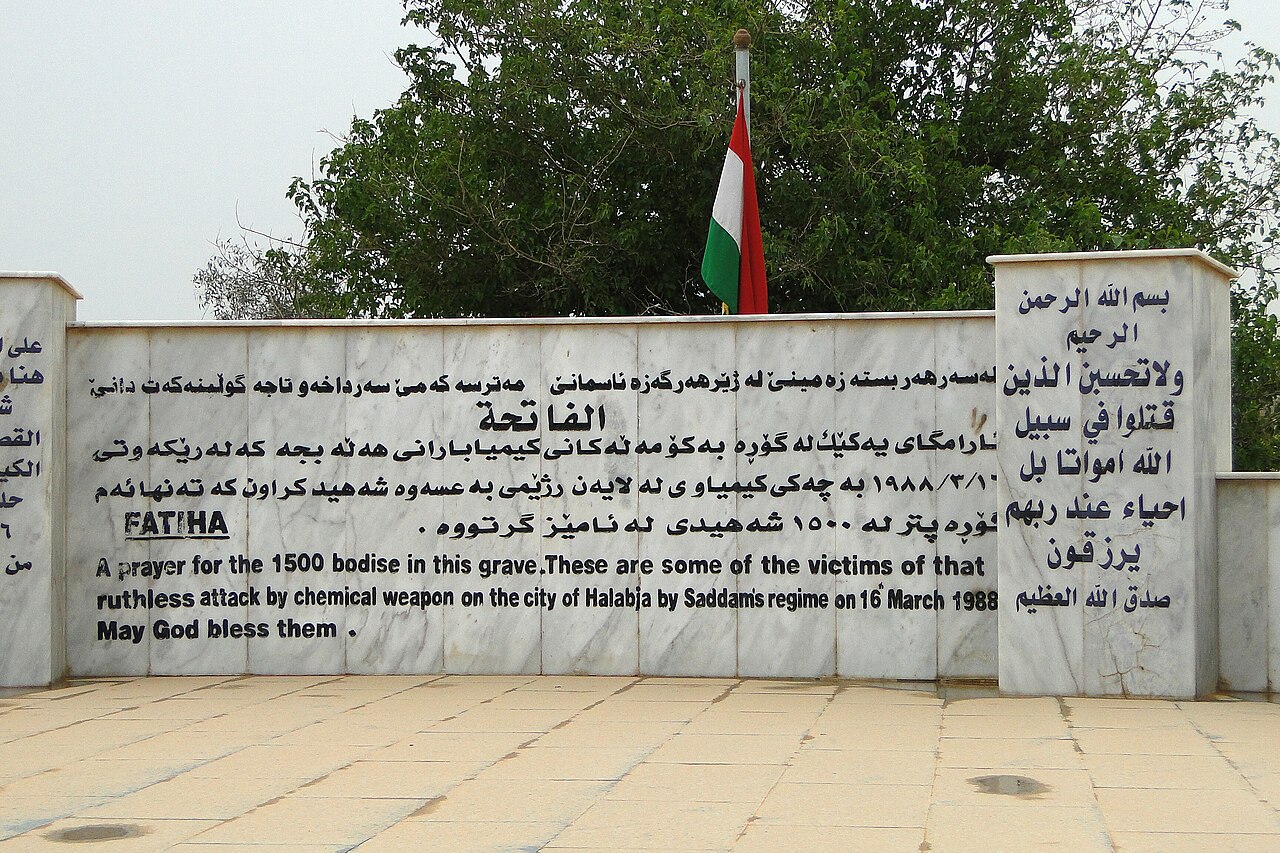

Halabja, March 1988
Halabja is a Kurdish town in north-eastern Iraq, about 15 kilometres from the Iranian border. On 15 March 1988, during Iran’s Operation Valfajr 10, Iranian forces and Iraqi Kurdish fighters of the Patriotic Union of Kurdistan took the town. The next day, 16 March, Iraqi aircraft attacked it with a mixture of chemical agents, probably mustard gas and nerve agents. Between 3,200 and 5,000 people were killed, most of them women, children and old people, and thousands more were injured.
Iran brought foreign journalists to the town within days, and the photographs of families lying dead in the streets, many taken by the Iranian photographer Kaveh Golestan, shocked the world. The attack was part of the wider Anfal campaign against Iraq’s Kurds, which Human Rights Watch documented in 1993 as genocide. Some US officials at the time suggested that Iran shared responsibility for the deaths at Halabja. Later investigations, including Human Rights Watch’s work and Hiltermann’s research in Iraqi and US records, found no evidence to support that claim and attribute the attack to Iraq. In 2010 the Iraqi High Tribunal recognised Halabja as an act of genocide; Ali Hassan al-Majid, the Iraqi official known as “Chemical Ali”, was executed that year for his role in the Anfal campaign.
- August 1983 Iraqi mustard gas attacks near Piranshahr and Haj Omran
- February–March 1984 Large-scale use during Operation Kheibar; first use of tabun
- March 1984 UN specialists confirm chemical weapons use
- 1986 Heavy use against Iranian forces at Fao; a Security Council statement names Iraq
- 28 June 1987 Attack on Sardasht
- 16 March 1988 Attack on Halabja
- April–July 1988 Gas used in Iraq’s final offensives to retake Fao and other ground
Iran’s response
Iran did not answer with chemical weapons in any documented attack. Accounts by Iranian officials say that Khomeini regarded such weapons as forbidden by Islam. The United States alleged in the late 1980s that Iran had started its own chemical weapons production. Iran denies ever using such weapons, and in 1997 it ratified the Chemical Weapons Convention, which bans their production and use.
The heavy use of gas in the final months of the war, together with fears that Iraq would put chemical warheads on missiles aimed at Tehran, is often cited as one of the reasons Iran accepted the ceasefire in July 1988 (see the end of the Iran–Iraq War).
Legacy
For Iranians the chemical war left a lasting mark. Survivors are known as shimiyai, “chemical” veterans, and many suffer from lung damage, eye problems and cancers decades later. The Tehran Peace Museum, founded with the help of survivors, documents their stories. The suppliers of Iraq’s programme have only rarely faced justice: in 2005 a Dutch court convicted the businessman Frans van Anraat of complicity in war crimes for selling Iraq the chemicals used to make mustard gas.
The experience also shaped Iranian strategic thinking. Many historians and analysts of Iranian policy note that the world’s silence over Iraqi gas attacks left Iran’s leaders convinced that they could rely on no one but themselves for defence, a lesson often linked to later debates over missiles and Iran’s nuclear programme.
Persian words from this page
| سلاح شیمیایی | selâh-e shimiyâi | chemical weapon |
| گاز خردل | gâz-e khardal | mustard gas |
| سردشت | Sardasht | Sardasht |
| حلبچه | Halabcheh | Halabja |
| جانباز | jânbâz | disabled war veteran |
Sources and further reading
- Joost R. Hiltermann, A Poisonous Affair: America, Iraq, and the Gassing of Halabja (Cambridge University Press, 2007)
- Human Rights Watch, Genocide in Iraq: The Anfal Campaign Against the Kurds (1993)
- Reports of the specialists appointed by the UN Secretary-General to investigate allegations of the use of chemical weapons (1984–1988), United Nations Security Council documents
- Williamson Murray and Kevin M. Woods, The Iran–Iraq War: A Military and Strategic History (Cambridge University Press, 2014)
- Pierre Razoux, The Iran–Iraq War (Harvard University Press, 2015)
Want to learn Persian? Get the free Starter Pack
Get the 14-page printable Starter Pack (all 32 letters, a 7-day reading plan, 100 core words and 20 survival phrases) and a short 5-email course. Free.
More in The Islamic Revolution and the Islamic Republic (1979–present)
- Causes of the 1979 Revolution
- Khomeini’s Return and the Fall of the Monarchy
- Ruhollah Khomeini
- The 1979 Referendum and the New Constitution
- The Iran Hostage Crisis (1979–1981)
- Power Struggles after the Revolution
- The Cultural Revolution and University Closures
- The Iran–Iraq War: Causes and Iraqi Invasion
- Khorramshahr: Fall and Liberation
- The Iran–Iraq War, 1982–1986
- The Basij and Child Soldiers in the Iran–Iraq War
- Chemical Weapons in the Iran–Iraq War
- The Tanker War and Iran Air Flight 655
- The Iran–Contra Affair
- The End of the Iran–Iraq War (1988)
- The 1988 Executions of Political Prisoners
- The Death of Khomeini and the Succession of Khamenei (1989)
- Ali Khamenei
- Rafsanjani and Post-War Reconstruction (1989–1997)
- Khatami and the Reform Era (1997–2005)
- The 1999 Student Protests (18 Tir)
- The Ahmadinejad Presidency (2005–2013)
- The 2009 Election and the Green Movement
- Iran’s Nuclear Program
- Sanctions on Iran
- Rouhani and the Nuclear Deal (JCPOA)
- The Protests of 2017–2018 and November 2019
- The Killing of Soleimani and Flight 752 (January 2020)
- Iran and the COVID-19 Pandemic
- The Raisi Presidency and His Death (2021–2024)
- The 2022 Mahsa Amini Protests: “Woman, Life, Freedom”
- Iran and Israel: From Allies to Open Conflict
- The Pezeshkian Presidency
- The Twelve-Day War of June 2025
- The Protests of Late 2025 and January 2026
- The 2026 War with the United States and Israel
- The Killing of Ali Khamenei (28 February 2026)
- Mojtaba Khamenei and the 2026 Succession
- The Iranian Diaspora
- Iran and Hezbollah
- Major Earthquakes in Modern Iran
- Iranian Cinema after 1979