Khorramshahr, a port on the Shatt al-Arab in Khuzestan, fell to the Iraqi army in late October 1980 after more than a month of street fighting, and was recaptured by Iran on 24 May 1982 in Operation Beit ol-Moqaddas. The defence and liberation of the city became the most powerful symbols of the Iran–Iraq War in Iran, where 24 May (3 Khordad) is marked as the Day of Resistance, Sacrifice and Victory.
| Iraqi assault | Late September to late October 1980 |
|---|---|
| Iranian defenders | Navy commandos, army units, Revolutionary Guards under Mohammad Jahanara, police and local volunteers |
| Liberation | Operation Beit ol-Moqaddas, 24 April to 24 May 1982 |
| Iranian commanders | Ali Sayad Shirazi (army), Mohsen Rezaei (Revolutionary Guards) |
| Iraqi prisoners | About 15,000 to 19,000 at Khorramshahr (estimates vary) |
| Persian name | خرمشهر, also called خونینشهر (Khunin-shahr, “city of blood”) |
The city in 1980
Khorramshahr, the old port of Mohammerah, stands where the Karun river meets the Shatt al-Arab, a short drive from the Abadan refinery and directly across from Iraqi territory. In 1980 it was one of Iran’s main ports, with a mixed population of Persian and Arabic speakers. For Iraq it was an obvious first target, both to control the waterway and to cut Abadan off from the rest of Iran (see the causes of the Iran–Iraq War). The city’s longer history and what visitors can see there today are on the page Abadan and Khorramshahr.
The defence of Khorramshahr, autumn 1980
Iraqi armoured divisions reached the outskirts within days of the invasion of 22 September. They expected to take the city quickly. Instead they met a disorganised but stubborn resistance from a few regular units, especially navy commandos from the Khorramshahr base, members of the newly formed Revolutionary Guards led by Mohammad Jahanara, police, and hundreds of local volunteers, among them teenagers, women and members of the city’s Arab community. They fought from house to house with rifles, grenades, petrol bombs and a handful of anti-tank weapons.
The Iraqis suffered heavy losses in street fighting for which their tank forces were poorly trained, and had to bring in special forces. The defenders received little support: the Iranian high command was divided, and President Bani-Sadr was accused by his rivals of holding back reinforcements, a charge he denied. By the last days of October Iraqi troops controlled most of the city, and the remaining defenders withdrew across the Karun. Iranians began to call the city Khunin-shahr, the city of blood.
One story from these weeks became central to Iranian memory of the war. Mohammad Hossein Fahmideh, a thirteen-year-old volunteer, was killed near Khorramshahr when he threw himself under an Iraqi tank with grenades. Khomeini later called him “our leader”. The use of very young volunteers is discussed on the page the Basij and child soldiers in the Iran–Iraq War.
Nineteen months of occupation
Iraq held Khorramshahr from late 1980 to May 1982. Most of its population had fled, and the city was looted and badly damaged. Iraqi forces built strong defences around it, including minefields, earth walls and flooded areas. Abadan, across the river, remained under siege and artillery fire until September 1981, when an Iranian offensive pushed the Iraqis back across the Karun.

Operation Beit ol-Moqaddas, spring 1982
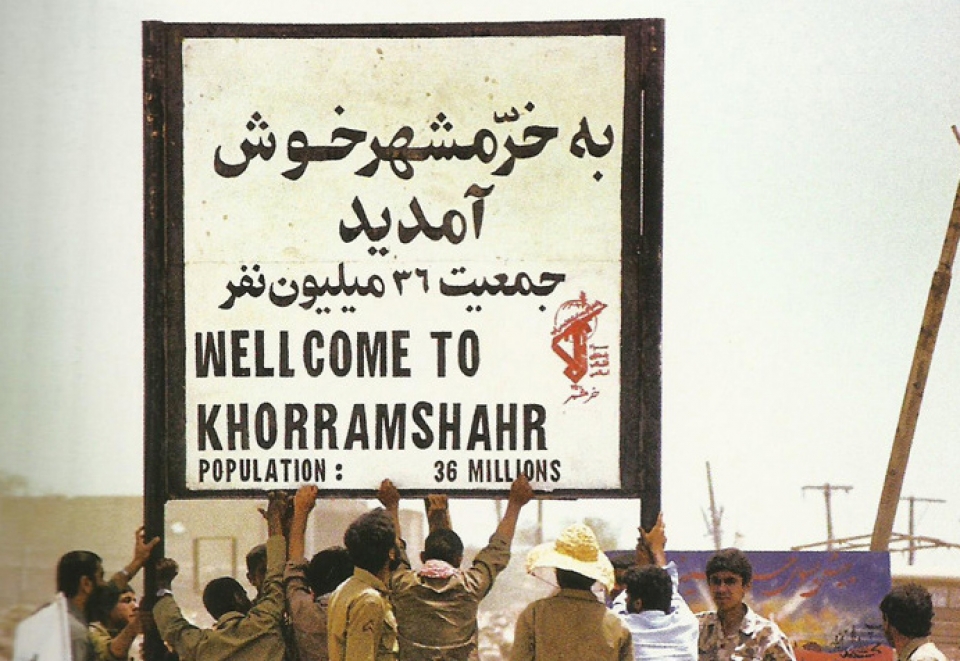
By 1982 Iran had reorganised. The regular army and the Revolutionary Guards, often rivals, now planned operations together, and tens of thousands of Basij volunteers had joined the front. A series of offensives from late 1981 to March 1982 broke Iraqi lines further north. On 24 April 1982 Iran launched Operation Beit ol-Moqaddas (Jerusalem), its largest offensive yet, with forces crossing the Karun and attacking across the desert west of Ahvaz.
After weeks of fighting, the Iraqi forces around Khorramshahr were nearly surrounded. Iran attacked the city itself in the final days of May, and on 24 May 1982 its defences collapsed. Iranian forces captured some 15,000 to 19,000 Iraqi soldiers there, according to different counts, along with large amounts of equipment. Iranian and Iraqi losses in the campaign were heavy, and figures from both sides are unreliable. Khomeini’s response, “Khorramshahr was liberated by God”, became one of the best-known sentences of the war.
- 22 September 1980 Iraq invades Khuzestan
- Late September–October 1980 Street fighting in Khorramshahr
- Late October 1980 Iraqi forces take the city
- September 1981 The siege of Abadan is broken
- 24 April 1982 Operation Beit ol-Moqaddas begins
- 24 May 1982 Khorramshahr is recaptured
- June 1982 Saddam Hussein announces a withdrawal from Iranian territory
- July 1982 Iran launches its first offensive into Iraq, towards Basra
A turning point and a fateful decision
The liberation of Khorramshahr was the high point of Iran’s war. In June 1982 Saddam announced that Iraqi forces would withdraw from most Iranian territory and offered a ceasefire. Iran’s leaders debated whether to stop. Khomeini and most of the leadership decided to carry the war into Iraq, demanding Saddam’s removal and reparations; Iran’s first offensive towards Basra began in July 1982 (see the Iran–Iraq War, 1982–1986).
That decision remains one of the most debated questions in Iranian history. Supporters argue that Iraq still occupied border areas, that Saddam could not be trusted, and that no acceptable peace was on offer. Critics, including some former officials and many historians such as Michael Axworthy and Pierre Razoux, argue that Iran missed its best chance to end the war on favourable terms and that six more years of fighting cost hundreds of thousands of lives.
Memory of the city
The damaged Jameh Mosque of Khorramshahr, which stood at the centre of the defence, became a national symbol, and images of its dome appear on posters and in films. Each year on 3 Khordad, ceremonies across Iran mark the liberation, and war songs from the period are broadcast. The city was rebuilt slowly after 1988, and its port never fully regained its pre-war importance.
Persian words from this page
| خرمشهر | Khorramshahr | “joyful city” |
| خونینشهر | Khunin-shahr | city of blood |
| آزادسازی | âzâd-sâzi | liberation |
| مسجد جامع | masjed-e jâme’ | congregational mosque |
| بیتالمقدس | Beyt ol-Moqaddas | Jerusalem (name of the operation) |
| خرداد | Khordâd | third month of the Iranian calendar |
Sources and further reading
- Pierre Razoux, The Iran–Iraq War (Harvard University Press, 2015)
- Williamson Murray and Kevin M. Woods, The Iran–Iraq War: A Military and Strategic History (Cambridge University Press, 2014)
- Dilip Hiro, The Longest War: The Iran–Iraq Military Conflict (Routledge, 1989)
- Michael Axworthy, Revolutionary Iran: A History of the Islamic Republic (Allen Lane, 2013)
- Kaveh Farrokh, Iran at War: 1500–1988 (Osprey, 2011)
Want to learn Persian? Get the free Starter Pack
Get the 14-page printable Starter Pack (all 32 letters, a 7-day reading plan, 100 core words and 20 survival phrases) and a short 5-email course. Free.
More in The Islamic Revolution and the Islamic Republic (1979–present)
- Causes of the 1979 Revolution
- Khomeini’s Return and the Fall of the Monarchy
- Ruhollah Khomeini
- The 1979 Referendum and the New Constitution
- The Iran Hostage Crisis (1979–1981)
- Power Struggles after the Revolution
- The Cultural Revolution and University Closures
- The Iran–Iraq War: Causes and Iraqi Invasion
- Khorramshahr: Fall and Liberation
- The Iran–Iraq War, 1982–1986
- The Basij and Child Soldiers in the Iran–Iraq War
- Chemical Weapons in the Iran–Iraq War
- The Tanker War and Iran Air Flight 655
- The Iran–Contra Affair
- The End of the Iran–Iraq War (1988)
- The 1988 Executions of Political Prisoners
- The Death of Khomeini and the Succession of Khamenei (1989)
- Ali Khamenei
- Rafsanjani and Post-War Reconstruction (1989–1997)
- Khatami and the Reform Era (1997–2005)
- The 1999 Student Protests (18 Tir)
- The Ahmadinejad Presidency (2005–2013)
- The 2009 Election and the Green Movement
- Iran’s Nuclear Program
- Sanctions on Iran
- Rouhani and the Nuclear Deal (JCPOA)
- The Protests of 2017–2018 and November 2019
- The Killing of Soleimani and Flight 752 (January 2020)
- Iran and the COVID-19 Pandemic
- The Raisi Presidency and His Death (2021–2024)
- The 2022 Mahsa Amini Protests: “Woman, Life, Freedom”
- Iran and Israel: From Allies to Open Conflict
- The Pezeshkian Presidency
- The Twelve-Day War of June 2025
- The Protests of Late 2025 and January 2026
- The 2026 War with the United States and Israel
- The Killing of Ali Khamenei (28 February 2026)
- Mojtaba Khamenei and the 2026 Succession
- The Iranian Diaspora
- Iran and Hezbollah
- Major Earthquakes in Modern Iran
- Iranian Cinema after 1979