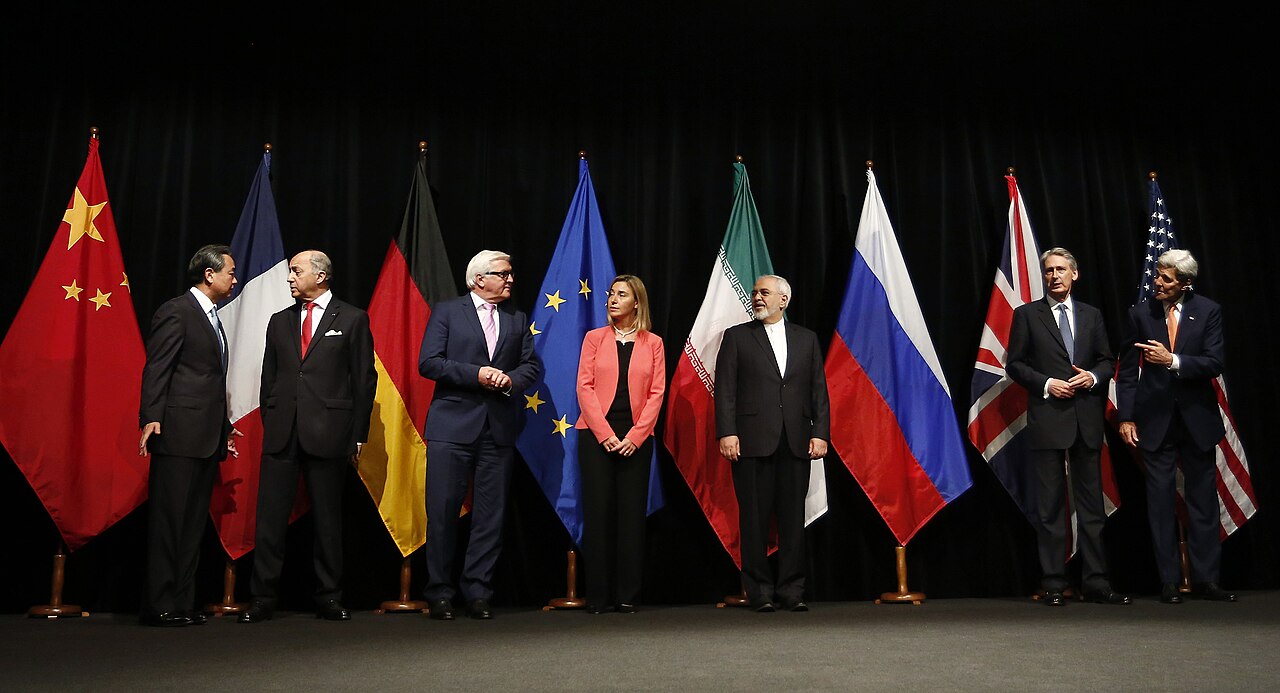
Hassan Rouhani, a cleric and veteran security official, was president of Iran from 2013 to 2021. His defining achievement was the Joint Comprehensive Plan of Action (JCPOA), the nuclear agreement signed in Vienna on 14 July 2015 with six world powers, which limited Iran’s nuclear programme in exchange for lifting sanctions. The deal brought a brief opening, but after the United States withdrew in May 2018 it unravelled, and with it much of Rouhani’s programme.
| President | Hassan Rouhani, born 1948 in Sorkheh, Semnan province; in office August 2013 to August 2021 |
|---|---|
| Elections | June 2013, about 51% (first round); May 2017, about 57% |
| Agreement | JCPOA, Vienna, 14 July 2015; endorsed by UN Security Council Resolution 2231 on 20 July 2015 |
| Parties | Iran with the P5+1 (US, UK, France, Russia, China, Germany) and the EU |
| In force | Implementation Day, 16 January 2016 |
| Persian name | برجام (Barjam), an acronym of the Persian title |

The key-holder of 2013
Rouhani had been secretary of the Supreme National Security Council for sixteen years and Iran’s chief nuclear negotiator in 2003–2005. In 2013, with the economy squeezed by sanctions and many voters still angry after 2009, he ran as a moderate. His symbol was a key, the key to Iran’s problems, and his slogan was a “government of prudence and hope”. With the support of Khatami and Rafsanjani he won in the first round with just over half the vote, and crowds celebrated in the streets.
Twenty months of negotiation
Rouhani made Mohammad Javad Zarif, a US-educated diplomat, his foreign minister and gave him charge of the talks. Leader Ali Khamenei endorsed negotiations, calling for “heroic flexibility”. In September 2013 Rouhani and President Barack Obama spoke by telephone, the first such conversation since 1979.
- 24 November 2013 Interim deal (Joint Plan of Action) in Geneva freezes parts of the programme in exchange for limited relief.
- 2 April 2015 Framework agreed in Lausanne; Tehran residents celebrate in the streets.
- 14 July 2015 The JCPOA is concluded in Vienna.
- 20 July 2015 UN Security Council Resolution 2231 endorses the deal.
- 16 January 2016 The IAEA confirms Iran has met its first obligations; sanctions relief begins. A prisoner exchange with the US takes place the same weekend.
What the deal required
The JCPOA ran to more than a hundred pages. Its main terms were:
- enrichment limited to 3.67 per cent for fifteen years, and a stockpile of no more than 300 kilograms of low-enriched uranium;
- installed centrifuges cut by about two thirds, to just over 6,000 at Natanz, with no enrichment at Fordow for fifteen years;
- the Arak reactor redesigned so it could not produce significant plutonium;
- wide IAEA inspections, including Iran’s provisional application of the Additional Protocol;
- in return, the lifting of UN nuclear sanctions and of EU and US “secondary” sanctions on oil, banking and trade, while other US sanctions stayed in place.
Several limits were due to expire after ten to fifteen years. These “sunset clauses” were one of the main targets of the deal’s critics.
Supporters and critics
Supporters, including the Obama administration and European governments, said the deal blocked Iran’s paths to a bomb for many years under the strictest inspections ever agreed. In Iran it was popular: many hoped for investment, jobs and normal ties with the world. Critics came from several directions. Israel’s prime minister Benjamin Netanyahu, who spoke against it before the US Congress in March 2015, and many US Republicans argued that it legitimised enrichment and freed money for Iran’s regional allies. Saudi Arabia was alarmed. In Iran, hard-line newspapers and politicians said Zarif had given away too much for too little.
A brief opening
After 2016 Iran’s oil exports quickly recovered, inflation fell from about 40 per cent in 2013 to around 10 per cent, and Iran Air signed deals for new Boeing and Airbus planes. European firms such as Total returned. Many promised investments never arrived, however, because banks feared remaining US sanctions, and ordinary Iranians felt little of the benefit. Rouhani was re-elected in 2017 against the conservative Ebrahim Raisi.
US withdrawal and the unravelling
On 8 May 2018 President Donald Trump announced that the United States was leaving the JCPOA, calling it a bad deal, and reimposed sanctions under a policy of “maximum pressure”. The IAEA had repeatedly reported that Iran was keeping to its commitments. Britain, France, Germany, Russia and China stayed in the deal, and the Europeans created a payment channel, INSTEX, which handled very little trade. From May 2019 Iran began to exceed the deal’s limits step by step, saying it would return to compliance if the other side did. Talks in Vienna in 2021–2022 to revive the deal came close but failed. The later history, through the 2025 snapback of UN sanctions and the wars of 2025–2026, is on Iran’s nuclear programme and sanctions on Iran.
A troubled second term
Rouhani’s second term was overshadowed by the return of sanctions, the collapse of the rial, the protests of 2017–2018 and November 2019, the downing of Flight 752 and the COVID-19 pandemic. Reformists who had backed him complained that he did little on civil rights; conservatives blamed him for trusting the West. He left office in 2021 with low approval and was succeeded by Ebrahim Raisi. In 2024 the Guardian Council barred him from standing again for the Assembly of Experts.
Persian words from this page
| برجام | Barjâm | the JCPOA |
| توافق | tavâfoq | agreement |
| مذاکره | mozâkere | negotiation |
| اعتدال | e’tedâl | moderation |
| کلید | kelid | key (Rouhani’s campaign symbol) |
| تدبیر و امید | tadbir va omid | prudence and hope |
Sources and further reading
- Joint Comprehensive Plan of Action (Vienna, 14 July 2015), annexed to UN Security Council Resolution 2231.
- IAEA, quarterly reports on verification and monitoring in Iran under Resolution 2231 (2016–2019).
- Seyed Hossein Mousavian, The Iranian Nuclear Crisis: A Memoir (Carnegie Endowment, 2012).
- Wendy R. Sherman, Not for the Faint of Heart: Lessons in Courage, Power and Persistence (PublicAffairs, 2018).
- Jay Solomon, The Iran Wars: Spy Games, Bank Battles, and the Secret Deals That Reshaped the Middle East (Random House, 2016).
Want to learn Persian? Get the free Starter Pack
Get the 14-page printable Starter Pack (all 32 letters, a 7-day reading plan, 100 core words and 20 survival phrases) and a short 5-email course. Free.
More in The Islamic Revolution and the Islamic Republic (1979–present)
- Causes of the 1979 Revolution
- Khomeini’s Return and the Fall of the Monarchy
- Ruhollah Khomeini
- The 1979 Referendum and the New Constitution
- The Iran Hostage Crisis (1979–1981)
- Power Struggles after the Revolution
- The Cultural Revolution and University Closures
- The Iran–Iraq War: Causes and Iraqi Invasion
- Khorramshahr: Fall and Liberation
- The Iran–Iraq War, 1982–1986
- The Basij and Child Soldiers in the Iran–Iraq War
- Chemical Weapons in the Iran–Iraq War
- The Tanker War and Iran Air Flight 655
- The Iran–Contra Affair
- The End of the Iran–Iraq War (1988)
- The 1988 Executions of Political Prisoners
- The Death of Khomeini and the Succession of Khamenei (1989)
- Ali Khamenei
- Rafsanjani and Post-War Reconstruction (1989–1997)
- Khatami and the Reform Era (1997–2005)
- The 1999 Student Protests (18 Tir)
- The Ahmadinejad Presidency (2005–2013)
- The 2009 Election and the Green Movement
- Iran’s Nuclear Program
- Sanctions on Iran
- Rouhani and the Nuclear Deal (JCPOA)
- The Protests of 2017–2018 and November 2019
- The Killing of Soleimani and Flight 752 (January 2020)
- Iran and the COVID-19 Pandemic
- The Raisi Presidency and His Death (2021–2024)
- The 2022 Mahsa Amini Protests: “Woman, Life, Freedom”
- Iran and Israel: From Allies to Open Conflict
- The Pezeshkian Presidency
- The Twelve-Day War of June 2025
- The Protests of Late 2025 and January 2026
- The 2026 War with the United States and Israel
- The Killing of Ali Khamenei (28 February 2026)
- Mojtaba Khamenei and the 2026 Succession
- The Iranian Diaspora
- Iran and Hezbollah
- Major Earthquakes in Modern Iran
- Iranian Cinema after 1979