Hezbollah, the Lebanese Shi’a movement and armed group, was founded in 1982 with the help of Iran’s Revolutionary Guards and has been the Islamic Republic’s closest and most powerful ally abroad ever since. Iran has supplied much of its money, weapons and training; Hezbollah has accepted the religious authority of Iran’s Supreme Leader. The partnership shaped Lebanon’s politics and the conflict with Israel for four decades, and was badly shaken by the wars of 2024–2026.
| Founded | 1982, in the Bekaa valley, Lebanon, with Revolutionary Guards support |
|---|---|
| Name | Hezbollah, “Party of God” (Persian حزبالله, hezbollâh) |
| Leaders | Subhi al-Tufayli (1989–1991), Abbas al-Musawi (1991–1992), Hassan Nasrallah (1992–2024), Naim Qassem (from October 2024) |
| Iranian support | Estimated by the US government in 2018 at about 700 million dollars a year |
| Ideology | Loyalty to velayat-e faqih, the guardianship of the Islamic jurist |
Lebanon’s Shi’a and the revolution in Iran
Ties between Iran and the Shi’a of Lebanon are centuries old: in the sixteenth century the Safavid shahs brought scholars from Jabal Amel in south Lebanon to teach Shi’ism in Iran. In the 1970s the Iranian-born cleric Musa al-Sadr organised Lebanon’s poor and marginalised Shi’a community and founded the Amal movement, before he disappeared on a visit to Libya in 1978. Many of the clerics who later led Hezbollah had studied in Najaf alongside Iranian revolutionaries.
When Israel invaded Lebanon in June 1982, revolutionary Iran saw an opportunity to export its revolution. With Syria’s permission, Iran sent a contingent of Revolutionary Guards, usually estimated at between 1,000 and 1,500 men, to the Bekaa valley, where they took over a Lebanese army barracks near Baalbek. Iran’s ambassador in Damascus, Ali Akbar Mohtashamipur, was a key organiser. The Guards trained young Lebanese Shi’a, many of them former Amal members, into the new movement.
The first decade
Hezbollah announced itself publicly in an “open letter” in February 1985, which declared obedience to Khomeini and called for the expulsion of Israel and Western forces from Lebanon. Before that, the suicide bombings of the US embassy in Beirut in April 1983 and of the US Marine and French barracks in October 1983, which killed 241 American service members and 58 French paratroopers, were claimed by a group calling itself Islamic Jihad. American courts and many governments attribute them to the network that became Hezbollah, acting with Iranian support; Hezbollah has denied responsibility. Western hostages were held in Lebanon through the 1980s, a crisis that fed into the Iran–Contra affair.
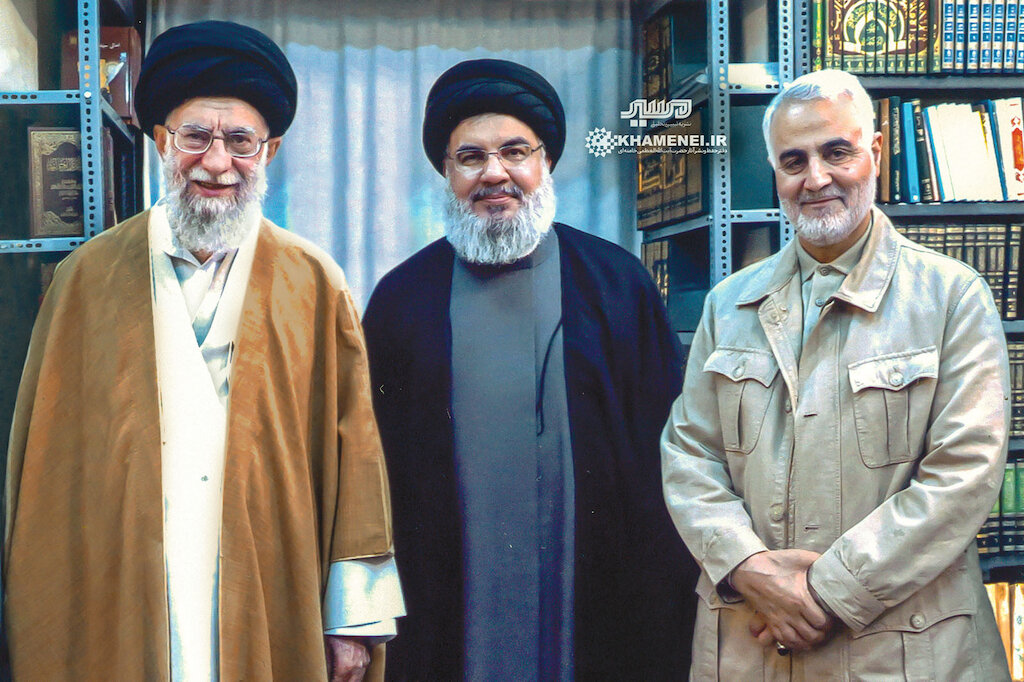

Nasrallah, resistance and politics
After Israel killed Secretary-General Abbas al-Musawi in February 1992, Hassan Nasrallah took over and led the movement for 32 years. Under him Hezbollah entered Lebanon’s parliament in 1992, built schools, hospitals and social services in Shi’a areas, and fought a long guerrilla campaign against Israel’s occupation of the south. Israel’s withdrawal in May 2000 was celebrated in Lebanon and Iran as Hezbollah’s victory. The 34-day war of 2006, in which Hezbollah withstood a heavy Israeli offensive, raised its prestige in the Arab world.
Its relationship with Iran is both ideological and material. Hezbollah’s leaders recognise the Iranian Supreme Leader as their highest religious and political authority, first Khomeini and then Ali Khamenei. In 2016 Nasrallah said openly that the group’s budget, salaries, weapons and missiles came from Iran. The Revolutionary Guards’ Quds Force, commanded from 1998 by Qasem Soleimani, managed the link, supplying rockets and later precision-guided missiles through Syria.
A regional force
From 2012 Hezbollah fighters fought in Syria in support of Bashar al-Assad, alongside Iranian forces, helping to save the government but losing many men and much of its popularity among Sunni Arabs. Hezbollah advisers also worked with Iran’s allies in Iraq and Yemen. Iran came to describe this network as the “axis of resistance”, with Hezbollah at its centre. Many Iranians resented the cost: during the 2009 protests in Tehran crowds chanted “Neither Gaza nor Lebanon, my life for Iran”, a slogan heard again in later protests.
2023–2026: decline under fire
After the Hamas attack on Israel on 7 October 2023, Hezbollah began firing at northern Israel in support of Gaza. In September 2024 Israel struck back with devastating force: thousands of pagers and radios used by Hezbollah members exploded on 17–18 September, and on 27 September an Israeli strike on Beirut killed Nasrallah together with the Iranian general Abbas Nilforoushan. His likely successor, Hashem Safieddine, was killed days later, and Naim Qassem became secretary-general in October. A ceasefire took effect on 27 November 2024. Less than two weeks later the fall of Assad in Syria cut Hezbollah’s main land supply route from Iran.
In 2025 Lebanon’s new government pressed for the state to hold a monopoly on arms. After the United States and Israel attacked Iran on 28 February 2026 and killed Ali Khamenei, Hezbollah launched rockets and drones at Israel on 1–2 March, and Israel answered with heavy strikes across Lebanon. The wider conflict is told in Iran and Israel and the 2026 war.
How the relationship is seen
For the Islamic Republic, Hezbollah is the most successful result of the revolution’s foreign policy and a deterrent against Israeli attack. Israel, the United States, the European Union (for its military wing) and many Arab states designate it a terrorist organisation. Lebanese opinion is deeply split: supporters see a resistance movement and protector of the Shi’a community, opponents see a state within the state that answers to Tehran. Scholars debate how far Hezbollah takes orders from Iran and how far it acts as a Lebanese party with its own interests; most describe a partnership in which Iran holds great influence but Hezbollah’s leaders have kept their own voice.
Persian words from this page
| حزبالله | hezbollâh | Hezbollah, “Party of God” |
| لبنان | Lobnân | Lebanon |
| مقاومت | moghâvemat | resistance |
| سپاه پاسداران | sepâh-e pâsdârân | the Revolutionary Guards |
| ولایت فقیه | velâyat-e faqih | guardianship of the jurist |
| نه غزه، نه لبنان، جانم فدای ایران | na Ghazze, na Lobnân, jânam fadâ-ye Irân | “Neither Gaza nor Lebanon, my life for Iran” |
Sources and further reading
- Augustus Richard Norton, Hezbollah: A Short History (Princeton University Press, revised edition 2014).
- H. E. Chehabi (ed.), Distant Relations: Iran and Lebanon in the Last 500 Years (I.B. Tauris, 2006).
- Matthew Levitt, Hezbollah: The Global Footprint of Lebanon’s Party of God (Georgetown University Press, 2013).
- Naim Qassem, Hizbullah: The Story from Within (Saqi, 2005).
- US Department of State, Country Reports on Terrorism (2018).
Want to learn Persian? Get the free Starter Pack
Get the 14-page printable Starter Pack (all 32 letters, a 7-day reading plan, 100 core words and 20 survival phrases) and a short 5-email course. Free.
More in The Islamic Revolution and the Islamic Republic (1979–present)
- Causes of the 1979 Revolution
- Khomeini’s Return and the Fall of the Monarchy
- Ruhollah Khomeini
- The 1979 Referendum and the New Constitution
- The Iran Hostage Crisis (1979–1981)
- Power Struggles after the Revolution
- The Cultural Revolution and University Closures
- The Iran–Iraq War: Causes and Iraqi Invasion
- Khorramshahr: Fall and Liberation
- The Iran–Iraq War, 1982–1986
- The Basij and Child Soldiers in the Iran–Iraq War
- Chemical Weapons in the Iran–Iraq War
- The Tanker War and Iran Air Flight 655
- The Iran–Contra Affair
- The End of the Iran–Iraq War (1988)
- The 1988 Executions of Political Prisoners
- The Death of Khomeini and the Succession of Khamenei (1989)
- Ali Khamenei
- Rafsanjani and Post-War Reconstruction (1989–1997)
- Khatami and the Reform Era (1997–2005)
- The 1999 Student Protests (18 Tir)
- The Ahmadinejad Presidency (2005–2013)
- The 2009 Election and the Green Movement
- Iran’s Nuclear Program
- Sanctions on Iran
- Rouhani and the Nuclear Deal (JCPOA)
- The Protests of 2017–2018 and November 2019
- The Killing of Soleimani and Flight 752 (January 2020)
- Iran and the COVID-19 Pandemic
- The Raisi Presidency and His Death (2021–2024)
- The 2022 Mahsa Amini Protests: “Woman, Life, Freedom”
- Iran and Israel: From Allies to Open Conflict
- The Pezeshkian Presidency
- The Twelve-Day War of June 2025
- The Protests of Late 2025 and January 2026
- The 2026 War with the United States and Israel
- The Killing of Ali Khamenei (28 February 2026)
- Mojtaba Khamenei and the 2026 Succession
- The Iranian Diaspora
- Iran and Hezbollah
- Major Earthquakes in Modern Iran
- Iranian Cinema after 1979