In the first eight days of January 2020 Iran and the United States came closer to open war than at any time since 1988. On 3 January a US drone strike in Baghdad killed General Qasem Soleimani, commander of the Revolutionary Guards’ Quds Force. On 8 January Iran fired missiles at US troops in Iraq, and hours later its air defences shot down a Ukrainian airliner leaving Tehran, killing all 176 people on board. Iran admitted responsibility for the crash three days later, setting off protests.
| Soleimani killed | 3 January 2020, near Baghdad International Airport, with Iraqi militia commander Abu Mahdi al-Muhandis |
|---|---|
| Iranian retaliation | 8 January 2020, ballistic missiles on Ain al-Asad air base and Erbil in Iraq |
| Flight | Ukraine International Airlines PS752, Tehran to Kyiv, Boeing 737-800 |
| Shot down | 8 January 2020, about 06:14 local time, minutes after take-off from Imam Khomeini Airport |
| Killed | 176 (167 passengers, 9 crew) |

Who Soleimani was
Qasem Soleimani was born in 1957 in a village in Kerman province and rose through the Revolutionary Guards in the war with Iraq. From the late 1990s he led the Quds Force, the branch responsible for operations abroad. He built Iran’s network of allied armed groups in Lebanon, Iraq, Syria and Yemen, and directed Iran’s role in the Syrian civil war and in the fight against the Islamic State group in Iraq. In Iran he was presented as a national hero and was popular well beyond supporters of the government. The United States held him responsible for the deaths of hundreds of American soldiers in Iraq after 2003, and many Syrians and Iraqis blamed him for brutal campaigns against civilians.
The strike in Baghdad
Tension had been building for months. In late December 2019 a rocket attack in Kirkuk killed an American contractor; US strikes then killed members of the Iraqi militia Kata’ib Hezbollah, and supporters of the militias stormed the outer compound of the US embassy in Baghdad. On the night of 3 January 2020 a US drone fired missiles at Soleimani’s convoy as it left Baghdad airport, killing him, al-Muhandis and others. President Donald Trump said Soleimani had been planning “imminent” attacks on Americans. Critics, including the UN Special Rapporteur on extrajudicial executions, Agnès Callamard, later concluded that the killing was unlawful under international law; Iraq’s parliament voted for foreign troops to leave the country.
Mourning and retaliation
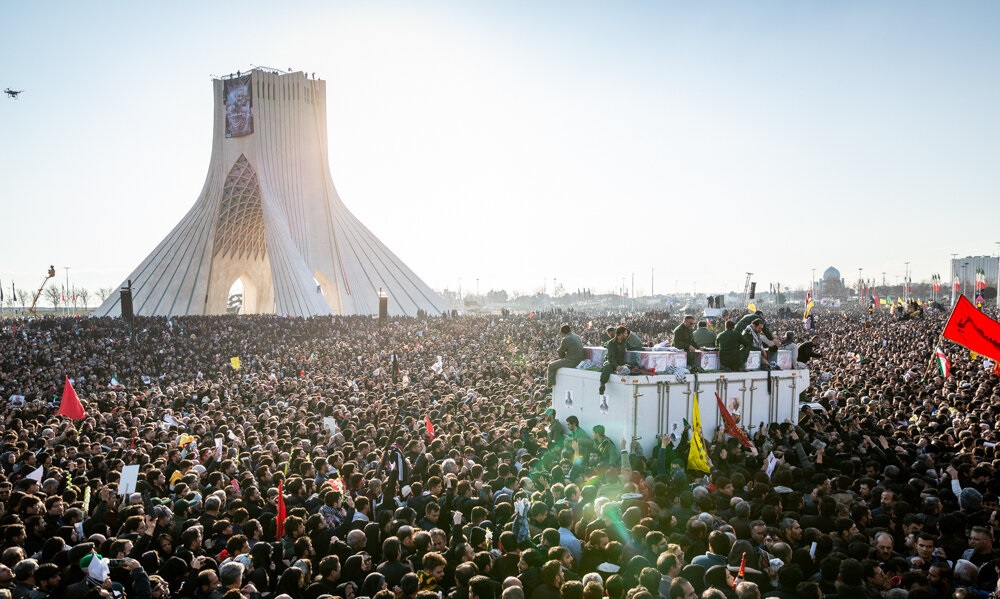
Huge funeral processions were held in Ahvaz, Mashhad, Tehran and Qom. At the burial in his home city of Kerman on 7 January, a stampede killed 56 people. Leader Ali Khamenei promised انتقام سخت (enteqam-e sakht, “harsh revenge”).
In the early hours of 8 January the Revolutionary Guards fired more than a dozen ballistic missiles at the Ain al-Asad air base and at Erbil. Iraq had been warned beforehand and no one was killed, though the US Department of Defense later said 110 service members had been treated for traumatic brain injuries. Trump announced that the United States would respond with sanctions rather than force, and the crisis eased.
Flight 752
Iran’s air defences had been put on the highest alert, braced for US retaliation, but civilian flights were allowed to continue from Tehran. Ukraine International Airlines Flight 752 took off from Imam Khomeini International Airport at about 06:12 local time. Two minutes later the operator of a Revolutionary Guards Tor-M1 missile system, misidentifying the plane as a cruise missile, fired two missiles. The aircraft caught fire and crashed near Shahedshahr, south-west of Tehran. All 176 on board died.
Most passengers were Iranian, many of them students and academics travelling back to universities in Canada after the New Year holidays, and many held dual citizenship. The airline’s manifest listed 82 Iranian, 63 Canadian, 11 Ukrainian (including the crew), 10 Swedish, 4 Afghan, 3 German and 3 British nationals; the Canadian government said 57 of the victims were Canadian citizens and 138 were travelling to Canada.
Denial, admission and protest
For three days Iranian officials rejected reports, based on Western intelligence and verified videos, that a missile had hit the plane, and attributed the crash to technical failure. On 11 January the armed forces admitted that the aircraft had been shot down “unintentionally” because of “human error”. The commander of the Guards’ aerospace force, Amir Ali Hajizadeh, said he took full responsibility.
The admission caused outrage. Students gathered at Amir Kabir University and other campuses in Tehran, crowds chanted against officials, and some refused to walk over US and Israeli flags painted on the ground. Security forces dispersed the protests. Some well-known state television presenters announced that they were quitting, saying they could no longer repeat falsehoods.
Investigations and legal cases
Iran’s Civil Aviation Organisation published its final report in March 2021. It blamed a misaligned radar, poor communication and the operator’s decision to fire without authorisation, and was criticised by Canada and Ukraine as incomplete. In December 2020 Iran announced 150,000 dollars in compensation for each victim’s family, an offer the other governments said should be decided through negotiation. A Canadian report in 2021 found no evidence the shoot-down was premeditated but held Iran fully responsible; an Ontario court, in a civil case, ruled the downing an act of terrorism. In 2023 Canada, Sweden, Ukraine and the United Kingdom took Iran to the International Court of Justice. Many victims’ families, organised in an association, say the military officials tried in Iran were low-ranking and that the truth has not been fully told.
Aftermath
The two events changed perceptions on both sides. Iran lost its most prominent general, and the IRGC’s reputation suffered at home, especially among the young educated Iranians who had lost friends on the flight. The memorial for Soleimani in Kerman was itself attacked on 3 January 2024, when two bombs claimed by the Islamic State group killed at least 95 people. For the background, see the protests of 2017–2019, Iran and Hezbollah and Iran and Israel; the year continued with the COVID-19 pandemic. An earlier shoot-down of an Iranian airliner, in 1988, is described on the Tanker War and Iran Air Flight 655.
Persian words from this page
| قاسم سلیمانی | Qâsem Soleymâni | Qasem Soleimani |
| نیروی قدس | niru-ye Qods | the Quds Force |
| سپاه پاسداران | sepâh-e pâsdârân | the Revolutionary Guards |
| انتقام سخت | enteqâm-e sakht | harsh revenge |
| هواپیما | havâpeymâ | aeroplane |
| پرواز | parvâz | flight |
Sources and further reading
- Civil Aviation Organisation of the Islamic Republic of Iran, final report on the accident to Flight PS752 (March 2021).
- Government of Canada, Forensic Examination and Assessment Team, report on the downing of Flight PS752 (2021).
- UN Human Rights Council, report of the Special Rapporteur on extrajudicial, summary or arbitrary executions, Agnès Callamard (July 2020).
- International Court of Justice, Aerial Incident of 8 January 2020 (Canada, Sweden, Ukraine and United Kingdom v. Iran), proceedings instituted July 2023.
- Arash Azizi, The Shadow Commander: Soleimani, the US, and Iran’s Global Ambitions (Oneworld, 2020).
Want to learn Persian? Get the free Starter Pack
Get the 14-page printable Starter Pack (all 32 letters, a 7-day reading plan, 100 core words and 20 survival phrases) and a short 5-email course. Free.
More in The Islamic Revolution and the Islamic Republic (1979–present)
- Causes of the 1979 Revolution
- Khomeini’s Return and the Fall of the Monarchy
- Ruhollah Khomeini
- The 1979 Referendum and the New Constitution
- The Iran Hostage Crisis (1979–1981)
- Power Struggles after the Revolution
- The Cultural Revolution and University Closures
- The Iran–Iraq War: Causes and Iraqi Invasion
- Khorramshahr: Fall and Liberation
- The Iran–Iraq War, 1982–1986
- The Basij and Child Soldiers in the Iran–Iraq War
- Chemical Weapons in the Iran–Iraq War
- The Tanker War and Iran Air Flight 655
- The Iran–Contra Affair
- The End of the Iran–Iraq War (1988)
- The 1988 Executions of Political Prisoners
- The Death of Khomeini and the Succession of Khamenei (1989)
- Ali Khamenei
- Rafsanjani and Post-War Reconstruction (1989–1997)
- Khatami and the Reform Era (1997–2005)
- The 1999 Student Protests (18 Tir)
- The Ahmadinejad Presidency (2005–2013)
- The 2009 Election and the Green Movement
- Iran’s Nuclear Program
- Sanctions on Iran
- Rouhani and the Nuclear Deal (JCPOA)
- The Protests of 2017–2018 and November 2019
- The Killing of Soleimani and Flight 752 (January 2020)
- Iran and the COVID-19 Pandemic
- The Raisi Presidency and His Death (2021–2024)
- The 2022 Mahsa Amini Protests: “Woman, Life, Freedom”
- Iran and Israel: From Allies to Open Conflict
- The Pezeshkian Presidency
- The Twelve-Day War of June 2025
- The Protests of Late 2025 and January 2026
- The 2026 War with the United States and Israel
- The Killing of Ali Khamenei (28 February 2026)
- Mojtaba Khamenei and the 2026 Succession
- The Iranian Diaspora
- Iran and Hezbollah
- Major Earthquakes in Modern Iran
- Iranian Cinema after 1979