The 1999 student protests, known in Iran as 18 Tir after the Persian date of 9 July 1999, began when police and hard-line vigilantes raided the dormitories of Tehran University after a peaceful demonstration over the closure of a reformist newspaper. The raid set off about six days of protest in Tehran and other cities, the largest unrest since the revolution up to that time. It was the first great test of President Khatami’s reform movement, and it ended with a crackdown.
| Dates | 8–13 July 1999 (17–22 Tir 1378) |
|---|---|
| Trigger | Closure of the daily Salam on 7 July and a bill to tighten the press law |
| Place | Kuy-e Daneshgah, the Tehran University dormitory complex in Amirabad, then central Tehran, Tabriz and other cities |
| Deaths | One confirmed by the state (Ezzat Ebrahimnejad); student groups and some reports put the toll higher |
| Arrests | Hundreds; some accounts give more than a thousand |

The newspaper that started it
By 1999 the press was the main battleground between reformists and conservatives (see Khatami and the reform era). Salam, a left-leaning Islamic daily, published in early July a confidential Intelligence Ministry memo that appeared to propose a tougher press law; its author was later linked to the ministry’s former deputy Saeed Emami, the alleged organiser of the chain murders. On 7 July the Special Court for the Clergy closed the paper. The same day parliament, then controlled by conservatives, gave first approval to the new press bill.
On the evening of 8 July several hundred students marched peacefully from the dormitories to protest the closure.
The night raid on the dormitories
In the early hours of 9 July, riot police and members of Ansar-e Hezbollah, a vigilante group of plain-clothes hard-liners, broke into the dormitory complex. Witnesses described attackers smashing doors, setting rooms on fire, beating students and throwing some from balconies. Many students were injured and many were detained. Ezzat Ebrahimnejad, a young man visiting the dormitories, was shot dead. Students’ accounts spoke of further deaths and disappearances, which the authorities did not confirm.
The raid shocked the country, including much of the political establishment. Leader Ali Khamenei said the attack had broken his heart and condemned it, and the Supreme National Security Council ordered an inquiry.
Six days in July
- 9 July Thousands of students gather at the university; protests begin in Tabriz and other cities.
- 10–11 July Sit-ins grow; slogans move from the press law to demands for the dismissal of the police chief and, from some protesters, attacks on the Leader himself.
- 12 July Clashes spread to central Tehran around Enqelab Street and the university; buses and shops are burned; vigilantes and police fight protesters.
- 13 July Security forces clear the streets. Khatami, who had sympathised with the students, now condemns the rioting as an attack on national security.
- 14 July The authorities stage a very large counter-rally in Tehran in support of the Leader.
The shift in the protests mattered. Many student leaders had at first asked only for justice for the raid and support for Khatami. When crowds in the streets began chanting against Khamenei, the reformist government drew back, and the protest lost its political protection. Some students felt betrayed by Khatami; his supporters argued he had no choice but to stop a confrontation the hard-liners could use against the whole reform project.
The crackdown and the trials
The arrests went on for weeks. Student activists such as Manouchehr Mohammadi were imprisoned. Ahmad Batebi became world-famous when a photograph of him holding up a friend’s bloodied T-shirt appeared on the cover of The Economist; he was sentenced to death, a sentence later reduced to a prison term. Amnesty International and Human Rights Watch reported torture and forced confessions of detained students.
By contrast, the trial of the police officers accused over the dorm raid ended in 2000 with the acquittal of the Tehran police chief and almost all of the defendants. One conscript was convicted of a minor offence, the theft of a student’s electric razor. To reformists this became a symbol of impunity.
Remembering 18 Tir
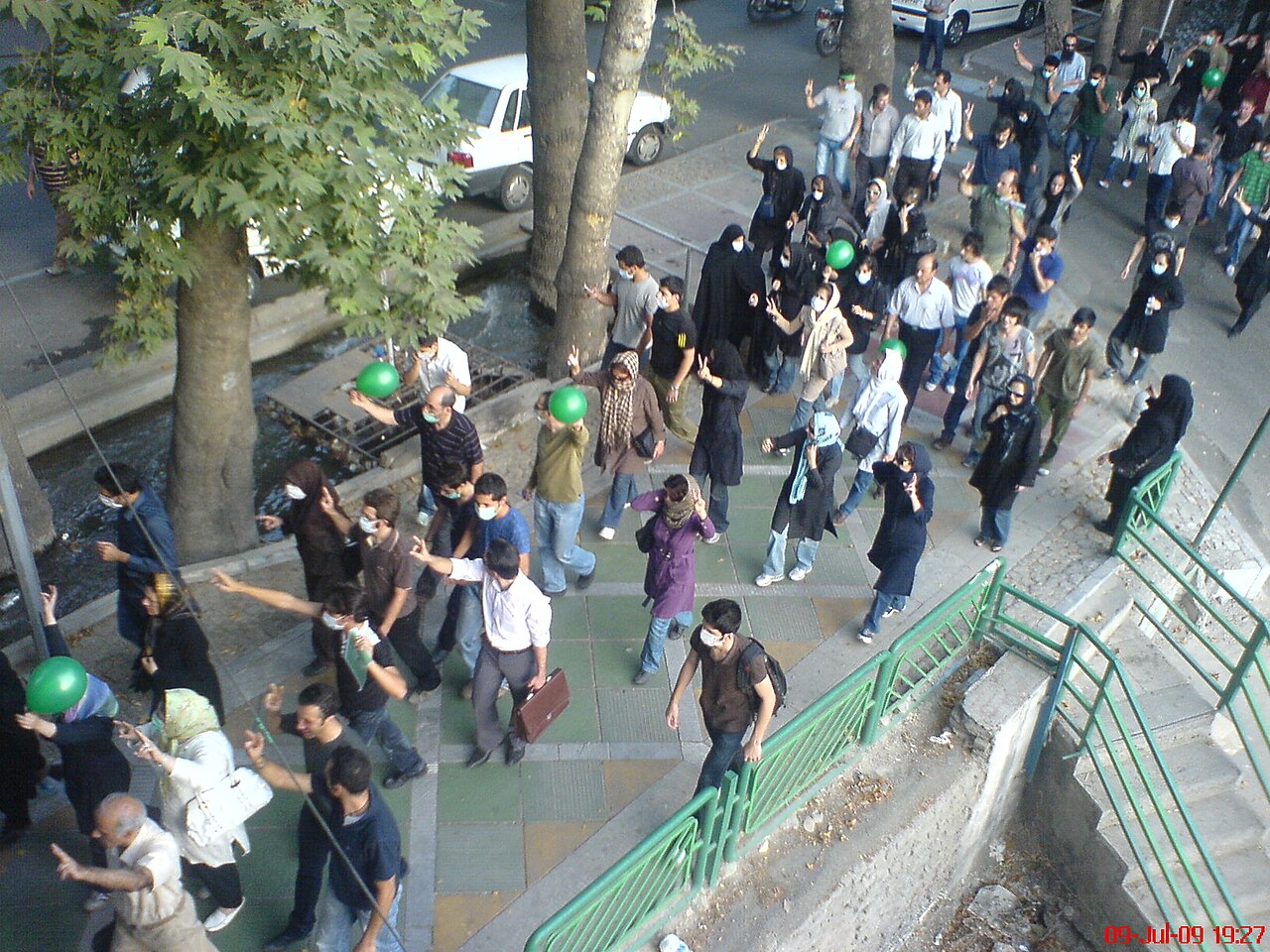
The anniversary of 18 Tir became a regular day of protest, especially in 2003 and 2009, when it merged with the Green Movement. Historians often see 1999 as the moment when the limits of change within the system became clear: unelected institutions and the security forces could stop the elected government, and the reform camp was unwilling to lead a street movement. Many of the students of 1999 later became journalists, activists, academics and political prisoners; some went into exile. For the wider pattern of protest in the Islamic Republic, see the protests of 2017–2019 and the 2022 protests.
Persian words from this page
| هجده تیر | hejdah-e Tir | 18 Tir (9 July) |
| کوی دانشگاه | Kuy-e Dâneshgâh | the university dormitory complex |
| دانشجو | dâneshju | student |
| روزنامه سلام | ruznâme-ye Salâm | the newspaper Salam |
| انصار حزبالله | Ansâr-e Hezbollâh | Ansar-e Hezbollah (vigilante group) |
| قانون مطبوعات | qânun-e matbu’ât | press law |
Sources and further reading
- Human Rights Watch, reports on Iran and the July 1999 student protests (1999–2000).
- Amnesty International, reports on detained student activists in Iran (1999–2001).
- Ali M. Ansari, Iran, Islam and Democracy: The Politics of Managing Change (2nd ed., Royal Institute of International Affairs, 2006).
- Ervand Abrahamian, A History of Modern Iran (Cambridge University Press, 2008).
- Michael Axworthy, Revolutionary Iran: A History of the Islamic Republic (Penguin, 2013).
Want to learn Persian? Get the free Starter Pack
Get the 14-page printable Starter Pack (all 32 letters, a 7-day reading plan, 100 core words and 20 survival phrases) and a short 5-email course. Free.
More in The Islamic Revolution and the Islamic Republic (1979–present)
- Causes of the 1979 Revolution
- Khomeini’s Return and the Fall of the Monarchy
- Ruhollah Khomeini
- The 1979 Referendum and the New Constitution
- The Iran Hostage Crisis (1979–1981)
- Power Struggles after the Revolution
- The Cultural Revolution and University Closures
- The Iran–Iraq War: Causes and Iraqi Invasion
- Khorramshahr: Fall and Liberation
- The Iran–Iraq War, 1982–1986
- The Basij and Child Soldiers in the Iran–Iraq War
- Chemical Weapons in the Iran–Iraq War
- The Tanker War and Iran Air Flight 655
- The Iran–Contra Affair
- The End of the Iran–Iraq War (1988)
- The 1988 Executions of Political Prisoners
- The Death of Khomeini and the Succession of Khamenei (1989)
- Ali Khamenei
- Rafsanjani and Post-War Reconstruction (1989–1997)
- Khatami and the Reform Era (1997–2005)
- The 1999 Student Protests (18 Tir)
- The Ahmadinejad Presidency (2005–2013)
- The 2009 Election and the Green Movement
- Iran’s Nuclear Program
- Sanctions on Iran
- Rouhani and the Nuclear Deal (JCPOA)
- The Protests of 2017–2018 and November 2019
- The Killing of Soleimani and Flight 752 (January 2020)
- Iran and the COVID-19 Pandemic
- The Raisi Presidency and His Death (2021–2024)
- The 2022 Mahsa Amini Protests: “Woman, Life, Freedom”
- Iran and Israel: From Allies to Open Conflict
- The Pezeshkian Presidency
- The Twelve-Day War of June 2025
- The Protests of Late 2025 and January 2026
- The 2026 War with the United States and Israel
- The Killing of Ali Khamenei (28 February 2026)
- Mojtaba Khamenei and the 2026 Succession
- The Iranian Diaspora
- Iran and Hezbollah
- Major Earthquakes in Modern Iran
- Iranian Cinema after 1979