Between 1979 and 1983 the broad coalition that overthrew the shah broke apart, and the clerics of the Islamic Republic Party (IRP), backed by Khomeini, defeated every rival: liberals, the first elected president Abolhassan Bani-Sadr, the Mojahedin-e Khalq, the secular left and dissident clergy. The decisive year was 1981, when Bani-Sadr was removed and bombings killed many of the regime’s leaders, followed by mass arrests and executions.
| Period | February 1979 to 1983 |
|---|---|
| Winning camp | Islamic Republic Party: Mohammad Beheshti, Akbar Hashemi Rafsanjani, Ali Khamenei, Mohammad-Javad Bahonar, Abdolkarim Mousavi Ardabili |
| Main losers | Mehdi Bazargan’s liberals, President Bani-Sadr, the Mojahedin-e Khalq (MEK), Fadaiyan, Tudeh Party, Grand Ayatollah Shariatmadari |
| Turning point | June 1981: MEK uprising (20 June), Bani-Sadr removed (21–22 June), IRP headquarters bombing (28 June) |
| Executions | About 8,000 opponents executed June 1981–June 1985, according to Ervand Abrahamian |
The players after February 1979
When the monarchy fell, power was spread between several centres. Mehdi Bazargan’s provisional government ran the ministries. The Revolutionary Council, mostly clerics, held real authority behind it. Local revolutionary committees, revolutionary courts under judges such as Sadegh Khalkhali, and the new Islamic Revolutionary Guard Corps (formed in May 1979) answered to Khomeini’s circle rather than the government. Bazargan complained repeatedly that the committees and courts ignored his government.
Outside the state stood an array of organised movements. The Mojahedin-e Khalq (MEK), led by Massoud Rajavi, mixed Shi’a Islam with Marxist ideas and had a large following among students. The Marxist Fadaiyan-e Khalq and the pro-Soviet Tudeh Party competed on the left. Kurdish parties fought government forces in the north-west from 1979. Grand Ayatollah Kazem Shariatmadari and his Muslim People’s Republican Party spoke for many in Azerbaijan who disliked rule by the jurist. The embassy seizure of November 1979 brought down Bazargan and shifted the balance towards the clerics.
Bani-Sadr against the Islamic Republic Party
In January 1980 Abolhassan Bani-Sadr, a French-educated economist who had been with Khomeini in Paris, won the first presidential election with about three-quarters of the vote. He was a religious modernist with his own ideas on Islamic economics and no party machine. The IRP, organised by Ayatollah Mohammad Beheshti, won control of the first Majlis in the spring and forced Bani-Sadr to accept its candidate, Mohammad-Ali Rajai, as prime minister in August 1980.
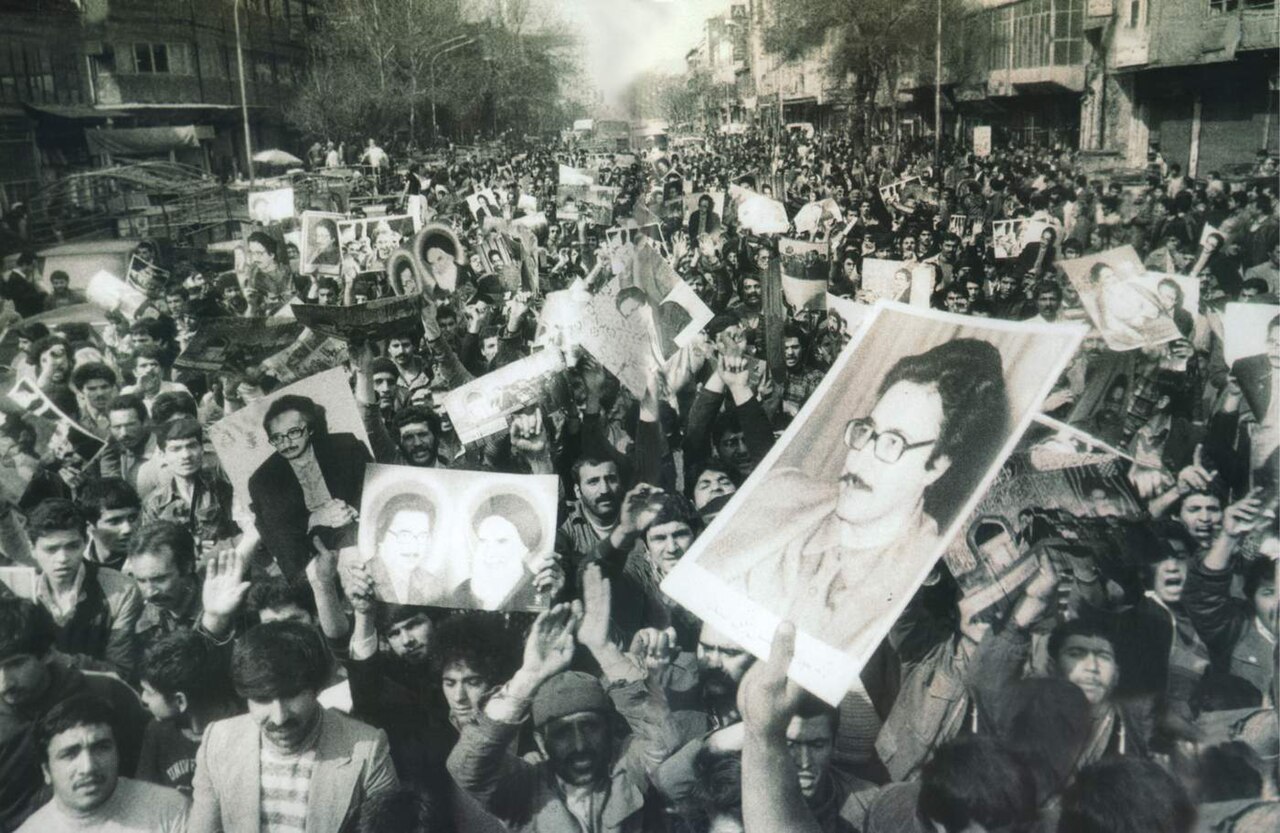

The war with Iraq, which began in September 1980, deepened the rift. Khomeini made Bani-Sadr acting commander-in-chief, and the president sided with the regular army against the Revolutionary Guards. He complained publicly about torture in prisons and attacks on his rallies by Hezbollahi street groups. His newspaper Enqelab-e Eslami was closed in June 1981. Shaul Bakhash, in The Reign of the Ayatollahs, describes how the IRP used parliament, the courts and Khomeini’s authority to strip the president of power step by step.
June 1981
On 20 June 1981 the MEK called mass demonstrations in Tehran in support of Bani-Sadr. Revolutionary Guards fired on the crowds, and the MEK announced armed struggle against the regime. The next day the Majlis declared Bani-Sadr politically incompetent, and Khomeini dismissed him on 22 June. Bani-Sadr went into hiding and in late July escaped to France with Rajavi aboard an air force jet. He lived in exile near Paris until his death in 2021.
On 28 June 1981 (7 Tir 1360) a bomb exploded at the IRP headquarters in Tehran during a party meeting. Seventy-four people were killed, among them Beheshti, then head of the judiciary, along with ministers and members of parliament. A day earlier Ali Khamenei had been badly injured, losing the use of his right hand, when a bomb hidden in a tape recorder went off as he spoke at a Tehran mosque. On 30 August a second bomb, at the prime minister’s office, killed Rajai, who had been elected president in July, and his prime minister Bahonar. The authorities blamed the MEK for these attacks; the organisation did not formally claim the 7 Tir bombing, and some details remain disputed.
- November 1979 Bazargan’s government resigns after the embassy seizure
- January 1980 Bani-Sadr elected president
- August 1980 Rajai becomes prime minister against Bani-Sadr’s wishes
- 20 June 1981 MEK demonstrations; the group turns to armed struggle
- 21–22 June 1981 Bani-Sadr declared incompetent and dismissed
- 28 June 1981 Bombing of the IRP headquarters (7 Tir)
- 30 August 1981 President Rajai and Prime Minister Bahonar killed
- October 1981 Ali Khamenei elected president; Mir-Hossein Mousavi becomes prime minister
- 1983 Tudeh leaders arrested and the party banned
Terror and counter-terror
The months after June 1981 were among the most violent in modern Iranian history. The MEK assassinated hundreds of officials, clerics and supporters of the government. The state answered with mass arrests and executions, often after brief trials, and published lists of those executed in the newspapers, including teenagers. Amnesty International reported thousands of executions in 1981 and 1982. The historian Ervand Abrahamian puts the number at about 8,000 opponents executed between June 1981 and June 1985, most of them MEK members, a toll far higher than the number killed during the revolution itself.
The government calls the MEK monafeqin, “hypocrites”, and holds it responsible for the deaths of thousands of Iranians in this period. The MEK, for its part, regards its dead as martyrs of the resistance. Its later alliance with Saddam Hussein’s Iraq, where it moved its forces in 1986, cost it much of its support inside Iran.
The rest of the field is cleared
Other rivals fell in turn. The National Front, which had called a rally against new Islamic punishment laws in June 1981, was denounced by Khomeini and banned. Sadegh Ghotbzadeh, a former foreign minister, was executed in 1982 for plotting a coup, and Grand Ayatollah Shariatmadari, accused of knowing about the plot, was stripped of his rank as a source of emulation, an unprecedented step against a senior jurist. The Tudeh Party and the Fadaiyan majority, which had supported the government against the MEK, were crushed in 1983, and Tudeh leaders confessed on television to spying for the Soviet Union. Abrahamian argues that these televised confessions became a defining tool of the Islamic Republic.
By 1983 power lay with a clerical leadership around Khomeini: President Khamenei, Majlis speaker Rafsanjani and Prime Minister Mousavi. Bazargan’s Freedom Movement survived, tolerated but marginal. Supporters of the outcome argue that the Islamic Republic survived a violent armed uprising and foreign invasion at the same time. Critics, including human-rights organisations and historians such as Abrahamian and Bakhash, describe the consolidation as the replacement of a revolutionary coalition by one-party clerical rule. Its sequel in the universities is told in the Cultural Revolution, and its darkest later chapter in the 1988 executions.
Persian words from this page
| حزب جمهوری اسلامی | Hezb-e Jomhuri-ye Eslâmi | Islamic Republic Party |
| مجاهدین خلق | Mojâhedin-e Khalq | People’s Mojahedin |
| منافقین | monâfeqin | “hypocrites”, the state’s name for the MEK |
| سپاه پاسداران | Sepâh-e Pâsdârân | Revolutionary Guards |
| رئیسجمهور | ra’is-jomhur | president |
| هفت تیر | haft-e Tir | 7 Tir, the date of the 1981 bombing |
Sources and further reading
- Shaul Bakhash, The Reign of the Ayatollahs: Iran and the Islamic Revolution (Basic Books, 1984)
- Ervand Abrahamian, The Iranian Mojahedin (Yale University Press, 1989)
- Ervand Abrahamian, Tortured Confessions: Prisons and Public Recantations in Modern Iran (University of California Press, 1999)
- Michael Axworthy, Revolutionary Iran: A History of the Islamic Republic (Allen Lane, 2013)
- Amnesty International, annual reports on Iran, 1981–1983
Want to learn Persian? Get the free Starter Pack
Get the 14-page printable Starter Pack (all 32 letters, a 7-day reading plan, 100 core words and 20 survival phrases) and a short 5-email course. Free.
More in The Islamic Revolution and the Islamic Republic (1979–present)
- Causes of the 1979 Revolution
- Khomeini’s Return and the Fall of the Monarchy
- Ruhollah Khomeini
- The 1979 Referendum and the New Constitution
- The Iran Hostage Crisis (1979–1981)
- Power Struggles after the Revolution
- The Cultural Revolution and University Closures
- The Iran–Iraq War: Causes and Iraqi Invasion
- Khorramshahr: Fall and Liberation
- The Iran–Iraq War, 1982–1986
- The Basij and Child Soldiers in the Iran–Iraq War
- Chemical Weapons in the Iran–Iraq War
- The Tanker War and Iran Air Flight 655
- The Iran–Contra Affair
- The End of the Iran–Iraq War (1988)
- The 1988 Executions of Political Prisoners
- The Death of Khomeini and the Succession of Khamenei (1989)
- Ali Khamenei
- Rafsanjani and Post-War Reconstruction (1989–1997)
- Khatami and the Reform Era (1997–2005)
- The 1999 Student Protests (18 Tir)
- The Ahmadinejad Presidency (2005–2013)
- The 2009 Election and the Green Movement
- Iran’s Nuclear Program
- Sanctions on Iran
- Rouhani and the Nuclear Deal (JCPOA)
- The Protests of 2017–2018 and November 2019
- The Killing of Soleimani and Flight 752 (January 2020)
- Iran and the COVID-19 Pandemic
- The Raisi Presidency and His Death (2021–2024)
- The 2022 Mahsa Amini Protests: “Woman, Life, Freedom”
- Iran and Israel: From Allies to Open Conflict
- The Pezeshkian Presidency
- The Twelve-Day War of June 2025
- The Protests of Late 2025 and January 2026
- The 2026 War with the United States and Israel
- The Killing of Ali Khamenei (28 February 2026)
- Mojtaba Khamenei and the 2026 Succession
- The Iranian Diaspora
- Iran and Hezbollah
- Major Earthquakes in Modern Iran
- Iranian Cinema after 1979