The Achaemenid kings and their satraps built walled parks and gardens across the empire, places of fruit trees, water channels, pavilions and hunting grounds. The Iranian word for such an enclosure passed into Greek as paradeisos and, through the Greek Bible, became the English word “paradise”. The earliest Persian royal garden whose plan survives is Cyrus’s at Pasargadae, laid out in the 540s–530s BCE.

From “walled enclosure” to “paradise”
The word goes back to an Old Iranian compound meaning “wall around”. It is found in the Avesta as pairi-daēza, “enclosure”, and scholars reconstruct an Old Persian form *paridaida (the asterisk marks a form not directly attested). The Elamite tablets from Persepolis write it as partetaš, used for estates where fruit trees were grown and workers drew rations.
Greeks met these parks in Asia Minor and wrote the word as paradeisos; Xenophon, around 400 BCE, is the first writer to use it often. In Hebrew it became pardes: the book of Nehemiah mentions Asaph, “keeper of the king’s pardes“, who was to supply timber. When Jewish scholars translated the Bible into Greek in the 3rd and 2nd centuries BCE, they used paradeisos for the Garden of Eden, and from there it entered Latin and the languages of Europe. Persian itself has the word twice: فردوس (ferdows), borrowed back through Arabic firdaws, and پردیس (pardis), a modern revival of the old form.
Cyrus’s garden at Pasargadae
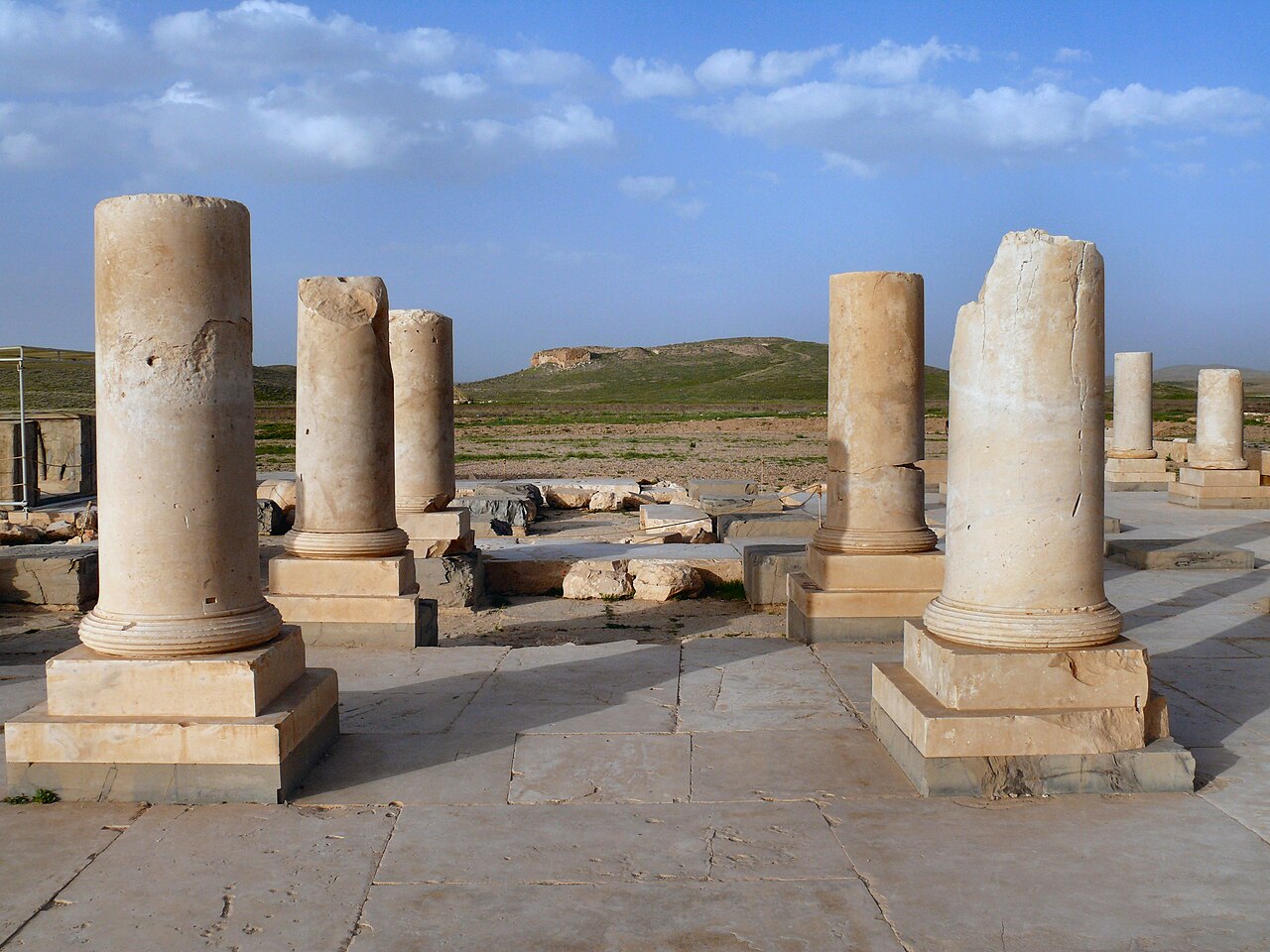
At Pasargadae the palaces were not enclosed in a fortified city but spread across a park. In front of the Private Palace, excavations led by David Stronach between 1961 and 1963 found stone water channels running in straight lines, with small square basins at regular intervals. Stronach reconstructed a rectangular garden divided into four parts by these channels, viewed from a throne position in the palace portico, and argued that this was the ancestor of the later Persian chahar bagh, the “fourfold garden”.
Later survey work, especially by Rémy Boucharlat and his team in the 2000s, has questioned the fourfold layout and suggested that the irrigated park was much larger and less symmetrical than once thought. Whatever its exact design, Pasargadae shows that from the very beginning of the empire, controlling water and arranging trees and buildings together was part of how a Persian king displayed his power.
Parks of the satraps in Greek accounts
Most descriptions come from Xenophon, who served with Cyrus the Younger and knew these parks at first hand. At Celaenae in Phrygia, he says, Cyrus had a palace and a large park full of wild animals, which he hunted on horseback, and the river Maeander rose inside it. In Syria the army passed the park of the satrap Belesys, a large and beautiful park full of the produce of every season, which Cyrus cut down and burned.
The best-known scene is in Xenophon’s Oeconomicus. The Spartan commander Lysander visited Cyrus at Sardis and admired his garden: the trees planted at equal distances in straight rows, the scents in the air. When he praised the man who had measured it out, Cyrus said he had designed it himself and planted some of the trees with his own hands. Lysander, looking at the prince’s fine clothes and jewellery, could hardly believe it, and Cyrus swore by Mithra that he never sat down to dinner without first working up a sweat at war or farming.
The king as gardener
Such stories fit a wider royal ideology. A Persian king was expected to make the land fertile, and planting trees was a royal virtue. Herodotus tells that Xerxes, marching through Lydia in 480 BCE, found a plane tree so beautiful that he decorated it with gold and left one of his Immortals to guard it. A Greek inscription records a letter of Darius praising his official Gadatas for planting fruit trees from beyond the Euphrates in Asia Minor, though some historians think the text is a later forgery.
The parks also had practical uses. They produced fruit, timber and game, served as stations on the royal roads, and provided training grounds where nobles hunted together, the hunt being one of the main settings of court life. The tablets show gardens attached to royal estates being supplied and staffed like any other part of the economy, a reminder that the paradise was a working landscape as well as a symbol. For the record-keeping behind them, see the Persepolis Fortification tablets.
What the gardens left behind
The idea of the walled garden with running water and shade trees outlived the Achaemenids by more than two thousand years. It passed through Sasanian and Islamic Iran into the Safavid gardens of Isfahan and the Mughal gardens of India. In 2011 UNESCO inscribed nine Iranian gardens together as The Persian Garden, with Pasargadae as the oldest. The later story is told on the Persian garden through history, and two of the best-known examples have their own pages: Fin Garden in Kashan and Eram Garden in Shiraz.
Persian words from this page
| باغ | bâgh | garden |
| پردیس | pardis | paradise, park |
| فردوس | ferdows | paradise |
| چهارباغ | chahâr bâgh | fourfold garden |
| درخت | derakht | tree |
| پاسارگاد | Pâsârgâd | Pasargadae |
Sources and further reading
- Xenophon, Oeconomicus 4.20–25; Anabasis 1.2.7 and 1.4.10.
- Herodotus, Histories 7.31; Nehemiah 2:8.
- David Stronach, Pasargadae: A Report on the Excavations Conducted by the British Institute of Persian Studies from 1961 to 1963 (1978).
- UNESCO World Heritage Centre, The Persian Garden.
- Pierre Briant, From Cyrus to Alexander: A History of the Persian Empire (2002), on royal paradises.
Want to learn Persian? Get the free Starter Pack
Get the 14-page printable Starter Pack (all 32 letters, a 7-day reading plan, 100 core words and 20 survival phrases) and a short 5-email course. Free.
More in The Achaemenid Empire (550–330 BCE)
- Achaemenes, Teispes and the Early Persian Kings of Anshan
- Cyrus the Great: Birth, Legends and Rise to Power
- Cyrus Conquers Lydia: Croesus and the Battle of Thymbra
- The Persian Conquest of Ionia and Asia Minor
- Cyrus Takes Babylon (539 BCE)
- The Cyrus Cylinder
- Cyrus and the Return of the Jews
- The Death of Cyrus and the Massagetae
- Pasargadae: Cyrus’s Capital and Tomb
- The Tomb of Cyrus through History
- Cambyses II
- Cambyses Conquers Egypt: The Battle of Pelusium
- Bardiya and Gaumata: The Usurper Question
- Darius the Great Takes the Throne
- The Great Revolts of 522–521 BCE
- The Behistun Inscription
- The Persian Conquest of the Indus Valley
- Darius’s Scythian Campaign
- Darius’s Canal from the Nile to the Red Sea
- Darius’s Reforms: Satrapies, Taxes and Law
- The Royal Road and the Persian Postal System
- The Daric: Achaemenid Coinage and Economy
- The Ionian Revolt (499–493 BCE)
- The Greco-Persian Wars: An Overview
- Mardonius and the First Persian Expedition to Greece (492 BCE)
- The Battle of Marathon (490 BCE)
- The Death of Darius I and the Succession of Xerxes
- The Royal Tombs of Naqsh-e Rostam
- Xerxes I: King of Kings (486–465 BCE)
- Xerxes’ Invasion of Greece (480–479 BCE)
- The Battle of Thermopylae (480 BCE)
- The Battle of Artemisium (480 BCE)
- The Persian Capture of Athens (480–479 BCE)
- The Battle of Salamis (480 BCE)
- The Battle of Plataea and the End of the Invasion (479 BCE)
- The Palace of Darius at Susa
- Building Persepolis: How Darius and Xerxes Built Parsa
- The Persepolis Fortification and Treasury Tablets
- Herodotus and the Persians
- The Apadana Reliefs: Nations Bringing Gifts
- The Achaemenid Paradise Gardens
- The Persian Immortals and the Achaemenid Army
- The Achaemenid Navy
- Religion of the Achaemenid Kings
- Women of the Achaemenid Court
- Old Persian Language and Cuneiform
- Egypt under Persian Rule
- Babylon under Persian Rule
- Artaxerxes I
- The Peace of Callias
- Darius II and the Peloponnesian War
- Famous Satraps of the Persian Empire
- Artaxerxes II Mnemon
- Cyrus the Younger and the Battle of Cunaxa
- The King’s Peace (387 BCE)
- The Great Satraps’ Revolt
- Artaxerxes III and the Reconquest of Egypt
- Darius III, the Last Achaemenid King
- The Battle of the Granicus (334 BCE)
- The Battle of Issus (333 BCE)
- Alexander Takes Tyre, Gaza and Egypt (332 BCE)
- The Battle of Gaugamela (331 BCE)
- Ariobarzanes and the Battle of the Persian Gate
- The Burning of Persepolis (330 BCE)
- The Death of Darius III and Bessus
- The Legacy of the Achaemenid Empire