The Maranjab Desert (کویر مرنجاب) is a stretch of sand dunes, salt flats and scrub on the southern edge of the Dasht-e Kavir, about an hour’s drive north-east of Kashan in Isfahan province. Its landmark is a fortified caravanserai built in 1603 under Shah Abbas I, which still stands beside a sweet-water well and makes the desert one of the easiest in Iran to visit overnight.
| Persian name | Kavir-e Maranjab |
|---|---|
| Location | Northern part of Aran o Bidgol county, Isfahan province; edge of the Dasht-e Kavir basin |
| Nearest towns | Aran o Bidgol and Kashan |
| Landscape | Sand dunes (the Band-e Rig sand sea), salt pans, a seasonal salt lake, tamarisk and saxaul scrub |
| Main monument | Maranjab caravanserai, 1603 (reign of Shah Abbas I) |
| Best season | Mid-autumn to mid-spring |

A desert on Kashan’s doorstep
Most of Iran’s great deserts are a long way from anywhere. Maranjab is the exception. The road leaves Aran o Bidgol, the twin town just north of Kashan, and runs out across flat, pale ground until the first dunes rise on the horizon. The last part is a graded dirt track that ordinary cars usually manage in dry weather, which is one reason Maranjab became the standard “first desert” for visitors staying in Kashan.
The desert sits on the southern rim of the Dasht-e Kavir, the huge salt basin of central Iran. North of the caravanserai the ground drops to a salt lake that is usually a hard white crust and only after rain becomes a sheet of shallow water. When it floods, a low rise in the middle stands out as an island; locals call it the Wandering Island (جزیره سرگردان, Jazire-ye Sargardan), because in the heat shimmer it seems to drift.
How the landscape works
Maranjab is a mix of three desert types, and part of the fun of a visit is seeing how close together they are.
Sand dunes
The Band-e Rig dunes lie at roughly 800 to 1,000 metres above sea level. Wind piles the sand into crescent and linear ridges, some reported to reach about 70 metres. The sand is fine and soft, so climbing even a modest dune for sunset is hard work.
Salt flats
Where groundwater rises close to the surface and evaporates, salt crystallises into polygon patterns that crack and curl as they dry. The edges of these flats look solid but can hide wet mud below the crust, which is why drivers keep to known tracks.
Desert scrub
Between the dunes and the salt, plants adapted to salty, dry soil hold the ground: tamarisk (گز, gaz), saxaul (تاغ, tâgh) planted in belts to stop sand reaching farmland, camel thorn and saltworts. Lizards, desert foxes and birds of prey are the animals you are most likely to notice, usually as tracks in the morning sand.
The caravanserai of Shah Abbas
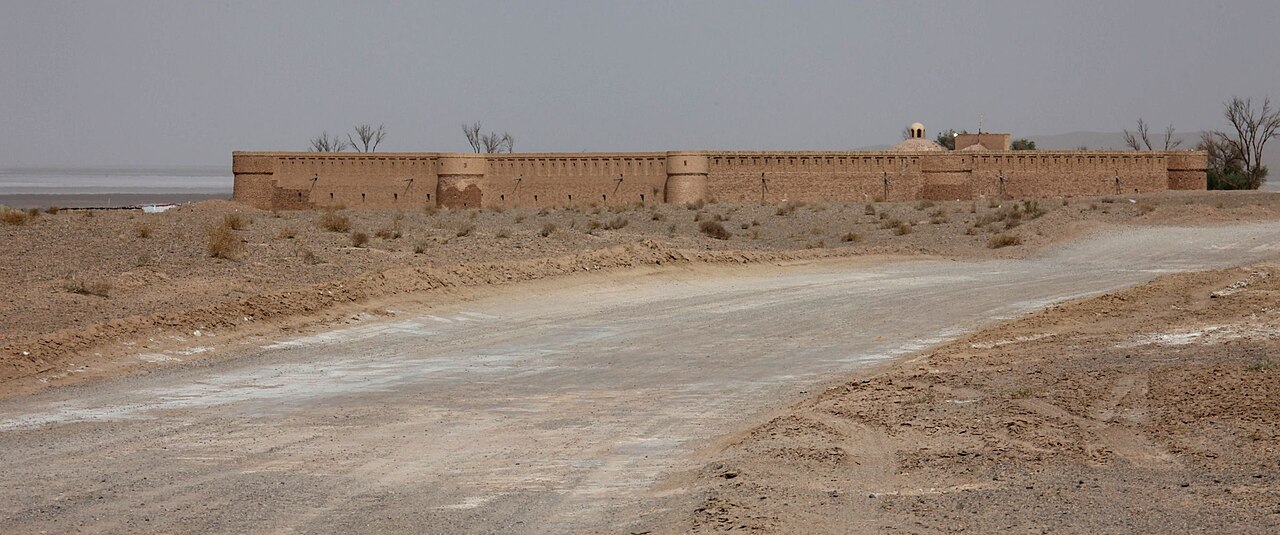
The caravanserai was built in 1603, in the reign of Shah Abbas I, on a route that crossed the desert between Kashan and the north. It is a square courtyard building of roughly 3,500 square metres with 29 rooms around the yard, thick walls, corner towers and a single gateway that could be closed at night. Caravans of camels and mules arrived, unloaded in the courtyard, and slept in the arched rooms or the stables behind them.
What made the site possible is water. About five kilometres east is a well whose water is drinkable even though the ground around it is salty: rain soaks through the sand, which filters it, and the fresh water floats on the heavier brine below. Travellers had good reason to call the place a refuge. The building has been restored and today works as basic desert lodging, so it is still doing roughly the job it was built for.
Maranjab is one stop in a network of hundreds of roadside inns across Iran. The page on Persian caravanserais explains how they were planned and which ones UNESCO listed in 2023, and the story of the ruler behind this one is on Shah Abbas the Great.
What to see and do
- Sunset from the dunes. The low sun turns the sand orange and shows every ripple. Walk a little away from the parked cars to get clean sand.
- The salt lake. In a dry season you can walk out on the crust near the shore; after rain the flooded flat mirrors the sky.
- The caravanserai courtyard. Look at the brick vaults of the rooms, the raised platforms where travellers slept, and the view from the roof if it is open.
- Night sky. Away from the lights of Kashan the stars are very clear on a moonless night, and winter nights are long.
- Qanats. On the drive in, the lines of mounds across the plain mark qanat shafts; Aran o Bidgol county has more than 1,600 kilometres of these underground channels.
Practical notes and safety
Come between mid-autumn and mid-spring. Summer days are dangerously hot, while winter nights can drop below freezing, so bring warm layers even if the afternoon was mild. Most people visit on a tour or with a local driver from Kashan; this is sensible, because the tracks branch and phone coverage is unreliable.
- Carry more water than you think you need, sun protection and a torch.
- Do not drive onto salt flats or dunes without an experienced local driver and a suitable vehicle; cars sink through the crust and get stuck in soft sand.
- Tell someone where you are going and when you expect to be back.
- Take your rubbish out. Visitor numbers have grown fast and litter and off-road driving are damaging the dunes and scrub.
- Check current access, lodging and opening arrangements locally, and follow your own government’s travel advice for Iran.
Maranjab pairs well with a stay in Kashan and its historic houses. If you want bigger dunes with a village atmosphere, compare the Varzaneh Desert south-east of Isfahan; for desert on a truly extreme scale, see the Dasht-e Lut. The wider picture of Iran’s deserts and mountains is on Geography of Iran.
Persian words from this page
| کویر | kavir | salt desert |
| کاروانسرا | kârvânsarâ | caravanserai |
| تپه شنی | tappe-ye sheni | sand dune |
| نمک | namak | salt |
| چاه | châh | well |
| قنات | qanât | underground water channel |
| جزیره سرگردان | jazire-ye sargardân | the Wandering Island |
Sources and further reading
- “Maranjab Desert”, Wikipedia (with references to Iranian survey literature), consulted 2026.
- Encyclopaedia Iranica, “Caravansary” (M.-Y. Kiani and W. Kleiss), iranicaonline.org.
- UNESCO World Heritage Centre, “The Persian Caravanserai”, whc.unesco.org/en/list/1668.
Want to learn Persian? Get the free Starter Pack
Get the 14-page printable Starter Pack (all 32 letters, a 7-day reading plan, 100 core words and 20 survival phrases) and a short 5-email course. Free.
More in Top Places to Visit in Iran
- Naqsh-e Jahan Square
- Shah (Imam) Mosque, Isfahan
- Sheikh Lotfollah Mosque
- Ali Qapu Palace
- Jameh Mosque of Isfahan
- Si-o-se Pol and Khaju Bridge
- Vank Cathedral
- Hasht Behesht Palace
- Naqsh-e Rostam
- Eram Garden, Shiraz
- Nasir al-Molk (Pink) Mosque
- Tomb of Hafez (Hafezieh)
- Tomb of Saadi (Saadieh)
- Shah Cheragh Shrine
- Arg of Karim Khan
- Fin Garden, Kashan
- Historic Houses of Kashan
- Jameh Mosque of Yazd
- Yazd Fire Temple and Towers of Silence
- Dowlatabad Garden and Windcatcher
- Amir Chakhmaq Complex
- Golestan Palace
- National Museum of Iran
- Treasury of National Jewels
- Tehran Grand Bazaar
- Milad Tower
- Imam Reza Shrine, Mashhad
- Tomb of Ferdowsi, Tus
- Tomb of Omar Khayyam, Neyshabur
- Tomb of Avicenna, Hamadan
- Ganjnameh Inscriptions, Hamadan
- Behistun (Bisotun): Visiting the Site
- Taq-e Bostan: Visiting the Site
- Tabriz Historic Bazaar
- Takht-e Soleyman
- Armenian Monastic Ensembles of Iran
- Sheikh Safi al-Din Shrine, Ardabil
- Dome of Soltaniyeh
- Alamut Castle
- Falak-ol-Aflak Castle
- Shushtar Historical Hydraulic System
- Chogha Zanbil: Visiting the Ziggurat
- Susa Archaeological Site
- Arg-e Bam
- Ganjali Khan Complex, Kerman
- Shazdeh Garden, Mahan
- Rayen Castle
- Dasht-e Lut (Lut Desert)
- Maranjab Desert and Caravanserai
- Varzaneh Desert
- Mount Damavand
- Hyrcanian Forests
- Lake Urmia
- Badab-e Surt Springs
- Ali Sadr Cave
- The Kaluts of Shahdad
- Qeshm Geopark
- Hormuz Island Colours
- Visiting Persepolis: A Day Trip from Shiraz
- Visiting Pasargadae
- Persian Caravanserais
- The Qanat of Gonabad
- Meymand Village
- Sasanian Sites of Fars: Firuzabad, Bishapur and Sarvestan
- Gonbad-e Qabus: Visiting the Tower
- Zayandeh Rud and Isfahan’s Bridges
- Tochal and Darband: Hiking Above Tehran
- Mount Sabalan
- Skiing in Iran: Dizin and Shemshak
- Golestan National Park