The Battle of Avarayr was fought on 26 May 451 CE between Armenian Christian rebels led by Vardan Mamikonian and the army of the Sasanian king Yazdegerd II, on a plain that lies today in West Azerbaijan province of Iran. The Persians won and Vardan was killed, but Armenians remember the battle as a moral victory: within a generation Iran confirmed their right to remain Christian.
| Date | 26 May 451 CE |
|---|---|
| Place | Avarayr plain, near modern Churs, West Azerbaijan province, Iran |
| Armenian side | Vardan Mamikonian, with nobles loyal to the church |
| Sasanian side | Commander Mushkan Niusalavurt; Armenian nobles under Vasak of Siunik |
| Numbers | Elishe gives 66,000 Armenians against a far larger Persian army with elephants; figures unreliable |
| Result | Sasanian victory; Vardan and, by tradition, 1,036 companions killed |
| Long-term outcome | Religious freedom for Armenia confirmed in the Treaty of Nvarsak (484) |
Sources: an Armenian story
Almost everything known about Avarayr comes from two Armenian historians writing within a few decades of the event: Elishe, whose History of Vardan and the Armenian War is a passionate account of martyrdom, and Ghazar Parpetsi, who wrote around 500 and was close to the Mamikonian family. The Persian and Arabic histories that depend on the Sasanian royal chronicle do not mention the battle at all. For the court at Ctesiphon it was a provincial rising; for Armenians it became a founding story. Both views should be kept in mind.
The road to revolt
Since the division of Armenia around 387 (see Shapur III and the partition of Armenia), the larger eastern part had been under Persian rule, and from 428 it was governed by a Sasanian marzban. Its great families were Christian and had their own church and, since about 405, their own alphabet.
Yazdegerd II wanted firmer loyalty. According to Elishe, his minister Mihr-Narseh sent the Armenian nobles a letter urging them to accept the Zoroastrian faith. A council of bishops and nobles, meeting in 449, replied that they would obey the king in everything except religion. Yazdegerd then summoned the leading nobles to court. Under pressure, they agreed to convert, and returned home with Zoroastrian priests to set up fire temples.
The conversion did not hold. When the priests began their work in 450, people and clergy rose against them, and the nobles, led by Vardan Mamikonian, the commander of the Armenian forces, joined the rising. Churches were reopened and fire temples attacked. The rebels sent for help to the Roman emperor Marcian, who refused: he had just made peace with Persia and was facing Attila’s Huns.
A divided nobility
The Armenians were not united. Vasak of Siunik, who held the office of marzban, at first joined the rebels but then went over to the Persians with a number of nobles. Elishe makes him the traitor of the story, and the name became a byword in Armenian. Modern historians see a more ordinary political choice: Vasak may have judged that the revolt could not succeed without Roman help and tried to save his house.

The battle on the Avarayr plain
In spring 451 a Sasanian army under Mushkan Niusalavurt marched into Armenia, with cavalry, infantry and war elephants, and with Vasak’s Armenians at its side. Vardan met it on the plain of Avarayr, by the small river Tghmut, in the district of Artaz in the south-east of historic Armenia.
Elishe gives the Armenians 66,000 men and says the Persians were three times as many. These numbers are far too high for the logistics of the time and should be read as part of the story’s moral contrast, the few faithful against the many. What does seem clear is that the Armenians fought hard, that their charge broke into the Persian ranks, and that the elephants and the larger Persian army decided the day. Vardan was killed with, according to the tradition, 1,036 of his companions. Persian losses were also heavy: the Armenian tradition puts them at 3,544.
After the battle
Defeat in the field did not end the resistance. Surviving rebels withdrew to mountain fortresses and fought on for years. The Persians arrested leading clerics, including the catholicos Hovsep, and in 454 a group of Armenian priests known as the Leontians, after Ghevond (Leontius), was executed in the east of the empire, where Armenian captives had been taken. Vasak was later disgraced and, according to Elishe, died in prison.
Yazdegerd did not push the conversion further, and his successors moved toward compromise. Between 481 and 484 Vardan’s nephew Vahan Mamikonian led a new revolt. After the death of King Peroz fighting the Hephthalites in 484, his successor Balash, short of troops and money, agreed the Treaty of Nvarsak, which guaranteed Armenian freedom of worship and removed fire temples from Armenia. Vahan was later made marzban. In that sense Avarayr lost the battle but won the war.
Memory and meaning
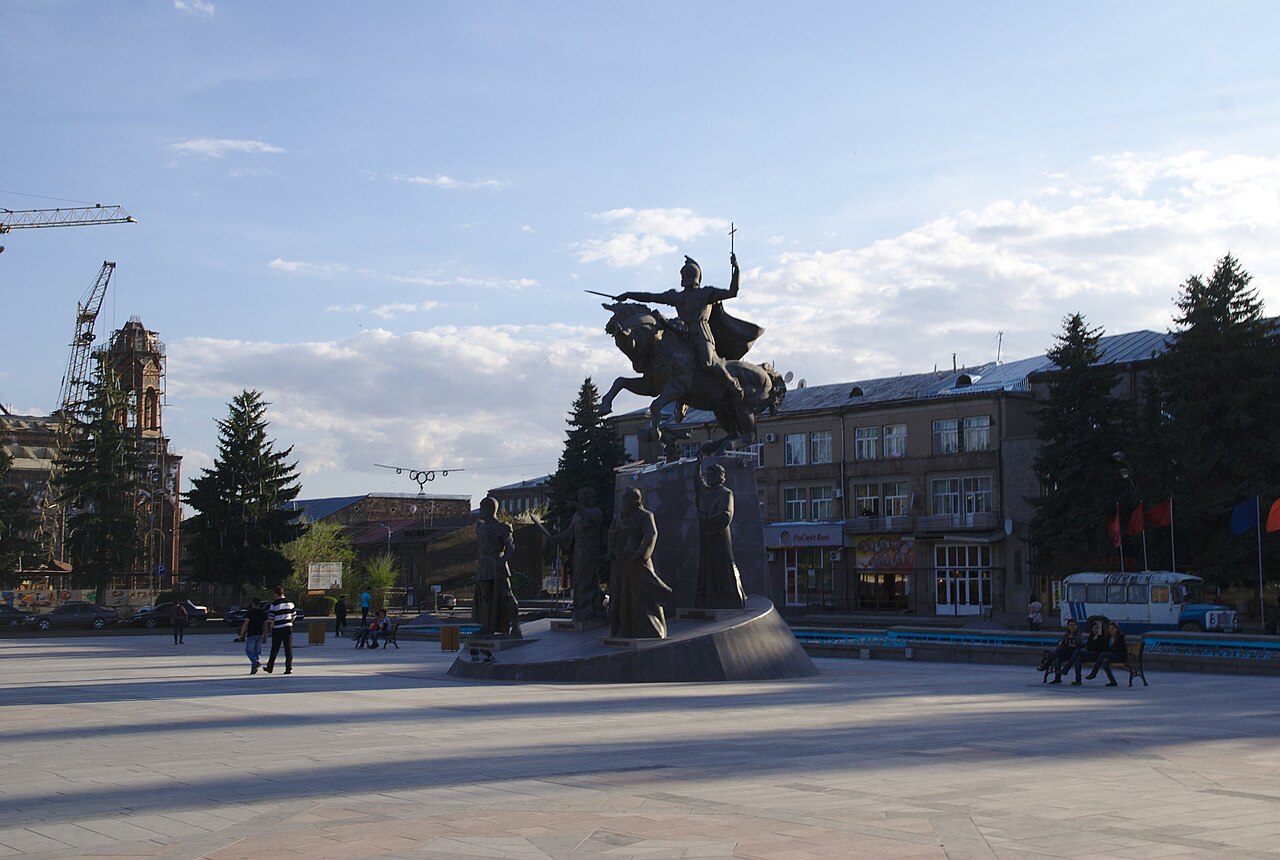
The Armenian Apostolic Church honours Vardan and his companions as saints, and the feast of Vardanants is kept on the Thursday before Lent. For Armenians Avarayr became a model of resistance for faith, and Vardan is a national hero, with memorials in Yerevan, Gyumri and elsewhere.
From the Iranian side, the episode shows the limits of Sasanian religious policy. Persia could win a battle against a provincial rising, but it could not make a whole Christian nobility Zoroastrian, and it learned to rule Armenia through compromise. The wider history of Christians under the Sasanians is told in Christians in the Sasanian Empire, and Peroz’s fatal war in Peroz I and the Hephthalite disaster.
Persian words from this page
| ارمنی | armani | Armenian |
| آتشکده | âtashkade | fire temple |
| فیل | fil | elephant |
| مرزبان | marzbân | frontier governor |
| آذربایجان غربی | Âzarbâyjân-e Gharbi | West Azerbaijan province |
| مسیحی | masihi | Christian |
Sources and further reading
- Elishe, History of Vardan and the Armenian War, trans. R. W. Thomson (1982)
- Ghazar Parpetsi, History of the Armenians, trans. R. W. Thomson (1991)
- Encyclopaedia Iranica, “Avarayr” (iranicaonline.org)
- R. G. Hovannisian (ed.), The Armenian People from Ancient to Modern Times, vol. 1 (1997)
- Touraj Daryaee, “Yazdegerd II”, Encyclopaedia Iranica (iranicaonline.org)
Want to learn Persian? Get the free Starter Pack
Get the 14-page printable Starter Pack (all 32 letters, a 7-day reading plan, 100 core words and 20 survival phrases) and a short 5-email course. Free.
More in The Sasanian Empire (224–651 CE)
- The Origins of the Sasanian Family
- Ardashir I, Founder of the Sasanian Empire
- Firuzabad: Ardashir’s Round City
- Shapur I, King of Kings of Iran and Non-Iran
- Bishapur: Shapur’s City
- The Battle of Edessa and the Capture of Valerian
- The Ka’ba-ye Zartosht Inscription of Shapur I
- Mani and Manichaeism
- Hormizd I and Bahram I
- Kartir and the Zoroastrian Church
- Bahram II
- Narseh and the Peace of Nisibis
- Shapur II the Great
- Julian’s Invasion of Persia (363)
- Christians in the Sasanian Empire
- Shapur III and the Partition of Armenia
- Yazdegerd I
- Bahram V Gur
- Yazdegerd II
- The Battle of Avarayr (451)
- The Hephthalites and Iran’s Eastern Frontier
- Peroz I and the Hephthalite Disaster
- Kavad I
- Zamasp and Kavad’s Return
- Mazdak and the Mazdakite Movement
- Khosrow I Anushirvan the Just
- The Sasanian–Byzantine Wars of the 6th Century
- The Battle of Dara (530)
- Khosrow I Sacks Antioch (540)
- The Lazic War (541–562)
- The Reforms of Khosrow I
- The Academy of Gondishapur: History and Legend
- Borzuya, Chess and Kalila wa Dimna
- Taq Kasra: The Arch of Ctesiphon
- The Sasanian Conquest of Yemen
- The Sasanians and the Western Turks
- Hormizd IV
- Bahram Chobin’s Rebellion
- Khosrow II Parviz
- The Last Great War: Byzantium and Persia, 602–628
- The Siege of Constantinople (626)
- Heraclius Strikes Back
- Shirin: Queen and Legend
- Shahrbaraz, the General Who Became King
- Civil War and the Queens Boran and Azarmidokht
- Yazdegerd III, the Last Sasanian King
- The Sasanian Army
- Sasanian Society and the Class System
- Zoroastrianism under the Sasanians
- Sasanian Art: Silver, Reliefs and Silk
- The Sasanian Reliefs of Naqsh-e Rostam
- Taq-e Bostan
- Sasanian Cities, Palaces and Bridges
- Middle Persian (Pahlavi) Language and Literature
- Sasanian Coins and Silverwork
- Women in the Sasanian Empire
- Polo, Hunting and Games at the Sasanian Court
- The Sasanian Legacy