Shapur III, son of Shapur II, ruled the Sasanian Empire from 383 to 388 CE. His short reign is remembered for one lasting settlement: the division of the kingdom of Armenia between Persia and Rome, usually dated to 387, which left the larger, eastern part of the country under Sasanian control and ended a century of fighting over who would choose Armenia’s kings.
| King | Shapur III, r. 383–388 CE |
|---|---|
| Predecessor | Ardashir II (r. 379–383), deposed by the nobles |
| Partition | c. 387 (some scholars argue for 384), with Theodosius I |
| Persian share | About four-fifths of Armenia, including Artashat and Dvin (“Persarmenia”) |
| Roman share | A western strip toward Erzurum and the upper Euphrates |
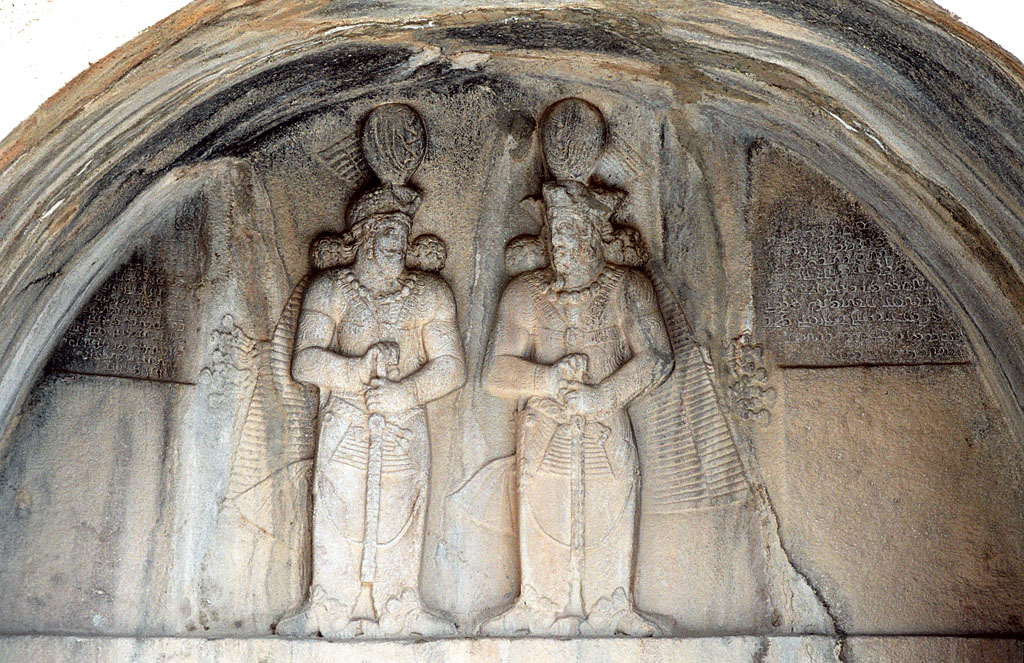
| Monument | Small grotto at Taq-e Bostan with Shapur II and Shapur III |
| Successor | Bahram IV (r. 388–399) |
After Shapur the Great
Shapur II died in 379 after a seventy-year reign that had broken Roman power in Armenia and won back the eastern provinces lost by Narseh (see Shapur II the Great). His successors were weaker. His half-brother Ardashir II ruled for four years. Arabic histories say he was deposed because he tried to curb the great nobles. The nobility now emerged as kingmakers, a role they would play for the rest of the dynasty.
The throne then passed to Shapur III. Al-Tabari says he was welcomed because the crown had returned to a son of Shapur II, and that he promised in his accession speech to tolerate no deceit or greed at court.
Armenia between two empires
Armenia had been the main prize between Rome and Iran since the Parthian period. Its kings belonged to the Arsacid house, a branch of the old Parthian royal family, and its great noble families, the nakharars, could switch sides when it suited them. Christianity, adopted by the Armenian court in the early 4th century, tied many of them to Rome.
The treaty of 363, which ended Julian’s war, had obliged Rome to stop protecting Armenia. Shapur II then imprisoned King Arshak II, but Rome kept backing his son Pap, and the dispute stayed open. After Pap was murdered on Roman orders around 374–375, Armenia was ruled by a series of weak kings under the control of the general Manuel Mamikonian. By the early 380s the country had two child kings, Arshak III and his brother, and a nobility divided between the two empires.
The division of about 387
When Armenian nobles turned against Arshak III, Shapur III’s forces entered the country and he crowned a rival Arsacid, Khosrov IV, giving him his sister Zurvandukht in marriage, according to Armenian tradition. Arshak III withdrew west to the district of Acilisene under Roman protection. Rather than fight, the two empires agreed to divide the kingdom.
The emperor Theodosius I had good reason to accept. In 378 the Goths had destroyed a Roman army at Adrianople and killed the emperor Valens, and the Balkans still needed every soldier. Persia, with a new king and restless nobles, also wanted peace.
No text of the treaty survives, and the date is reconstructed from Armenian and Roman writers. Most scholars place it in 387; some prefer 384 or a two-stage settlement. The line ran roughly from the region of Erzurum south toward Mush. Persia received by far the larger part, the eastern and central lands with the old capital Artashat and the growing city of Dvin. Rome kept a western strip. Each half kept an Arsacid king for the time being.

What followed in each half
Roman Armenia
Arshak III died around 389, and Rome did not appoint a successor. The western part was absorbed into the Roman provincial system, at first under local princes and later under Roman officials. The fortress-city of Theodosiopolis, modern Erzurum, became its anchor.
Persian Armenia
In the larger eastern part, Arsacid kings ruled under Sasanian supervision for another forty years. Khosrov IV was soon removed by Shapur’s successor Bahram IV and replaced by his brother Vramshapuh (c. 389–414). Under Vramshapuh, the cleric Mesrop Mashtots created the Armenian alphabet, around 405, which gave the Armenian church its own scriptures. In 428, at the request of Armenian nobles, Bahram V removed the last king, Artashes IV, and Persarmenia was governed by a marzban, a Sasanian frontier governor. The next crisis there, over religion, led to the Battle of Avarayr in 451.
Shapur III at Taq-e Bostan
Shapur III’s most visible legacy is in stone. At Taq-e Bostan, near Kermanshah, he had a small barrel-vaulted grotto cut into the cliff. On its back wall two crowned kings stand side by side, each resting his hands on a long sword. Middle Persian inscriptions beside them name them as Shapur II and his son Shapur III. It is the first Sasanian relief set inside a vaulted recess like an iwan, a form later enlarged in the great grotto attributed to Khosrow II. See Taq-e Bostan for the whole site.
A violent death
Shapur III died in 388. The Arabic histories say that nobles cut the ropes of a great tent he had set up in a palace courtyard, so that it collapsed on him. Whether it was an accident or a murder, his death fits the pattern of these years: kings were made and unmade by the high nobility. He was followed by his son Bahram IV, and then by Yazdegerd I.
How historians see the partition
Older writers sometimes compared it to the partitions of Poland, the end of an independent Armenia. Modern historians stress continuity as well: the nobles kept their lands, the Armenian church grew stronger, and the division set a boundary that, with changes, lasted until the 6th century. For Iran, it was a quiet success. Without a battle, the Sasanians gained most of what Shapur II had fought for.
Persian words from this page
| شاپور سوم | Shâpur-e sevvom | Shapur III |
| ارمنستان | Armanestân | Armenia |
| مرزبان | marzbân | frontier governor |
| طاق بستان | Tâq-e Bostân | Taq-e Bostan |
| کرمانشاه | Kermânshâh | Kermanshah |
| ایوان | eyvân | vaulted hall open at one end |
Sources and further reading
- P’awstos Buzand (Faustus of Byzantium), History of the Armenians, Book 6
- Al-Tabari, The History of al-Tabari, vol. 5, trans. C. E. Bosworth (1999)
- Encyclopaedia Iranica, entries on Shapur III and Armenia and Iran (iranicaonline.org)
- R. G. Hovannisian (ed.), The Armenian People from Ancient to Modern Times, vol. 1 (1997)
- Geoffrey Greatrex and Samuel N. C. Lieu, The Roman Eastern Frontier and the Persian Wars, Part II, AD 363–630 (2002)
Want to learn Persian? Get the free Starter Pack
Get the 14-page printable Starter Pack (all 32 letters, a 7-day reading plan, 100 core words and 20 survival phrases) and a short 5-email course. Free.
More in The Sasanian Empire (224–651 CE)
- The Origins of the Sasanian Family
- Ardashir I, Founder of the Sasanian Empire
- Firuzabad: Ardashir’s Round City
- Shapur I, King of Kings of Iran and Non-Iran
- Bishapur: Shapur’s City
- The Battle of Edessa and the Capture of Valerian
- The Ka’ba-ye Zartosht Inscription of Shapur I
- Mani and Manichaeism
- Hormizd I and Bahram I
- Kartir and the Zoroastrian Church
- Bahram II
- Narseh and the Peace of Nisibis
- Shapur II the Great
- Julian’s Invasion of Persia (363)
- Christians in the Sasanian Empire
- Shapur III and the Partition of Armenia
- Yazdegerd I
- Bahram V Gur
- Yazdegerd II
- The Battle of Avarayr (451)
- The Hephthalites and Iran’s Eastern Frontier
- Peroz I and the Hephthalite Disaster
- Kavad I
- Zamasp and Kavad’s Return
- Mazdak and the Mazdakite Movement
- Khosrow I Anushirvan the Just
- The Sasanian–Byzantine Wars of the 6th Century
- The Battle of Dara (530)
- Khosrow I Sacks Antioch (540)
- The Lazic War (541–562)
- The Reforms of Khosrow I
- The Academy of Gondishapur: History and Legend
- Borzuya, Chess and Kalila wa Dimna
- Taq Kasra: The Arch of Ctesiphon
- The Sasanian Conquest of Yemen
- The Sasanians and the Western Turks
- Hormizd IV
- Bahram Chobin’s Rebellion
- Khosrow II Parviz
- The Last Great War: Byzantium and Persia, 602–628
- The Siege of Constantinople (626)
- Heraclius Strikes Back
- Shirin: Queen and Legend
- Shahrbaraz, the General Who Became King
- Civil War and the Queens Boran and Azarmidokht
- Yazdegerd III, the Last Sasanian King
- The Sasanian Army
- Sasanian Society and the Class System
- Zoroastrianism under the Sasanians
- Sasanian Art: Silver, Reliefs and Silk
- The Sasanian Reliefs of Naqsh-e Rostam
- Taq-e Bostan
- Sasanian Cities, Palaces and Bridges
- Middle Persian (Pahlavi) Language and Literature
- Sasanian Coins and Silverwork
- Women in the Sasanian Empire
- Polo, Hunting and Games at the Sasanian Court
- The Sasanian Legacy