Mazdak was a religious leader in late 5th- and early 6th-century Iran whose followers, the Mazdakites, preached that wealth and women should be shared rather than hoarded by the powerful. Linked in the sources with King Kavad I, the movement shook the Sasanian social order until it was crushed, probably around 528, by Kavad and his son Khosrow I. Almost everything we know about it comes from its enemies, and historians still argue about what it really taught.
| Period | Late 5th century to c. 528 CE (dates disputed) |
|---|---|
| Leader | Mazdak, son of Bamdad, in the Persian and Arabic tradition |
| Earlier founder | A Zoroastrian priest named Zaradusht, son of Khurragan, from Fasa in Fars, according to later sources |
| Royal patron | Kavad I, at least in his first reign |
| Suppressed by | Kavad I and Prince Khosrow (later Khosrow I) |
| Later echoes | The Khurramis (Khorramdinan) of early Islamic Iran |
A movement known through its enemies
No Mazdakite book survives. Our information comes from three groups of writers, none of them friendly. Contemporary Byzantine and Syriac authors, such as Procopius and the chronicle attributed to Joshua the Stylite, mention that Kavad introduced a law or revived a sect that held “women in common”, but they do not name Mazdak. The Persian royal tradition, compiled under Khosrow I and his successors, told the story from the point of view of the king who destroyed the sect. Muslim writers of the 9th to 12th centuries, including al-Tabari, Ferdowsi, Nizam al-Mulk and the theologian al-Shahrastani, reworked that tradition and added detail of their own.
The result is a story of a dangerous heretic, written by the winners. Modern historians agree on this much; they disagree on almost everything else.
What the Mazdakites believed
The religious ideas reported for the movement come mostly from later Muslim authors on sects. They describe a dualist faith, close to Zoroastrianism and perhaps influenced by Manichaeism, in which the world was a mixture of light and darkness. Light acted by free will and knowledge, darkness by blind chance, and the task of the believer was to help light prevail. Some accounts add that the Mazdakites avoided killing and eating animals.
The social teaching is what made the movement famous. According to al-Tabari, Mazdak taught that God had placed the means of life on earth for all to share equally, and that people had wronged one another by seizing more than their share. The remedy was to take from the rich and give to the poor. The sources say this applied to women as well as to property, which in the setting of the time meant breaking open the large households and harems of the aristocracy. Whether this was really “communism”, a call for the redistribution of wealth, or a narrower attack on aristocratic polygamy and inheritance is one of the main questions in the debate.

Mazdak and Kavad
The Persian tradition says Mazdak won the favour of Kavad I during his first reign (488–496) and that the king allowed his followers to seize grain stores and the property of the rich. The nobles and priests deposed Kavad in 496, and the tradition connects his fall to his support for the sect.
Why would a king back such a movement? Many historians, following Arthur Christensen and later Ehsan Yarshater, see a political calculation. The crown had been weakened by the great noble houses after the death of Peroz in 484, and the country was suffering after war and famine. A movement that attacked aristocratic wealth and the huge households through which noble families kept their power could serve a king who wanted to rule them.
The end of the sect
After his return to power around 498, Kavad turned away from the Mazdakites. The movement became tied to the succession struggle at court, apparently backing his eldest son Kawus against Khosrow. Late in the reign, probably around 528, the king summoned the Mazdakite leaders to a meeting, said by the tradition to be a religious debate with the Zoroastrian priests. There they were seized and killed.
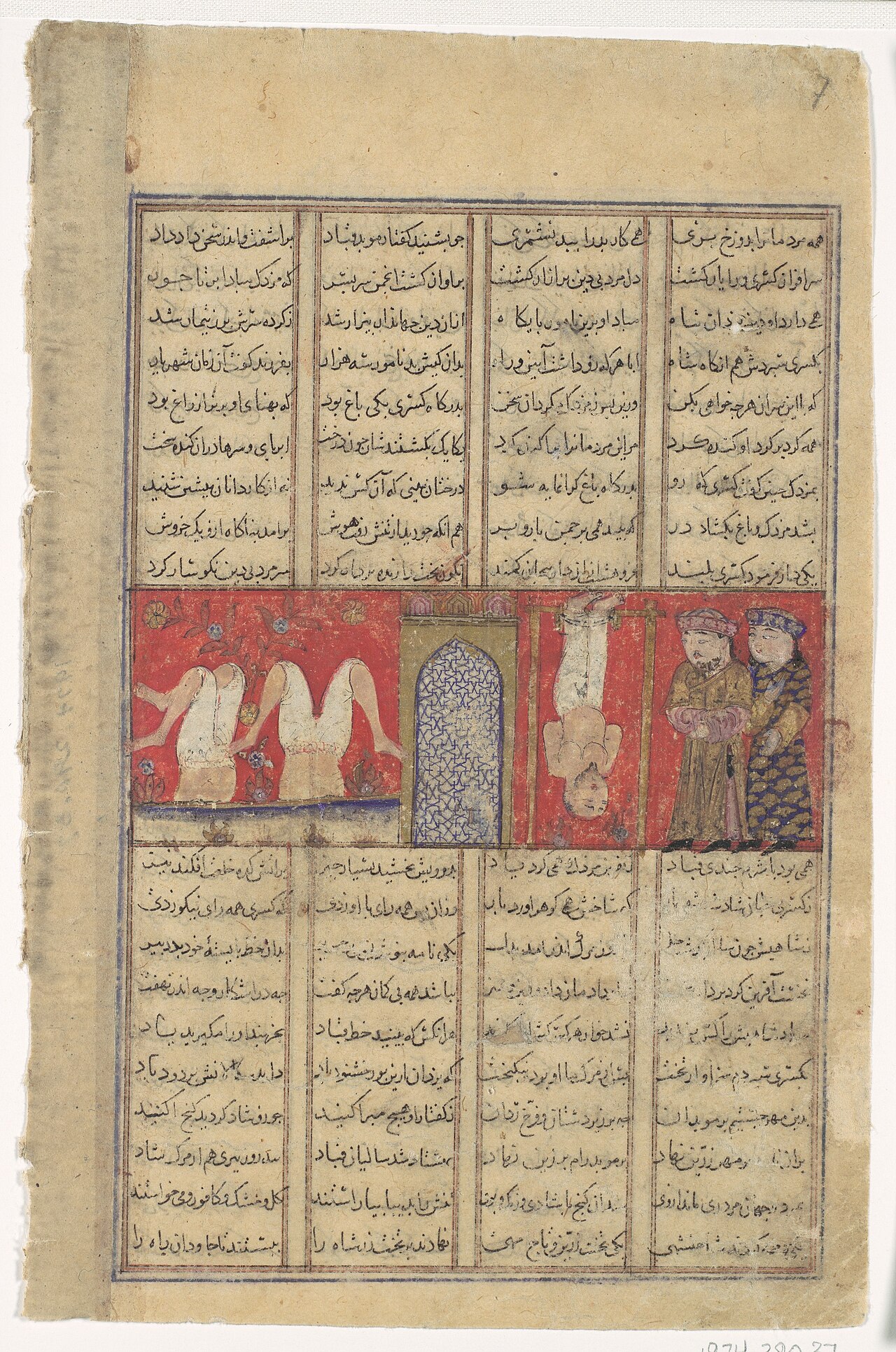
Ferdowsi’s version has become the best known. Khosrow had the Mazdakites buried head-down in a walled garden with their feet in the air, then invited Mazdak to view his “garden”, where he was hanged and shot with arrows. The image is a literary punishment, and its numbers and details cannot be trusted, but there is no doubt that the movement was destroyed by force. Its suppression became part of the legend of Khosrow as the “just king” who restored order to society.
Where historians disagree
Was there one movement or two?
Patricia Crone, in an influential article of 1991, pointed out that the sources contemporary with Kavad’s first reign speak of Kavad’s own heresy but never of Mazdak. She argued that Kavad’s reforms in the 490s and the popular revolt led by Mazdak were separate events, and that the revolt belongs to the end of Kavad’s reign or the beginning of Khosrow’s. The later Persian tradition, on this view, merged the two to blame the king’s earlier policy on a heretic.
Did Mazdak exist?
The German historian Heinz Gaube went further and asked whether Mazdak was a historical person at all, or a figure created later to give a face to the movement. Most scholars accept that he existed, but the doubt shows how thin the evidence is.
Religious reform or social revolt?
Some historians read the movement mainly as a radical Zoroastrian reform, others as a protest of the poor against the nobility in a time of hardship, and others as a royal tool. These readings are not exclusive, and the sources do not allow a firm choice.
After Mazdak
The ideas survived the massacre. In early Islamic Iran, groups known as the Khurramis or Khorramdinan were described by Muslim writers as heirs of Mazdak, and they played a part in the revolts that followed the death of Abu Muslim and in the long rising of Babak Khorramdin. In the 11th century Nizam al-Mulk used the story of Mazdak in his Siyasatnama as a warning against heresy. In the 20th century some Iranian writers recast Mazdak as an early social reformer. Each age has read him in its own way, which is itself a sign of how little the original movement can be pinned down.
For the religious background, see Zoroastrianism under the Sasanians and Mani and Manichaeism.
Persian words from this page
| مزدک | Mazdak | Mazdak |
| مزدکیان | Mazdakiân | the Mazdakites |
| بامداد | Bâmdâd | Bamdad, Mazdak’s father; also “dawn” |
| خرمدینان | Khorramdinân | the Khurramis |
| سیاستنامه | Siyâsatnâmeh | Book of Government |
| باغ | bâgh | garden |
Sources and further reading
- Al-Tabari, The History of al-Tabari, vol. V, trans. C. E. Bosworth (SUNY Press, 1999).
- Ferdowsi, Shahnameh, reign of Qobad and Kesra Nushin-ravan; English translation by Dick Davis (Penguin, 2006).
- Patricia Crone, “Kavād’s Heresy and Mazdak’s Revolt”, Iran 29 (1991), pp. 21–42.
- Patricia Crone, The Nativist Prophets of Early Islamic Iran (Cambridge University Press, 2012).
- Ehsan Yarshater, “Mazdakism”, in The Cambridge History of Iran, vol. 3(2) (1983).
Want to learn Persian? Get the free Starter Pack
Get the 14-page printable Starter Pack (all 32 letters, a 7-day reading plan, 100 core words and 20 survival phrases) and a short 5-email course. Free.
More in The Sasanian Empire (224–651 CE)
- The Origins of the Sasanian Family
- Ardashir I, Founder of the Sasanian Empire
- Firuzabad: Ardashir’s Round City
- Shapur I, King of Kings of Iran and Non-Iran
- Bishapur: Shapur’s City
- The Battle of Edessa and the Capture of Valerian
- The Ka’ba-ye Zartosht Inscription of Shapur I
- Mani and Manichaeism
- Hormizd I and Bahram I
- Kartir and the Zoroastrian Church
- Bahram II
- Narseh and the Peace of Nisibis
- Shapur II the Great
- Julian’s Invasion of Persia (363)
- Christians in the Sasanian Empire
- Shapur III and the Partition of Armenia
- Yazdegerd I
- Bahram V Gur
- Yazdegerd II
- The Battle of Avarayr (451)
- The Hephthalites and Iran’s Eastern Frontier
- Peroz I and the Hephthalite Disaster
- Kavad I
- Zamasp and Kavad’s Return
- Mazdak and the Mazdakite Movement
- Khosrow I Anushirvan the Just
- The Sasanian–Byzantine Wars of the 6th Century
- The Battle of Dara (530)
- Khosrow I Sacks Antioch (540)
- The Lazic War (541–562)
- The Reforms of Khosrow I
- The Academy of Gondishapur: History and Legend
- Borzuya, Chess and Kalila wa Dimna
- Taq Kasra: The Arch of Ctesiphon
- The Sasanian Conquest of Yemen
- The Sasanians and the Western Turks
- Hormizd IV
- Bahram Chobin’s Rebellion
- Khosrow II Parviz
- The Last Great War: Byzantium and Persia, 602–628
- The Siege of Constantinople (626)
- Heraclius Strikes Back
- Shirin: Queen and Legend
- Shahrbaraz, the General Who Became King
- Civil War and the Queens Boran and Azarmidokht
- Yazdegerd III, the Last Sasanian King
- The Sasanian Army
- Sasanian Society and the Class System
- Zoroastrianism under the Sasanians
- Sasanian Art: Silver, Reliefs and Silk
- The Sasanian Reliefs of Naqsh-e Rostam
- Taq-e Bostan
- Sasanian Cities, Palaces and Bridges
- Middle Persian (Pahlavi) Language and Literature
- Sasanian Coins and Silverwork
- Women in the Sasanian Empire
- Polo, Hunting and Games at the Sasanian Court
- The Sasanian Legacy