Yazd is the centre of Iran’s Zoroastrian community, and two of its sites are the most visited Zoroastrian places in the country: the Atash Bahram fire temple in the city, whose sacred fire is said to have burned since about 470 CE, and the two Towers of Silence (دخمه, dakhme) on the hills to the south, where the dead were exposed until the 1960s and 1970s. One is a living place of worship, the other a former funerary ground now open to visitors.
| Fire temple | Âtash Bahrâm-e Yazd (Âtashkade-ye Yazd); present building completed 1934 |
|---|---|
| Built with | Funds from the Parsi Zoroastrians of India |
| The fire | By tradition kept alight since c. 470 CE and moved several times before reaching Yazd |
| Towers of Silence | Two hilltop enclosures south-east of the city; used until the 1960s–1970s |
| Status | Temple: active place of worship. Towers: historic site |
Why Yazd
After the Arab conquest of the 7th century, Iran became Muslim slowly, over several centuries. Zoroastrian communities lasted longest in the dry towns of Yazd and Kerman, far from the main centres of power. Many Zoroastrians also emigrated to Gujarat in India, where they became the Parsis. The story is told on our page about Zoroastrians after the Arab conquest.
By the 19th century the Zoroastrians of Yazd were a poor minority who paid a special tax and faced restrictions on dress and building. The Parsis, by then wealthy under British rule in Bombay, sent envoys and money to help them. The best known was Manekji Limji Hataria, who worked in Iran from the 1850s and campaigned successfully for the tax to be abolished in 1882. Parsi money paid for schools, temples and, in the 1930s, the new fire temple.
The Atash Bahram
A fire of the highest grade
Zoroastrians pray in the presence of fire, seen as a symbol of purity and of the divine light, not as an object of worship in itself. Fires are ranked. The highest grade, an âtash bahrâm (آتش بهرام, “victorious fire”), is consecrated through long rituals from many separate fires and must be tended by priests without a break. The fire at Yazd is the only one of this grade in Iran.
Zoroastrian tradition says that this fire has burned since about 470 CE, in the Sasanian period. It was moved from place to place to keep it safe, spending long periods at Aqda and in Ardakan, north of Yazd, before it was brought to the city. That history comes from community tradition and cannot be checked independently, but it is central to how Zoroastrians see the temple. For the role of fire temples in ancient Iran, see Zoroastrianism under the Sasanians.
The building
The present temple was completed in 1934. It is a single-storey building in a garden with a pool, with a columned porch in a style that mixes Iranian and Parsi forms. Over the entrance is the faravahar (فروهر), the winged figure that has become the best-known Zoroastrian symbol. Inside, visitors stand in a hall and see the fire through a glass screen. It burns in a large metal vessel in an inner chamber that only priests enter. Non-Zoroastrians may not go further, and that rule should be respected.

The Towers of Silence
Why the dead were exposed
In Zoroastrian belief a dead body quickly becomes impure and must not pollute the sacred elements of earth, water and fire. Burial and cremation were therefore avoided. Instead, bodies were carried to a dakhme, a walled circular platform on a hill, and laid out in the open, where vultures and the sun stripped the bones. The bones were later gathered into a central pit. The custom is described already in the Avesta and in Herodotus’ account of the Magi (Book 1), though how widely it was practised in ancient times is debated.
The two towers
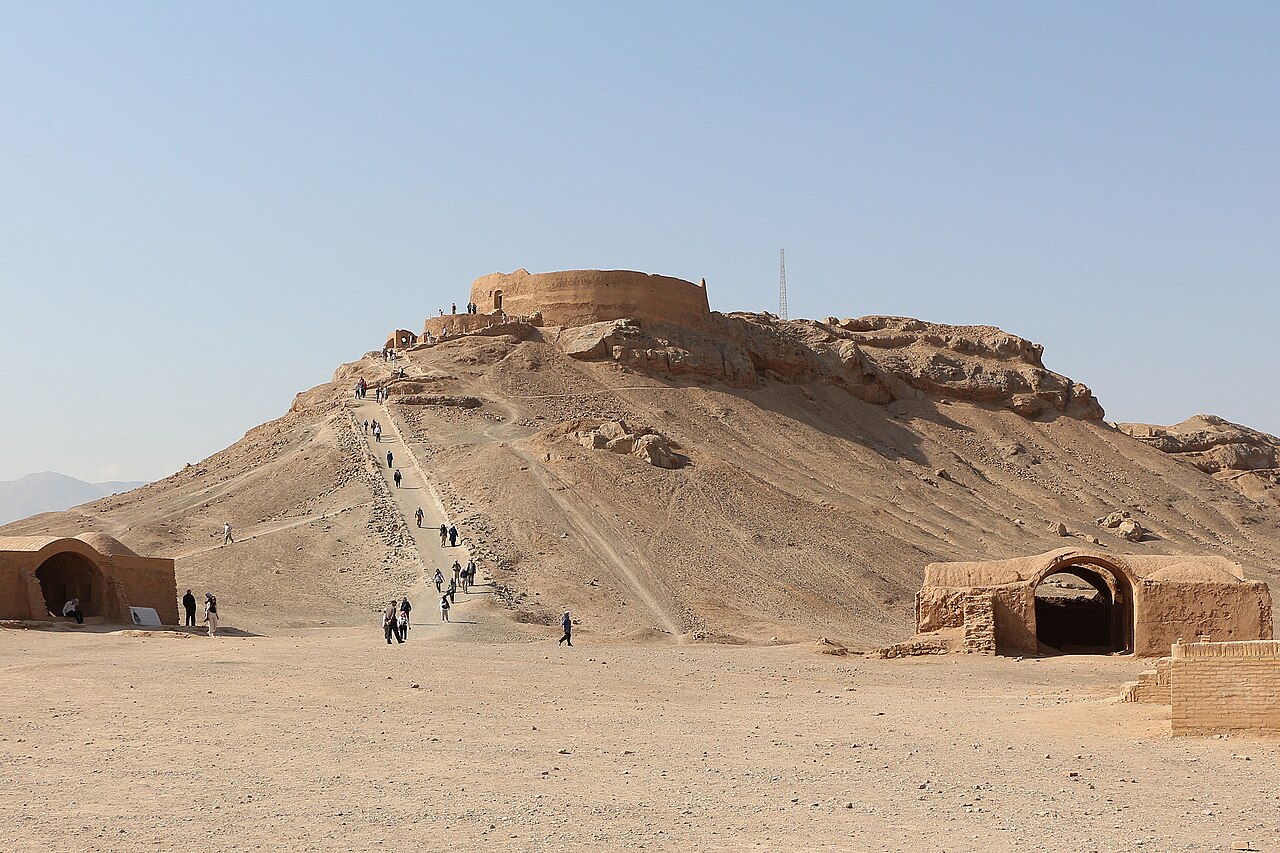
The Yazd towers stand on two low hills rising from the plain south-east of the city. Each is a round enclosure of mud brick with high walls and no roof. A path leads up to the entrance, and from the top you can look into the inner floor and the central pit, and back over the city and the desert. The older tower is usually dated to the Qajar period. The second is associated with Manekji Limji Hataria and the Parsi reforms of the 19th century.
At the foot of the hills are ruined mud-brick buildings: rooms where families mourned and waited, a cistern with a domed roof, wells and kitchens. They are often overlooked, but they show that a funeral here was a long ritual for the living as much as a disposal of the dead.
The end of the custom
In the 20th century the city grew towards the hills, attitudes in the community changed, and the authorities objected to exposure. In the 1960s and 1970s the Yazd Zoroastrians moved to burial in a cemetery with cement-lined graves, built below the towers, which keeps the body separated from the earth. The towers have been empty since.
Visiting
- The fire temple is in the city, in a residential area south of the centre. The Towers of Silence are on the south-eastern outskirts; a taxi is the simplest way to reach them. Many people visit both in half a day.
- At the fire temple dress modestly and keep your voice low. Take photographs only where staff allow it.
- The towers are a former burial site. Climbing is allowed, but walk on the paths and do not take anything away.
- The towers are best at sunset, when the light is low and the heat has passed. The climbs are short but steep and slippery with dust.
- Opening hours and ticket prices change. Check current information locally.
Our Yazd page covers the city’s Zoroastrian quarters and other sights, and Zoroaster and the Avesta explains the faith’s origins.
Persian words from this page
| آتشکده | âtashkade | fire temple |
| آتش بهرام | âtash bahrâm | “victorious fire”, the highest grade of sacred fire |
| دخمه | dakhme | tower of silence |
| زرتشتی | zartoshti | Zoroastrian |
| موبد | mobed | Zoroastrian priest |
| فروهر | faravahar | the winged Zoroastrian symbol |
Sources and further reading
- Encyclopaedia Iranica, “ĀTAŠ” (on sacred fires and their grades).
- Encyclopaedia Iranica, “DAḴMA”.
- Encyclopaedia Iranica, “ZOROASTRIANS IN IRAN“.
- Mary Boyce, A Persian Stronghold of Zoroastrianism (Clarendon Press, 1977), based on her fieldwork in the Yazd region.
- Herodotus, Histories, Book 1.
Want to learn Persian? Get the free Starter Pack
Get the 14-page printable Starter Pack (all 32 letters, a 7-day reading plan, 100 core words and 20 survival phrases) and a short 5-email course. Free.
More in Top Places to Visit in Iran
- Naqsh-e Jahan Square
- Shah (Imam) Mosque, Isfahan
- Sheikh Lotfollah Mosque
- Ali Qapu Palace
- Jameh Mosque of Isfahan
- Si-o-se Pol and Khaju Bridge
- Vank Cathedral
- Hasht Behesht Palace
- Naqsh-e Rostam
- Eram Garden, Shiraz
- Nasir al-Molk (Pink) Mosque
- Tomb of Hafez (Hafezieh)
- Tomb of Saadi (Saadieh)
- Shah Cheragh Shrine
- Arg of Karim Khan
- Fin Garden, Kashan
- Historic Houses of Kashan
- Jameh Mosque of Yazd
- Yazd Fire Temple and Towers of Silence
- Dowlatabad Garden and Windcatcher
- Amir Chakhmaq Complex
- Golestan Palace
- National Museum of Iran
- Treasury of National Jewels
- Tehran Grand Bazaar
- Milad Tower
- Imam Reza Shrine, Mashhad
- Tomb of Ferdowsi, Tus
- Tomb of Omar Khayyam, Neyshabur
- Tomb of Avicenna, Hamadan
- Ganjnameh Inscriptions, Hamadan
- Behistun (Bisotun): Visiting the Site
- Taq-e Bostan: Visiting the Site
- Tabriz Historic Bazaar
- Takht-e Soleyman
- Armenian Monastic Ensembles of Iran
- Sheikh Safi al-Din Shrine, Ardabil
- Dome of Soltaniyeh
- Alamut Castle
- Falak-ol-Aflak Castle
- Shushtar Historical Hydraulic System
- Chogha Zanbil: Visiting the Ziggurat
- Susa Archaeological Site
- Arg-e Bam
- Ganjali Khan Complex, Kerman
- Shazdeh Garden, Mahan
- Rayen Castle
- Dasht-e Lut (Lut Desert)
- Maranjab Desert and Caravanserai
- Varzaneh Desert
- Mount Damavand
- Hyrcanian Forests
- Lake Urmia
- Badab-e Surt Springs
- Ali Sadr Cave
- The Kaluts of Shahdad
- Qeshm Geopark
- Hormuz Island Colours
- Visiting Persepolis: A Day Trip from Shiraz
- Visiting Pasargadae
- Persian Caravanserais
- The Qanat of Gonabad
- Meymand Village
- Sasanian Sites of Fars: Firuzabad, Bishapur and Sarvestan
- Gonbad-e Qabus: Visiting the Tower
- Zayandeh Rud and Isfahan’s Bridges
- Tochal and Darband: Hiking Above Tehran
- Mount Sabalan
- Skiing in Iran: Dizin and Shemshak
- Golestan National Park