Under the Sasanians (224–651 CE), Zoroastrianism became the religion of the state, with an organised priesthood, a network of fire temples across the empire and kings who presented themselves as “Mazda-worshipping” rulers. It was in this period that the Avesta, the sacred text, was finally written down in a script invented for it. Much of what is known about Zoroastrian belief and practice today was shaped in these four centuries.
| Period | 224–651 CE |
|---|---|
| Royal title | mazdēsn bay, “the Mazda-worshipping lord”, on coins and inscriptions |
| Clergy | mowbed (priest, later the senior priest of a district), hērbed (teaching priest), mowbedān mowbed (chief priest) |
| Great fires | Adur Farnbag (Fars), Adur Gushnasp (Azerbaijan), Adur Burzen-Mihr (Khorasan) |
| Scripture | Avesta, written down in the Avestan alphabet, probably in the 6th century; Middle Persian commentary (Zand) |
| Key site | Takht-e Soleyman, the temple of Adur Gushnasp; UNESCO World Heritage Site |
A religion of the crown
The Sasanian family came from Istakhr in Fars, where Ardashir I’s grandfather Sasan is said to have served at the temple of the goddess Anahita. From the start the dynasty tied its rule to the faith. On the back of their silver coins the kings placed a fire altar, often flanked by two attendants, and on the front they called themselves worshippers of Mazda, of divine descent. The rock relief of Ardashir I at Naqsh-e Rostam shows him receiving the ring of kingship from the god Ohrmazd (Ahura Mazda), both on horseback.
Later Zoroastrian tradition remembered the alliance of throne and altar as natural: religion and kingship were “twins”, and neither could stand without the other. The saying is attributed to Ardashir in Middle Persian and Arabic works. See the origins of the Sasanian family and Ardashir I.
Priests and their power
The Sasanian clergy became a hierarchy with ranks, offices and its own law. Ordinary priests served the fires and performed rites. Teaching priests, the hērbeds, trained new priests and passed on the sacred texts by memory. Senior mowbeds acted as judges and administrators in the provinces, and by the later empire a chief priest, the mowbedān mowbed, stood at the top.
The most famous priest of the early empire is Kartir, who served from Shapur I to Narseh. His inscriptions boast that he founded many fires, appointed priests and struck at Jews, Christians, Manichaeans, Buddhists and others. Historians debate how far his claims reflect real persecution. His career is covered in Kartir and the Zoroastrian Church.
Under Shapur II in the 4th century, the high priest Adurbad i Mahraspandan is remembered for fixing the canon of the faith. Tradition says he proved its truth by undergoing an ordeal of molten metal poured on his chest. Wise sayings attributed to him survive in Middle Persian.

Fire temples
Fire was the focus of worship as the visible sign of Ohrmazd’s truth and purity, not as a god in itself. Temples sheltered fires that were kept burning permanently and fed by priests wearing mouth-cloths so that their breath would not pollute the flame. Fires were graded. The highest, the “Victorious fires” (Ādur ī Wahrām, later Atash Bahram), were consecrated with long rituals from many sources of fire; lesser fires served towns and villages and households.
Three great fires stood above the rest and were linked, in later tradition, with the three classes of society:
- Adur Farnbag, the fire of the priests, in Fars.
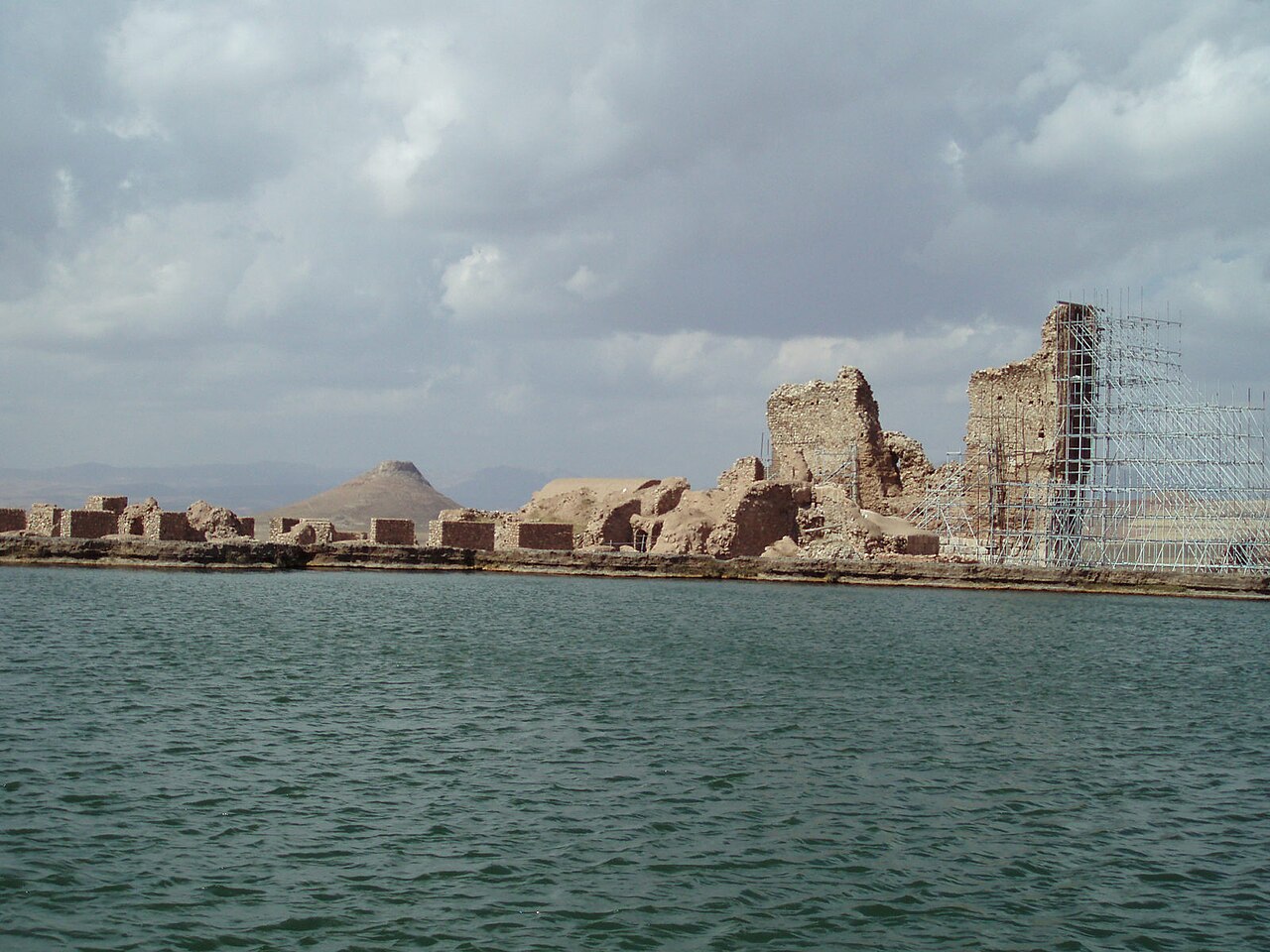
- Adur Gushnasp, the fire of the warriors and kings, at the site now called Takht-e Soleyman in Azerbaijan, beside a deep spring-fed lake. Kings made pilgrimages and gifts to it. Heraclius’ army destroyed the temple in 624, after its fire had been removed; see Heraclius strikes back.
- Adur Burzen-Mihr, the fire of the farmers, on Mount Revand in Khorasan near Nishapur.
Many smaller temples were built on a simple plan: a square domed chamber open on four sides through arches, the chahar taq (“four arches”). The remains of such buildings still stand in many places in Iran, for example at Niasar near Kashan. The ruins of Takht-e Soleyman can be visited; see the Takht-e Soleyman guide and the UNESCO listing.
Writing down the Avesta
For centuries the Avesta was passed on orally, in an ancient language that few people outside the priesthood understood. Under the Sasanians, priests created a new alphabet, based on the Pahlavi script but with many more letters, to record its sounds exactly. Most scholars date this to the 6th century, perhaps under Khosrow I, although some argue for an earlier date.
The Sasanian Avesta was large. A 9th-century summary in the Denkard describes it in twenty-one books (nasks). Only perhaps a quarter of it survives, mainly the texts used in worship, including the Gathas, the hymns attributed to Zoroaster. Priests also produced the Zand, a Middle Persian translation and commentary. For the earlier history of the texts, see Zoroaster and the Avesta.
Belief and debate
Sasanian Zoroastrianism taught a cosmic struggle between Ohrmazd, the wise creator, and Ahriman, the destructive spirit, ending in the final renovation of the world. Humans took part in the struggle through good thoughts, good words and good deeds, through rituals and through careful laws of purity. The dead were exposed to birds and the weather so that corpses would not pollute earth or fire; the cleaned bones were then placed in ossuaries or rock-cut niches.
Religious life was not uniform. Many scholars think that a movement giving a central place to Zurvan, the god of time, was influential in the Sasanian period, though how far it formed a separate school is debated. The empire also faced religious challengers from inside: the prophet Mani in the 3rd century and the reformer Mazdak in the 5th and 6th. The state church answered both with persecution. At the same time, large Christian and Jewish communities lived in the empire; see Christians in the Sasanian Empire.
Festivals and daily practice
Zoroastrians wore the sacred shirt (sedreh) and cord (kusti), prayed facing a source of light several times a day and observed a calendar of festivals. Nowruz at the spring equinox and Mihragan in autumn were great court festivals, when the king received gifts and gave audiences. Nowruz survives today as the Iranian New Year; read the site’s guide to Nowruz.
What survives
Most Zoroastrian books in Middle Persian, such as the Denkard, the Bundahishn and the Book of Arda Wiraz, were written down or edited in the 9th and 10th centuries, after the Arab conquest, but they preserve Sasanian teaching. The faith lost its state support after 651 and declined over the following centuries, though communities survived in Iran, especially around Yazd and Kerman, and in India among the Parsis. See Zoroastrians after the Arab conquest, Zoroastrianism through the ages and the Yazd fire temple and towers of silence.
Persian words from this page
| آتشکده | âtashkade | fire temple |
| موبد | mowbed | Zoroastrian priest |
| اوستا | Avestâ | Avesta |
| اهورامزدا | Ahurâ Mazdâ | Ahura Mazda |
| اهریمن | Ahriman | Ahriman, the evil spirit |
| چهارطاق | chahâr tâq | “four arches”, domed fire shrine |
| مهرگان | Mehrgân | Mihragan, the autumn festival |
Sources and further reading
- Mary Boyce, Zoroastrians: Their Religious Beliefs and Practices (Routledge, 1979; later editions).
- Michael Stausberg, Yuhan Sohrab-Dinshaw Vevaina and Anna Tessmann (eds.), The Wiley Blackwell Companion to Zoroastrianism (2015).
- Touraj Daryaee, Sasanian Persia: The Rise and Fall of an Empire (I.B. Tauris, 2009), chapter on religion.
- “Adur Gushnasp” and “Avesta”, Encyclopaedia Iranica.
- UNESCO World Heritage Centre, Takht-e Soleyman.
Want to learn Persian? Get the free Starter Pack
Get the 14-page printable Starter Pack (all 32 letters, a 7-day reading plan, 100 core words and 20 survival phrases) and a short 5-email course. Free.
More in The Sasanian Empire (224–651 CE)
- The Origins of the Sasanian Family
- Ardashir I, Founder of the Sasanian Empire
- Firuzabad: Ardashir’s Round City
- Shapur I, King of Kings of Iran and Non-Iran
- Bishapur: Shapur’s City
- The Battle of Edessa and the Capture of Valerian
- The Ka’ba-ye Zartosht Inscription of Shapur I
- Mani and Manichaeism
- Hormizd I and Bahram I
- Kartir and the Zoroastrian Church
- Bahram II
- Narseh and the Peace of Nisibis
- Shapur II the Great
- Julian’s Invasion of Persia (363)
- Christians in the Sasanian Empire
- Shapur III and the Partition of Armenia
- Yazdegerd I
- Bahram V Gur
- Yazdegerd II
- The Battle of Avarayr (451)
- The Hephthalites and Iran’s Eastern Frontier
- Peroz I and the Hephthalite Disaster
- Kavad I
- Zamasp and Kavad’s Return
- Mazdak and the Mazdakite Movement
- Khosrow I Anushirvan the Just
- The Sasanian–Byzantine Wars of the 6th Century
- The Battle of Dara (530)
- Khosrow I Sacks Antioch (540)
- The Lazic War (541–562)
- The Reforms of Khosrow I
- The Academy of Gondishapur: History and Legend
- Borzuya, Chess and Kalila wa Dimna
- Taq Kasra: The Arch of Ctesiphon
- The Sasanian Conquest of Yemen
- The Sasanians and the Western Turks
- Hormizd IV
- Bahram Chobin’s Rebellion
- Khosrow II Parviz
- The Last Great War: Byzantium and Persia, 602–628
- The Siege of Constantinople (626)
- Heraclius Strikes Back
- Shirin: Queen and Legend
- Shahrbaraz, the General Who Became King
- Civil War and the Queens Boran and Azarmidokht
- Yazdegerd III, the Last Sasanian King
- The Sasanian Army
- Sasanian Society and the Class System
- Zoroastrianism under the Sasanians
- Sasanian Art: Silver, Reliefs and Silk
- The Sasanian Reliefs of Naqsh-e Rostam
- Taq-e Bostan
- Sasanian Cities, Palaces and Bridges
- Middle Persian (Pahlavi) Language and Literature
- Sasanian Coins and Silverwork
- Women in the Sasanian Empire
- Polo, Hunting and Games at the Sasanian Court
- The Sasanian Legacy