Kartir (also spelled Kerdir or Kirdir) was a Zoroastrian priest who rose under five Sasanian kings in the second half of the third century CE to become the most powerful religious figure in the empire. He is known almost entirely from four inscriptions he had carved in Fars, in which he describes building up the Zoroastrian church and claims to have “struck” Jews, Christians, Buddhists, Manichaeans and others. Historians still debate how much of that claim was real.
| Active | c. 260s to c. 293 CE |
|---|---|
| Served | Shapur I, Hormizd I, Bahram I, Bahram II and, briefly, Narseh |
| Highest titles | Mowbed (chief priest) and judge (dadwar) of the whole empire; steward of the Anahid fire at Istakhr |
| Inscriptions | Ka’ba-ye Zartosht (KKZ), Naqsh-e Rostam (KNRm), Sar Mashhad (KSM), Naqsh-e Rajab (KNRb) |
| Language | Middle Persian only |

A priest’s career in four reigns
Kartir’s own words give a step-by-step account of his promotion, and they are unusual because no other Sasanian subject left such a record. He was not a prince or a noble from one of the great houses. His power came from the kings he served and from the church he organised.
Under Shapur I
Kartir first appears in the list of courtiers in Shapur I’s great inscription at the Ka’ba-ye Zartosht, with the modest title herbed, a teaching priest. In his own inscriptions he says Shapur gave him authority over the priests at court and in the provinces, and that he accompanied the king’s armies into Roman territory, where he looked after Zoroastrian priests and fires.
Under Hormizd I
Shapur’s son Hormizd I (r. c. 270–271) gave Kartir the cap and belt that marked high rank and the title mowbed of Ohrmazd, “chief priest of Ahura Mazda”. A priest had never been honoured so visibly before.
Under Bahram I
Under Bahram I (r. c. 271–274) Kartir’s influence grew. This was the reign in which the prophet Mani was arrested and died in prison, and Manichaean sources name Kartir as his chief enemy at court. The story is told on Mani and Manichaeism.
Under Bahram II
Kartir reached his peak under Bahram II (r. 274–293). The king made him one of the “grandees” (wuzurgan), gave him the titles of mowbed and judge of the whole empire, and put him in charge of the fire of Anahid at Istakhr, the family shrine of the Sasanians (see The Origins of the Sasanian Family). He took a new name, “Kartir who saved the soul of Bahram”. For the king’s own reign and reliefs, see Bahram II.
The four inscriptions
Kartir’s inscriptions are all in Middle Persian and all in the royal landscape of Fars. Two are placed in deliberate relation to royal monuments.
- Ka’ba-ye Zartosht (KKZ), carved under the Middle Persian text of Shapur I’s inscription on the same building at Naqsh-e Rostam. See The Ka’ba-ye Zartosht Inscription of Shapur I.
- Naqsh-e Rostam (KNRm), beside a relief of Bahram II.
- Sar Mashhad (KSM), in southern Fars, next to a relief of Bahram II defending his family against lions.
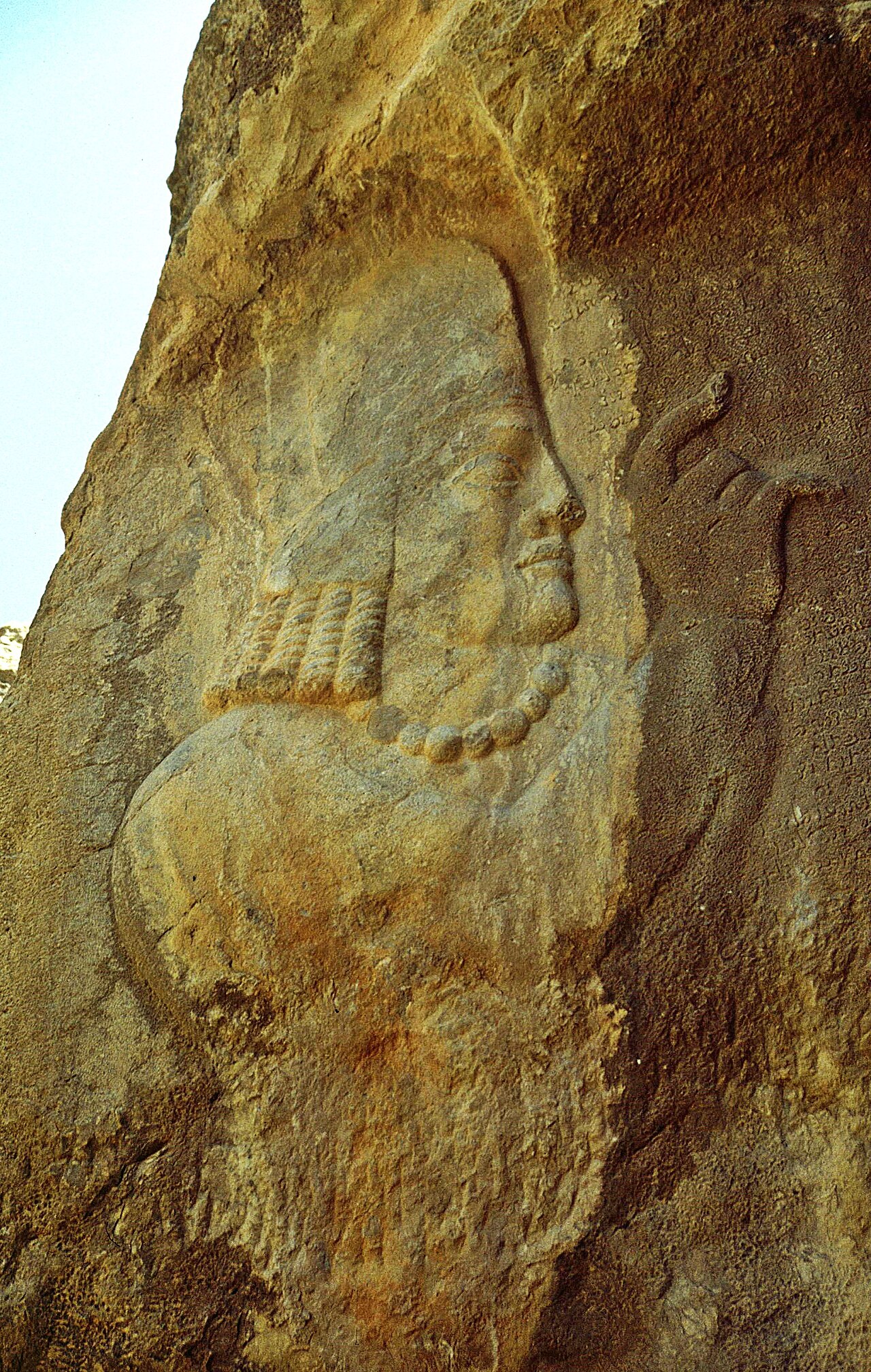
- Naqsh-e Rajab (KNRb), a short text beside a bust of Kartir himself, near Persepolis.
The longer texts at Naqsh-e Rostam and Sar Mashhad also describe a vision. Kartir says he prayed to the gods to show him the fate of souls after death, and that a figure in his likeness travelled to the other world, saw heaven and hell and crossed the bridge of judgement. He presents the vision as proof that his teaching was true. It is one of the earliest datable descriptions of the Zoroastrian afterlife, centuries before the later Pahlavi book of the priest Arda Wiraz describes a similar journey.
Building the church
Most of Kartir’s inscriptions deal with what he saw as reform. He says he founded many fires (Bahram fires, the highest grade of sacred fire), appointed and supervised priests, and ensured that rituals were carried out correctly. He mentions “next-of-kin marriages”, a Zoroastrian practice that he promoted. He also says he punished heretics within the faith and corrected priests who did not follow the proper doctrine.
Outside Iran, he says that in the lands conquered by Shapur, from Antioch and Cilicia to Cappadocia, Armenia, Georgia and Albania, he looked after Zoroastrian priests and fires that had been carried there as captives or that served Iranian troops.
“Struck” religions
The best-known passage lists the religions that, according to Kartir, were struck down in the empire: Jews, shaman (Buddhists), braman (Brahmins), nasra and kristiyan (two terms for Christians, perhaps native Aramaic-speaking Christians and Greek-speaking deportees), makdag (baptists, perhaps the Mandaeans) and zandik (Manichaeans). He also says idols were destroyed and the “abodes of demons” turned into seats of the gods.
How seriously to take it
Historians read this list with caution. Christian and Jewish sources from the period do not describe a general persecution in the late third century. The Manichaeans clearly suffered, but much of the list may describe pressure on particular communities in particular places, or the replacement of non-Zoroastrian shrines in the newly conquered lands, rather than an empire-wide campaign. Kartir also had every reason to exaggerate his own zeal. What the inscriptions show for certain is a new idea: that a Zoroastrian priesthood closely tied to the crown should define and defend an official faith.
Disappearance
When Narseh took the throne in 293 (see Narseh and the Peace of Nisibis), his Paikuli inscription names a Kartir among the nobles who supported him. After that he vanishes from the record. Narseh’s own inscriptions give the gods, including Anahita, a prominent place, and he may have restored a more relaxed royal religion. The beardless portraits of him have led some scholars to suggest he was a eunuch, but there is no textual evidence for it.
Why Kartir matters
Kartir is often described as the founder of the Sasanian Zoroastrian “state church”. That phrase can mislead: the church took centuries to develop, and later Zoroastrian tradition, which credits Tansar under Ardashir and Adurbad-i Mahraspandan under Shapur II, does not remember Kartir at all. But his inscriptions are the first clear evidence of a priest using royal favour to shape religious policy, and they foreshadow the tensions between kings, priests and minorities that run through Sasanian history. For the wider story, see Zoroastrianism under the Sasanians and Christians in the Sasanian Empire.
Persian words from this page
| کرتیر | Kartir | Kartir |
| موبد | mubad | mowbed, Zoroastrian chief priest |
| آتش بهرام | âtash-e Bahrâm | Bahram fire, the highest sacred fire |
| نقش رجب | Naghsh-e Rajab | Naqsh-e Rajab |
| سرمشهد | Sar Mashhad | Sar Mashhad |
| دین | din | religion |
Sources and further reading
- Encyclopaedia Iranica, “Kirdēr” by P. O. Skjærvø.
- Martin Sprengling, Third Century Iran: Sapor and Kartir (Oriental Institute, University of Chicago, 1953).
- Philippe Gignoux, Les quatre inscriptions du mage Kirdīr (Studia Iranica, Cahier 9, 1991).
- Touraj Daryaee, Sasanian Persia: The Rise and Fall of an Empire (I.B. Tauris, 2009).
- Mary Boyce, Zoroastrians: Their Religious Beliefs and Practices (Routledge, 1979; later editions).
Want to learn Persian? Get the free Starter Pack
Get the 14-page printable Starter Pack (all 32 letters, a 7-day reading plan, 100 core words and 20 survival phrases) and a short 5-email course. Free.
More in The Sasanian Empire (224–651 CE)
- The Origins of the Sasanian Family
- Ardashir I, Founder of the Sasanian Empire
- Firuzabad: Ardashir’s Round City
- Shapur I, King of Kings of Iran and Non-Iran
- Bishapur: Shapur’s City
- The Battle of Edessa and the Capture of Valerian
- The Ka’ba-ye Zartosht Inscription of Shapur I
- Mani and Manichaeism
- Hormizd I and Bahram I
- Kartir and the Zoroastrian Church
- Bahram II
- Narseh and the Peace of Nisibis
- Shapur II the Great
- Julian’s Invasion of Persia (363)
- Christians in the Sasanian Empire
- Shapur III and the Partition of Armenia
- Yazdegerd I
- Bahram V Gur
- Yazdegerd II
- The Battle of Avarayr (451)
- The Hephthalites and Iran’s Eastern Frontier
- Peroz I and the Hephthalite Disaster
- Kavad I
- Zamasp and Kavad’s Return
- Mazdak and the Mazdakite Movement
- Khosrow I Anushirvan the Just
- The Sasanian–Byzantine Wars of the 6th Century
- The Battle of Dara (530)
- Khosrow I Sacks Antioch (540)
- The Lazic War (541–562)
- The Reforms of Khosrow I
- The Academy of Gondishapur: History and Legend
- Borzuya, Chess and Kalila wa Dimna
- Taq Kasra: The Arch of Ctesiphon
- The Sasanian Conquest of Yemen
- The Sasanians and the Western Turks
- Hormizd IV
- Bahram Chobin’s Rebellion
- Khosrow II Parviz
- The Last Great War: Byzantium and Persia, 602–628
- The Siege of Constantinople (626)
- Heraclius Strikes Back
- Shirin: Queen and Legend
- Shahrbaraz, the General Who Became King
- Civil War and the Queens Boran and Azarmidokht
- Yazdegerd III, the Last Sasanian King
- The Sasanian Army
- Sasanian Society and the Class System
- Zoroastrianism under the Sasanians
- Sasanian Art: Silver, Reliefs and Silk
- The Sasanian Reliefs of Naqsh-e Rostam
- Taq-e Bostan
- Sasanian Cities, Palaces and Bridges
- Middle Persian (Pahlavi) Language and Literature
- Sasanian Coins and Silverwork
- Women in the Sasanian Empire
- Polo, Hunting and Games at the Sasanian Court
- The Sasanian Legacy