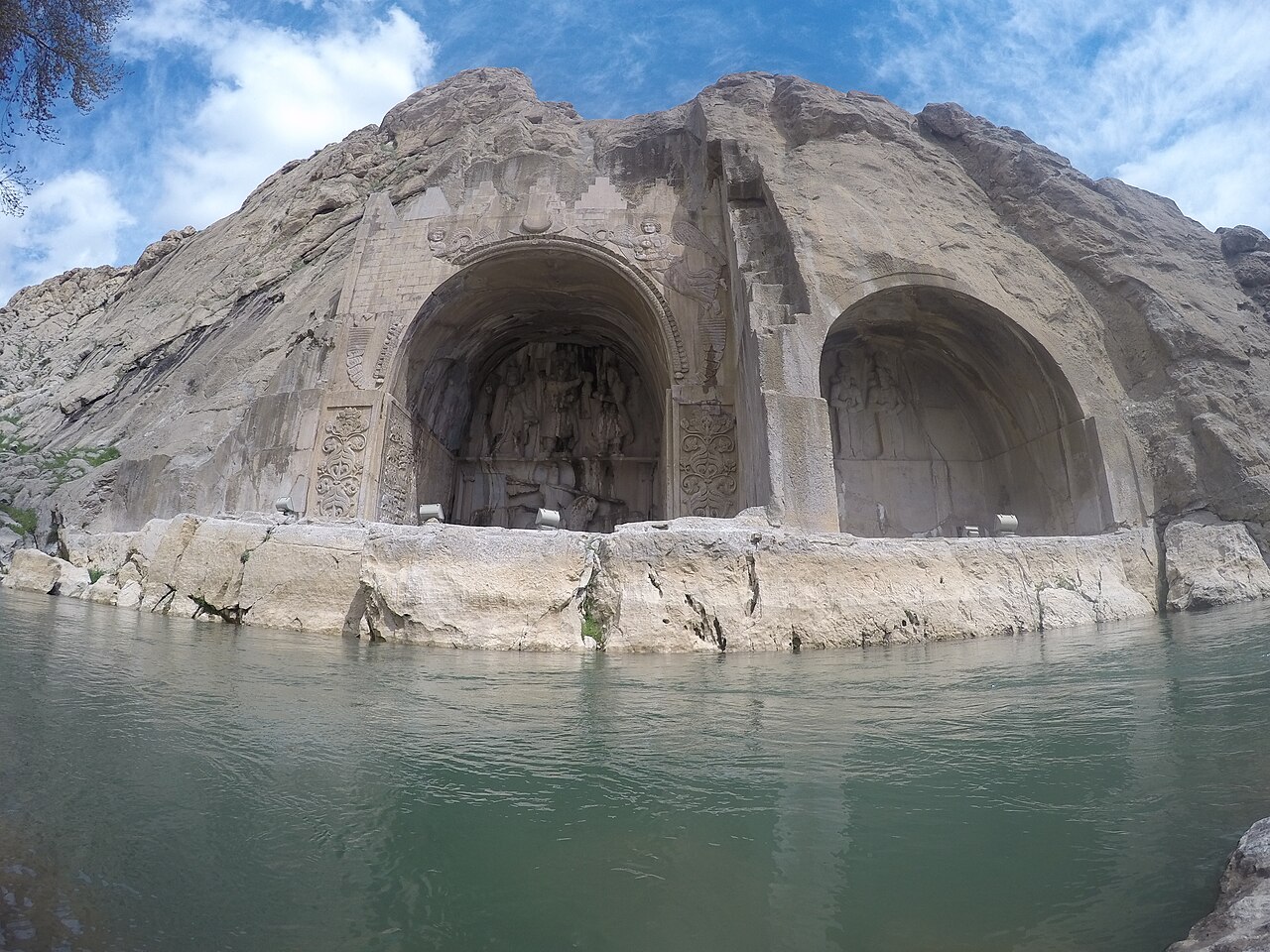
Taq-e Bostan (طاق بستان, “arch of the garden”) is a group of Sasanian rock reliefs and two carved grottoes at the foot of a cliff on the north-eastern edge of Kermanshah, beside springs that feed a large pool. Carved between the late 4th and early 7th centuries CE, they include the finest royal hunting scenes to survive from pre-Islamic Iran. Today the site is a city park, and one of the most pleasant places in western Iran to see ancient art up close.
| Location | Northern edge of Kermanshah, about 5 km from the centre |
|---|---|
| Period | Sasanian, c. 380 – early 7th century CE; one Qajar relief of the early 19th century |
| Main works | Investiture of Ardashir II; small grotto of Shapur II and Shapur III; large grotto with hunting scenes |
| Setting | Spring-fed pool and park below Mount Parav |
The history and meaning of the reliefs, including the long debates about which king is which, are set out on our history page Taq-e Bostan. This page is a guide for visitors: what to look at, in what order, and what to notice.

The setting
Springs rise here at the foot of the mountain and spill into a wide pool, the reason the Sasanian kings chose the place. Their hunting parks lay on the plain in front, and the reliefs face the water, so that the kings in stone look out over the pool and the garden. Arriving from the city, you see the two arches reflected in the water before you reach them. Plane trees, tea houses and paths make it a popular evening spot for Kermanshah families.
What to look at
1. The investiture of Ardashir II
The single relief, cut directly into the rock face, shows a king receiving a ring of kingship from a god, while a second divine figure stands on a lotus flower holding a bundle of rods, his head ringed by rays. A defeated enemy lies under their feet. The king is usually identified as Ardashir II (379–383), the sun-crowned figure as Mithra, and the fallen man in Roman dress has often been taken as the emperor Julian, killed in 363. Each identification has been challenged, which is part of the interest.
2. The small grotto
The smaller arch, about 6 m deep, holds two standing kings facing each other. Middle Persian inscriptions name them as Shapur II, the long-reigning “Shapur the Great”, and his son Shapur III (383–388). This is one of the few places where you can see Sasanian royal inscriptions in the original script, carved beside the figures.
3. The great grotto
The large arch is the masterpiece. Start with the outside: two winged Victories with ribbons hover in the spandrels over the arch, a motif borrowed from Roman triumphal arches. Inside, on the back wall, an upper panel shows an investiture with three standing figures, usually read as the king between the god Ahuramazda and the goddess Anahita. Below it rides a heavily armoured horseman with lance and shield, his horse also in armour. He is traditionally identified as Khosrow II on his famous horse Shabdiz, although some scholars suggest an earlier king.
Then turn to the side walls. On the left is a boar hunt in a marsh: the king stands in a boat drawing his bow, while elephants drive the boars out of the reeds and musicians play in other boats. On the right is a deer hunt, with the king on horseback under a parasol and the game penned into an enclosure. Spend time on the details: the patterns on the king’s robes copy the silk textiles of the court, and the scenes are packed with animals, rowers, harpists and attendants. Some parts were left unfinished, so you can see how the sculptors worked from sketched outlines to finished relief.
4. The Qajar relief
Above and beside the Sasanian work is a much later relief carved in the early 19th century for Mohammad-Ali Mirza Dowlatshah, the Qajar prince-governor of Kermanshah, showing him with Fath-Ali Shah. It is an interesting example of a later dynasty borrowing ancient prestige by adding itself to the same rock.
5. The capitals
Near the pool, a group of large carved stone capitals, Sasanian and early Islamic, has been gathered from Taq-e Bostan, Bisotun and Kermanshah. Several show royal figures and leaf patterns similar to those in the great grotto.
Practical notes
- Getting there: a short taxi ride from central Kermanshah. Many visitors combine it with Bisotun, about 30 km to the east.
- When: the reliefs are lit in the evening, and the site is beautiful at dusk, though crowded on weekends and holidays. For photographing the hunting scenes, go in daylight.
- Time needed: at least an hour; longer if you want to study the hunting reliefs.
- Tickets and hours: check current official information.
- Safety: follow your own government’s travel advice for Iran.
For more on Sasanian art, read Sasanian Art: Silver, Reliefs and Silk, and for the city, our guide to Kermanshah.
Persian words from this page
| طاق | tâq | arch, vault |
| بستان | bostân | garden |
| شکار | shekâr | hunt |
| گراز | gorâz | wild boar |
| گوزن | gavazn | deer |
| شبدیز | Shabdiz | Khosrow II’s horse in legend |
| استخر | estakhr | pool |
Sources and further reading
- Shinji Fukai and Kiyoharu Horiuchi, Taq-i-Bustan, 4 vols. (Tokyo, 1969–1984), the standard photographic survey.
- Bruno Overlaet, “Ardashir II or Shapur III? Reflections on the Identity of a King in the Smaller Grotto at Taq-i Bustan”, Iranica Antiqua 46 (2011).
- Matthew P. Canepa, The Two Eyes of the Earth: Art and Ritual of Kingship between Rome and Sasanian Iran (University of California Press, 2009).
- Encyclopaedia Iranica, “KERMANSHAH i. Geography“.
Want to learn Persian? Get the free Starter Pack
Get the 14-page printable Starter Pack (all 32 letters, a 7-day reading plan, 100 core words and 20 survival phrases) and a short 5-email course. Free.
More in Top Places to Visit in Iran
- Naqsh-e Jahan Square
- Shah (Imam) Mosque, Isfahan
- Sheikh Lotfollah Mosque
- Ali Qapu Palace
- Jameh Mosque of Isfahan
- Si-o-se Pol and Khaju Bridge
- Vank Cathedral
- Hasht Behesht Palace
- Naqsh-e Rostam
- Eram Garden, Shiraz
- Nasir al-Molk (Pink) Mosque
- Tomb of Hafez (Hafezieh)
- Tomb of Saadi (Saadieh)
- Shah Cheragh Shrine
- Arg of Karim Khan
- Fin Garden, Kashan
- Historic Houses of Kashan
- Jameh Mosque of Yazd
- Yazd Fire Temple and Towers of Silence
- Dowlatabad Garden and Windcatcher
- Amir Chakhmaq Complex
- Golestan Palace
- National Museum of Iran
- Treasury of National Jewels
- Tehran Grand Bazaar
- Milad Tower
- Imam Reza Shrine, Mashhad
- Tomb of Ferdowsi, Tus
- Tomb of Omar Khayyam, Neyshabur
- Tomb of Avicenna, Hamadan
- Ganjnameh Inscriptions, Hamadan
- Behistun (Bisotun): Visiting the Site
- Taq-e Bostan: Visiting the Site
- Tabriz Historic Bazaar
- Takht-e Soleyman
- Armenian Monastic Ensembles of Iran
- Sheikh Safi al-Din Shrine, Ardabil
- Dome of Soltaniyeh
- Alamut Castle
- Falak-ol-Aflak Castle
- Shushtar Historical Hydraulic System
- Chogha Zanbil: Visiting the Ziggurat
- Susa Archaeological Site
- Arg-e Bam
- Ganjali Khan Complex, Kerman
- Shazdeh Garden, Mahan
- Rayen Castle
- Dasht-e Lut (Lut Desert)
- Maranjab Desert and Caravanserai
- Varzaneh Desert
- Mount Damavand
- Hyrcanian Forests
- Lake Urmia
- Badab-e Surt Springs
- Ali Sadr Cave
- The Kaluts of Shahdad
- Qeshm Geopark
- Hormuz Island Colours
- Visiting Persepolis: A Day Trip from Shiraz
- Visiting Pasargadae
- Persian Caravanserais
- The Qanat of Gonabad
- Meymand Village
- Sasanian Sites of Fars: Firuzabad, Bishapur and Sarvestan
- Gonbad-e Qabus: Visiting the Tower
- Zayandeh Rud and Isfahan’s Bridges
- Tochal and Darband: Hiking Above Tehran
- Mount Sabalan
- Skiing in Iran: Dizin and Shemshak
- Golestan National Park