Shirin was the Christian wife of the Sasanian king Khosrow II (r. 590–628) and one of the most influential women at his court. Little is known for certain about her life, but contemporary Byzantine and Armenian writers confirm her position and her role in church politics. Centuries later she became the heroine of Persian romance, above all in Nizami Ganjavi’s poem Khosrow and Shirin, where the tragic stonecutter Farhad dies for love of her.
| Lived | Late 6th century to 628 CE |
|---|---|
| Husband | Khosrow II Parviz |
| Origin | Disputed: Khuzistan (Sebeos), “Aramean” (Syriac chronicles), Roman (Theophylact Simocatta) |
| Religion | Christian; first of the Church of the East, later a Miaphysite |
| Son | Mardanshah, killed in 628 on the orders of his half-brother Kavad II |
| In literature | Ferdowsi’s Shahnameh (completed c. 1010); Nizami’s Khosrow and Shirin (c. 1180) and many later versions |
The historical queen
The earliest mention of Shirin comes from the Byzantine church historian Evagrius, writing in the 590s. He copies letters that Khosrow sent with gifts to the shrine of Saint Sergius at Rusafa, in the Syrian desert. In one, dated to 592 or 593, the king says that his wife Sira, a Christian, had not been able to have children, and he promises the saint gifts if she conceives. A later letter thanks the saint for answering the prayer. The Byzantine historian Theophylact Simocatta tells the same story and adds that she was Roman by birth.
The sources do not agree on where she came from. The Armenian history attributed to Sebeos, written in the 7th century, makes her a woman of Khuzistan in south-western Iran. Two Syriac chronicles call her an Aramean, from Mesopotamia. The later Persian story that she was an Armenian princess appears to be a literary invention. Many historians think she was most likely a subject of the Sasanian Empire rather than a foreigner.

Power at court
Shirin’s influence showed most in church affairs. She began in the Church of the East, the main Christian church of the Sasanian Empire, but moved to the Miaphysite church, which rejected the Council of Chalcedon and was strong in Syria and northern Mesopotamia. With the royal physician Gabriel of Sinjar, another convert to the Miaphysite side, she helped that church gain ground at court, while Khosrow left the office of catholicos of the Church of the East empty from 609 until his death.
When the Persians took Jerusalem in 614, the relic of the True Cross was brought to Ctesiphon, and some sources say it was kept in Shirin’s palace. She is also said to have built churches and monasteries. Her son Mardanshah was, according to Tabari, the son Khosrow wished to succeed him, which helps explain the hatred of Khosrow’s eldest son, Shiroe. When Shiroe seized power as Kavad II in 628, Mardanshah was among the many brothers he had killed.
What happened to Shirin herself is unknown. She seems to have died in 628 or soon after. More on Christian life in the empire is on Christians in the Sasanian Empire, and on royal women in Women in the Sasanian Empire.
Shirin in the Shahnameh
Ferdowsi, drawing on the Sasanian royal chronicle, tells the love story in his account of Khosrow Parviz. Shirin is Khosrow’s beloved from his youth; he neglects her when he becomes king and marries Maryam, the daughter of the Roman emperor, then returns to her and brings her into the palace. In Ferdowsi’s version Shirin poisons Maryam. After Khosrow’s murder, Shiroe demands Shirin’s hand. She asks to see her husband’s body in his tomb and there takes poison and dies beside him. The scene made her a model of loyalty in Persian literature.
Nizami’s romance and Farhad
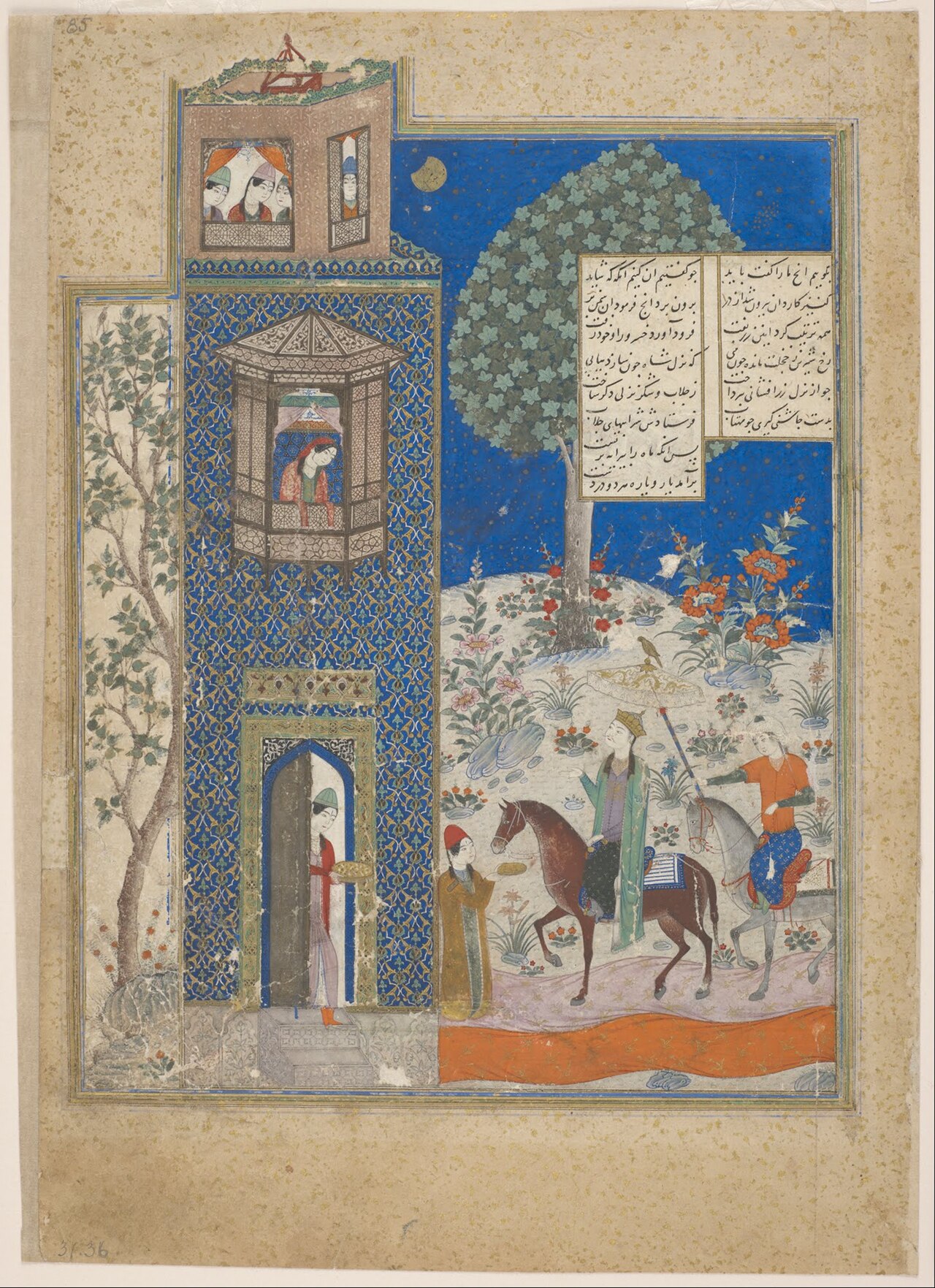
About 1180 the poet Nizami Ganjavi, living at Ganja in the Caucasus, wrote Khosrow and Shirin, the second poem of his Khamsa (Five Poems). It turned the story into one of the great love poems of Persian literature. In Nizami, Shirin is the niece and heir of Mahin Banu, an Armenian queen. Khosrow’s friend, the painter Shapur, shows her the prince’s portrait, and she falls in love. Khosrow first sees her bathing in a spring, without knowing who she is. Separation, pride and politics keep them apart for most of the poem.
Nizami added the figure of Farhad, a sculptor and engineer who falls hopelessly in love with Shirin. To be rid of him, Khosrow sets him an impossible task: to cut a road through the mountain of Bisotun. Farhad begins to carve the rock. When the king sends a messenger with the false news that Shirin is dead, Farhad throws himself from the mountain. Local tradition still calls a smoothed rock face at Bisotun near Kermanshah “Farhad’s carving”. See the Behistun (Bisotun) site guide and Kermanshah.
The poem ends, as in Ferdowsi, with Shirin’s death at Khosrow’s tomb, but Nizami makes her a wiser and stronger character than the king, who has to earn her through years of trial. The story was retold many times: by Amir Khusraw of Delhi, by Vahshi Bafqi in Farhad and Shirin, by Navai in Chagatai Turkish and by Ottoman poets. Farhad, the lover who works himself to death, became the hero of many of these later versions.
Names and places
Shirin means “sweet” in Persian, and it remains a common girl’s name in Iran and across the Persian-speaking world. The town of Qasr-e Shirin, “Shirin’s palace”, near the border with Iraq, keeps her name, and later writers linked Sasanian ruins in the area with her. For the poet, see Nizami Ganjavi; for the king, Khosrow II Parviz.
Persian words from this page
| شیرین | shirin | sweet; Shirin |
| فرهاد | Farhâd | Farhad |
| نظامی گنجوی | Nezâmi Ganjavi | Nizami Ganjavi |
| خمسه | Khamse | Khamsa, “the Five” |
| بیستون | Bisotun | Bisotun |
| قصر شیرین | Qasr-e Shirin | “Shirin’s palace”, a town |
Sources and further reading
- Evagrius Scholasticus, Ecclesiastical History, book 6, trans. Michael Whitby (Liverpool University Press, 2000).
- Theophylact Simocatta, History, book 5, trans. Michael and Mary Whitby (Oxford, 1986).
- “Khosrow o Shirin”, Encyclopaedia Iranica, iranicaonline.org.
- Ferdowsi, Shahnameh, trans. Dick Davis, Shahnameh: The Persian Book of Kings (Penguin, 2006).
- Nizami Ganjavi, Khosrow va Shirin, Persian text ed. Vahid Dastgerdi.
- Touraj Daryaee, Sasanian Persia: The Rise and Fall of an Empire (I.B. Tauris, 2009).
Want to learn Persian? Get the free Starter Pack
Get the 14-page printable Starter Pack (all 32 letters, a 7-day reading plan, 100 core words and 20 survival phrases) and a short 5-email course. Free.
More in The Sasanian Empire (224–651 CE)
- The Origins of the Sasanian Family
- Ardashir I, Founder of the Sasanian Empire
- Firuzabad: Ardashir’s Round City
- Shapur I, King of Kings of Iran and Non-Iran
- Bishapur: Shapur’s City
- The Battle of Edessa and the Capture of Valerian
- The Ka’ba-ye Zartosht Inscription of Shapur I
- Mani and Manichaeism
- Hormizd I and Bahram I
- Kartir and the Zoroastrian Church
- Bahram II
- Narseh and the Peace of Nisibis
- Shapur II the Great
- Julian’s Invasion of Persia (363)
- Christians in the Sasanian Empire
- Shapur III and the Partition of Armenia
- Yazdegerd I
- Bahram V Gur
- Yazdegerd II
- The Battle of Avarayr (451)
- The Hephthalites and Iran’s Eastern Frontier
- Peroz I and the Hephthalite Disaster
- Kavad I
- Zamasp and Kavad’s Return
- Mazdak and the Mazdakite Movement
- Khosrow I Anushirvan the Just
- The Sasanian–Byzantine Wars of the 6th Century
- The Battle of Dara (530)
- Khosrow I Sacks Antioch (540)
- The Lazic War (541–562)
- The Reforms of Khosrow I
- The Academy of Gondishapur: History and Legend
- Borzuya, Chess and Kalila wa Dimna
- Taq Kasra: The Arch of Ctesiphon
- The Sasanian Conquest of Yemen
- The Sasanians and the Western Turks
- Hormizd IV
- Bahram Chobin’s Rebellion
- Khosrow II Parviz
- The Last Great War: Byzantium and Persia, 602–628
- The Siege of Constantinople (626)
- Heraclius Strikes Back
- Shirin: Queen and Legend
- Shahrbaraz, the General Who Became King
- Civil War and the Queens Boran and Azarmidokht
- Yazdegerd III, the Last Sasanian King
- The Sasanian Army
- Sasanian Society and the Class System
- Zoroastrianism under the Sasanians
- Sasanian Art: Silver, Reliefs and Silk
- The Sasanian Reliefs of Naqsh-e Rostam
- Taq-e Bostan
- Sasanian Cities, Palaces and Bridges
- Middle Persian (Pahlavi) Language and Literature
- Sasanian Coins and Silverwork
- Women in the Sasanian Empire
- Polo, Hunting and Games at the Sasanian Court
- The Sasanian Legacy