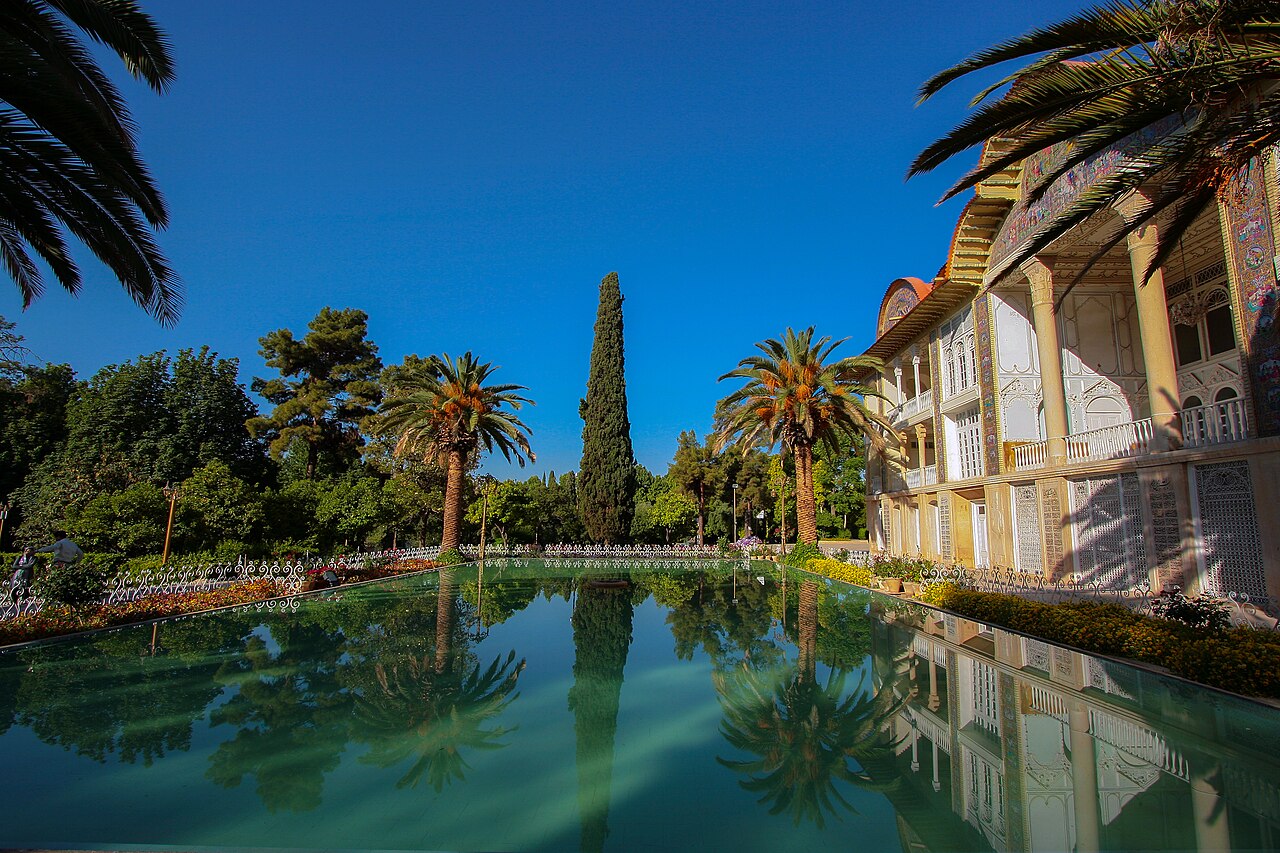
Eram Garden (باغ ارم, Bâgh-e Eram) is a historic walled garden in the north-west of Shiraz, with a Qajar-era mansion reflected in a long pool, avenues of tall cypresses and a botanical collection run by Shiraz University. It is one of the nine gardens inscribed by UNESCO in 2011 as “The Persian Garden”, and the best place in Shiraz to see how a formal Persian garden works.
| Persian name | Bâgh-e Eram |
|---|---|
| Location | North-west Shiraz, on Eram Boulevard near the university campus |
| Dates | A garden on the site is traditionally traced to the Seljuk period; mansion and present layout mainly 19th century |
| Owners | Qajar-era tribal chiefs and the Qavam family; Shiraz University since the 20th century |
| UNESCO | Part of The Persian Garden, inscribed 2011 |
| Best season | Spring, for flowers and roses |

The name
Eram is the Persian form of Iram, a legendary city mentioned in the Qur’an as “Iram of the pillars”. Later stories made it the garden built by the proud king Shaddad to rival paradise. Calling a garden Eram was therefore a claim that it was a paradise on earth, an idea at the heart of Iranian garden design since the walled royal gardens of the Achaemenids. That long tradition is told in The Persian Garden (Pardis) through History.
A short history
Local tradition says that a garden on this site goes back to the Seljuk period, and Shiraz was certainly a city of gardens long before the Qajars, as the poems of Hafez and Saadi show. What you see today, however, is mostly the work of the 19th century. The mansion was built in the Qajar period for the chiefs of the Qashqai tribal confederation, whose summer and winter pastures lay around Shiraz, and the estate later passed to the Qavam family, the most powerful family of Qajar Shiraz, who also built the Narenjestan and the Nasir al-Molk Mosque. In the 20th century the garden was acquired by Shiraz University, which runs it today as a botanical garden open to the public.
How the garden is laid out
A classic Persian garden is built around water and straight lines. At Eram, the main axis runs from the entrance towards the mansion. Along it flows a narrow water channel that widens into a long rectangular pool directly in front of the house. Paths, flower beds and rows of trees run parallel to it. When the water is still, the mansion appears twice, once in stone and once in the pool, which is the view on most photographs of Shiraz.
The trees are part of the design, not decoration. Tall cypresses, a symbol of life and of the beloved in Persian poetry, line the main avenue and give shade. Behind them are orange and other fruit trees, palms, and many plant collections added by the university: roses of many varieties, cacti, and trees from different parts of Iran. In spring the scent of orange blossom (bahâr-nârenj) fills the garden.
The mansion
The mansion (kushk) is a three-storey building with a raised central porch held up by slender columns. Its facade is covered in tile panels in the Qajar style, with figures from Persian legend and history, scenes of kings and courtiers, flowers and birds, and lines of poetry. Inside, the rooms have painted ceilings and mirror work, though access to the interior varies and the building is often seen only from outside.
Look at the tiles closely: the bright yellows, pinks and greens and the European-influenced figures are typical of late 19th-century Shiraz, quite different from the blue and white tiles of Safavid Isfahan. The tiles of the Nasir al-Molk Mosque, built in the same decades, share this palette.
Visiting
- When to go: spring (March to May) is the classic season, when roses and orange trees are in flower and Nowruz brings crowds of Iranian families. Autumn is also pleasant. Summer middays are hot, though the shade of the cypresses helps.
- Time of day: late afternoon is good for the reflection of the mansion in the pool and softer light on the tile panels.
- Time to allow: an hour to an hour and a half for a slow walk.
- Getting there: the garden is in the north-west of the city, a short taxi ride from the centre; it combines well with an afternoon at the Tomb of Hafez, also in the north of the city.
- Opening hours and tickets change; check current information locally.
Other gardens in the UNESCO group include Fin Garden in Kashan and Shazdeh Garden near Kerman; see Fin Garden, Kashan and Shazdeh Garden, Mahan. For the rest of the city, see our Shiraz city guide.
Persian words from this page
| باغ | bâgh | garden |
| ارم | Eram | Iram, the legendary garden |
| سرو | sarv | cypress |
| کوشک | kushk | pavilion, mansion |
| بهارنارنج | bahâr-nârenj | orange blossom |
| گل سرخ | gol-e sorkh | rose |
Sources and further reading
- UNESCO World Heritage Centre, The Persian Garden.
- Encyclopaedia Iranica, “Gardens” (article series) and “Shiraz”.
- Penelope Hobhouse, Gardens of Persia (Kales Press, 2004).
- Mehdi Khansari, M. Reza Moghtader and Minouch Yavari, The Persian Garden: Echoes of Paradise (Mage, 1998).
Want to learn Persian? Get the free Starter Pack
Get the 14-page printable Starter Pack (all 32 letters, a 7-day reading plan, 100 core words and 20 survival phrases) and a short 5-email course. Free.
More in Top Places to Visit in Iran
- Naqsh-e Jahan Square
- Shah (Imam) Mosque, Isfahan
- Sheikh Lotfollah Mosque
- Ali Qapu Palace
- Jameh Mosque of Isfahan
- Si-o-se Pol and Khaju Bridge
- Vank Cathedral
- Hasht Behesht Palace
- Naqsh-e Rostam
- Eram Garden, Shiraz
- Nasir al-Molk (Pink) Mosque
- Tomb of Hafez (Hafezieh)
- Tomb of Saadi (Saadieh)
- Shah Cheragh Shrine
- Arg of Karim Khan
- Fin Garden, Kashan
- Historic Houses of Kashan
- Jameh Mosque of Yazd
- Yazd Fire Temple and Towers of Silence
- Dowlatabad Garden and Windcatcher
- Amir Chakhmaq Complex
- Golestan Palace
- National Museum of Iran
- Treasury of National Jewels
- Tehran Grand Bazaar
- Milad Tower
- Imam Reza Shrine, Mashhad
- Tomb of Ferdowsi, Tus
- Tomb of Omar Khayyam, Neyshabur
- Tomb of Avicenna, Hamadan
- Ganjnameh Inscriptions, Hamadan
- Behistun (Bisotun): Visiting the Site
- Taq-e Bostan: Visiting the Site
- Tabriz Historic Bazaar
- Takht-e Soleyman
- Armenian Monastic Ensembles of Iran
- Sheikh Safi al-Din Shrine, Ardabil
- Dome of Soltaniyeh
- Alamut Castle
- Falak-ol-Aflak Castle
- Shushtar Historical Hydraulic System
- Chogha Zanbil: Visiting the Ziggurat
- Susa Archaeological Site
- Arg-e Bam
- Ganjali Khan Complex, Kerman
- Shazdeh Garden, Mahan
- Rayen Castle
- Dasht-e Lut (Lut Desert)
- Maranjab Desert and Caravanserai
- Varzaneh Desert
- Mount Damavand
- Hyrcanian Forests
- Lake Urmia
- Badab-e Surt Springs
- Ali Sadr Cave
- The Kaluts of Shahdad
- Qeshm Geopark
- Hormuz Island Colours
- Visiting Persepolis: A Day Trip from Shiraz
- Visiting Pasargadae
- Persian Caravanserais
- The Qanat of Gonabad
- Meymand Village
- Sasanian Sites of Fars: Firuzabad, Bishapur and Sarvestan
- Gonbad-e Qabus: Visiting the Tower
- Zayandeh Rud and Isfahan’s Bridges
- Tochal and Darband: Hiking Above Tehran
- Mount Sabalan
- Skiing in Iran: Dizin and Shemshak
- Golestan National Park