Golestan National Park (پارک ملی گلستان) in north-east Iran is the country’s oldest national park, first protected in 1957 and given national park status in the 1970s. Its roughly 900 square kilometres run from damp Caspian-type forest in the west to dry steppe in the east, and it is one of the best places in Iran for large mammals, including the Persian leopard, brown bear, maral red deer, urial and wild goat.
| Area | About 920 km² (918.95 km² in most recent figures) |
|---|---|
| Altitude | About 450 m to 2,411 m |
| Provinces | Golestan, North Khorasan and Semnan |
| Protected | 1957 as a protected area; national park from the mid-1970s; UNESCO biosphere reserve 1976 |
| Landscapes | Hyrcanian broadleaf forest, juniper woodland, grassland and steppe |

Where forest meets steppe
Golestan lies at the eastern tip of the Alborz, where the moist air from the Caspian Sea runs out. On the western, wetter side the valleys are covered with the Hyrcanian forest of oak, hornbeam, maple and ironwood that lines the whole south Caspian coast (see Hyrcanian Forests). Moving east and upward, the trees thin into juniper and scrub, then open into rolling grassland and dry steppe that looks towards the plains of Central Asia.
This sharp change over a short distance is what makes the park special. Within a day you can pass from shady, dripping woodland to wide, sunlit hills where herds of wild sheep graze. The mix of habitats supports an unusually large share of Iran’s mammal and bird species.
Wildlife
The park is known above all for its mammals:
- Persian leopard (پلنگ, palang), the top predator, rarely seen but present in good numbers by Iranian standards.
- Maral (مرال), the Caspian red deer, whose autumn rut fills the forest with roaring stags.
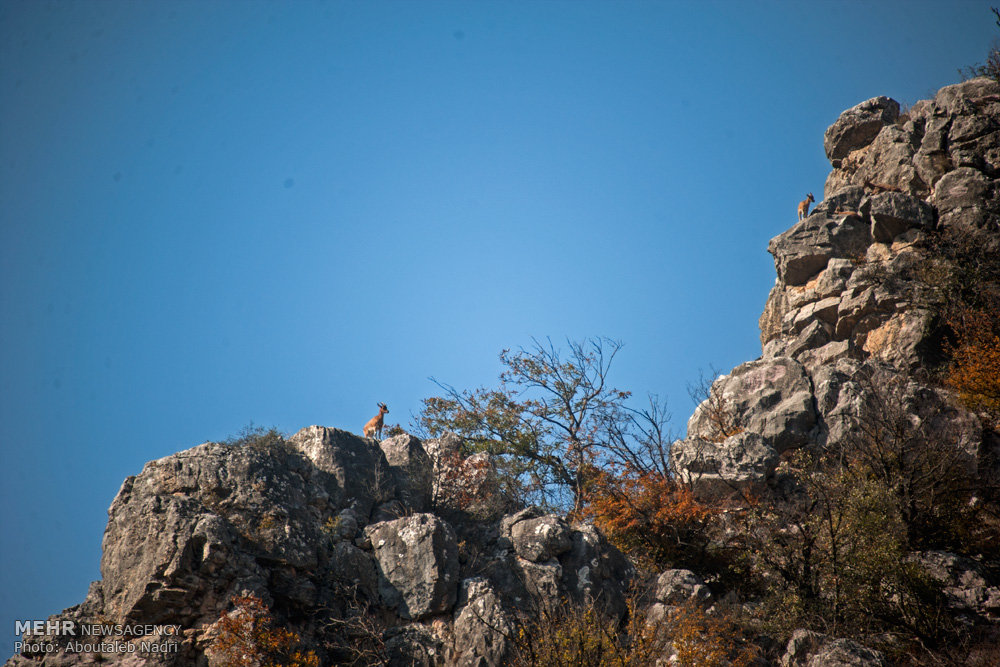
- Urial wild sheep and wild goats on the open hills and cliffs.
- Brown bear, wolf, golden jackal, wild boar, roe deer and, on the eastern steppe, goitered gazelle.
Rangers carry out regular wildlife counts, especially in autumn and winter, when animals are easiest to see on the open slopes. Birdlife includes raptors over the steppe and woodpeckers and other forest species in the west.
A short history
The area first came under protection in 1957 as the Almeh and Ishki protected area, run by Iran’s hunting authority. It was enlarged and renamed several times in the 1960s and 1970s and was declared a national park in the mid-1970s, the first in Iran. In 1976 UNESCO recognised it as a biosphere reserve. After the 1979 revolution an area added in the east was separated again, and the park took its present name, from the province of Golestan, under the Department of Environment.
The road through the park
The park’s biggest problem is the main road between Gorgan and Mashhad, which runs straight through its forested western valley. For millions of travellers, including pilgrims heading to Mashhad, the drive through the “Golestan forest” is a familiar stretch of green. For the park it brings traffic, noise, litter, fires from roadside picnics and animals killed on the road. The valley is also prone to flash floods; a severe flood in August 2001 caused heavy loss of life along the road. Plans to reroute or limit traffic have been discussed for years.
Visiting Golestan National Park
- Getting there: the park lies between Gorgan and Bojnurd. Most visitors drive the main road from Gorgan or stop on the way to Mashhad.
- What you can see from the road: the forest valley, roadside picnic areas and viewpoints. Much of the park is off limits without permission, to protect wildlife.
- Wildlife watching: to reach the open eastern areas such as the Mirzabaylu grasslands, arrange a visit through the park authorities or a licensed local guide.
- Seasons: spring for flowers and green hills, autumn for forest colours and the deer rut. Summers are hot on the steppe; winters can bring snow.
- Rules: do not light fires, leave litter or feed animals; stay on permitted routes.
- Safety: watch for fast traffic and animals on the road, and avoid camping in stream beds after rain. Follow your own government’s current travel advice for Iran.
Combine the park with the brick tower of Gonbad-e Qabus to the west. For the wider Caspian region, see our guide to the north of Iran.
Persian words from this page
| پارک ملی | pârk-e melli | national park |
| جنگل | jangal | forest |
| پلنگ | palang | leopard |
| مرال | marâl | Caspian red deer |
| خرس | khers | bear |
| گراز | gorâz | wild boar |
| محیط زیست | mohit-e zist | environment |
Sources and further reading
- UNESCO Man and the Biosphere Programme, Golestan Biosphere Reserve (designated 1976).
- Department of Environment of Iran, Golestan National Park information.
- Encyclopaedia Iranica, “Hyrcania”, on the region’s geography and history.
Want to learn Persian? Get the free Starter Pack
Get the 14-page printable Starter Pack (all 32 letters, a 7-day reading plan, 100 core words and 20 survival phrases) and a short 5-email course. Free.
More in Top Places to Visit in Iran
- Naqsh-e Jahan Square
- Shah (Imam) Mosque, Isfahan
- Sheikh Lotfollah Mosque
- Ali Qapu Palace
- Jameh Mosque of Isfahan
- Si-o-se Pol and Khaju Bridge
- Vank Cathedral
- Hasht Behesht Palace
- Naqsh-e Rostam
- Eram Garden, Shiraz
- Nasir al-Molk (Pink) Mosque
- Tomb of Hafez (Hafezieh)
- Tomb of Saadi (Saadieh)
- Shah Cheragh Shrine
- Arg of Karim Khan
- Fin Garden, Kashan
- Historic Houses of Kashan
- Jameh Mosque of Yazd
- Yazd Fire Temple and Towers of Silence
- Dowlatabad Garden and Windcatcher
- Amir Chakhmaq Complex
- Golestan Palace
- National Museum of Iran
- Treasury of National Jewels
- Tehran Grand Bazaar
- Milad Tower
- Imam Reza Shrine, Mashhad
- Tomb of Ferdowsi, Tus
- Tomb of Omar Khayyam, Neyshabur
- Tomb of Avicenna, Hamadan
- Ganjnameh Inscriptions, Hamadan
- Behistun (Bisotun): Visiting the Site
- Taq-e Bostan: Visiting the Site
- Tabriz Historic Bazaar
- Takht-e Soleyman
- Armenian Monastic Ensembles of Iran
- Sheikh Safi al-Din Shrine, Ardabil
- Dome of Soltaniyeh
- Alamut Castle
- Falak-ol-Aflak Castle
- Shushtar Historical Hydraulic System
- Chogha Zanbil: Visiting the Ziggurat
- Susa Archaeological Site
- Arg-e Bam
- Ganjali Khan Complex, Kerman
- Shazdeh Garden, Mahan
- Rayen Castle
- Dasht-e Lut (Lut Desert)
- Maranjab Desert and Caravanserai
- Varzaneh Desert
- Mount Damavand
- Hyrcanian Forests
- Lake Urmia
- Badab-e Surt Springs
- Ali Sadr Cave
- The Kaluts of Shahdad
- Qeshm Geopark
- Hormuz Island Colours
- Visiting Persepolis: A Day Trip from Shiraz
- Visiting Pasargadae
- Persian Caravanserais
- The Qanat of Gonabad
- Meymand Village
- Sasanian Sites of Fars: Firuzabad, Bishapur and Sarvestan
- Gonbad-e Qabus: Visiting the Tower
- Zayandeh Rud and Isfahan’s Bridges
- Tochal and Darband: Hiking Above Tehran
- Mount Sabalan
- Skiing in Iran: Dizin and Shemshak
- Golestan National Park