Egypt was ruled by the Persian kings twice: from Cambyses’ conquest in 525 BCE until a revolt ended Persian control around 404–400 BCE (the 27th Dynasty), and again from Artaxerxes III’s reconquest in 343/342 BCE until Alexander arrived in 332 BCE (the 31st Dynasty). It was the richest province in the west and the most rebellious. Egyptian documents show Persian kings presented as pharaohs and working with the Egyptian elite, while Greek writers remembered mainly cruelty and revolt.
| First Persian period | 525–c. 404/400 BCE (27th Dynasty): Cambyses II to Darius II, nominally Artaxerxes II |
|---|---|
| Second Persian period | 343/342–332 BCE (31st Dynasty): Artaxerxes III, Artaxerxes IV (Arses), Darius III |
| Seat of the satrap | Memphis |
| Known satraps | Aryandes, Pherendates, Achaemenes, Arsames, later Sabaces and Mazaces |
| Main revolts | c. 486–484, c. 460–454 (Inaros), c. 404 (Amyrtaeus), c. 338–336 (Khababash) |
How Cambyses won Egypt at Pelusium in 525 BCE, and what to make of the stories about his treatment of the Apis bull, is told on Cambyses conquers Egypt. This page is about the two centuries of rule that followed.
Persian kings as pharaohs
The Persians did not abolish the pharaoh: they became him. Cambyses took an Egyptian throne name, Mesutire, “offspring of Ra”, and Darius I appears in temple reliefs in full pharaonic dress offering to Egyptian gods. Egyptian priests and officials counted the years by the reign of the Persian king, as they had by their own kings. Manetho, the Egyptian priest who wrote a history of Egypt in Greek around 280 BCE, simply listed the Persians as the 27th Dynasty.
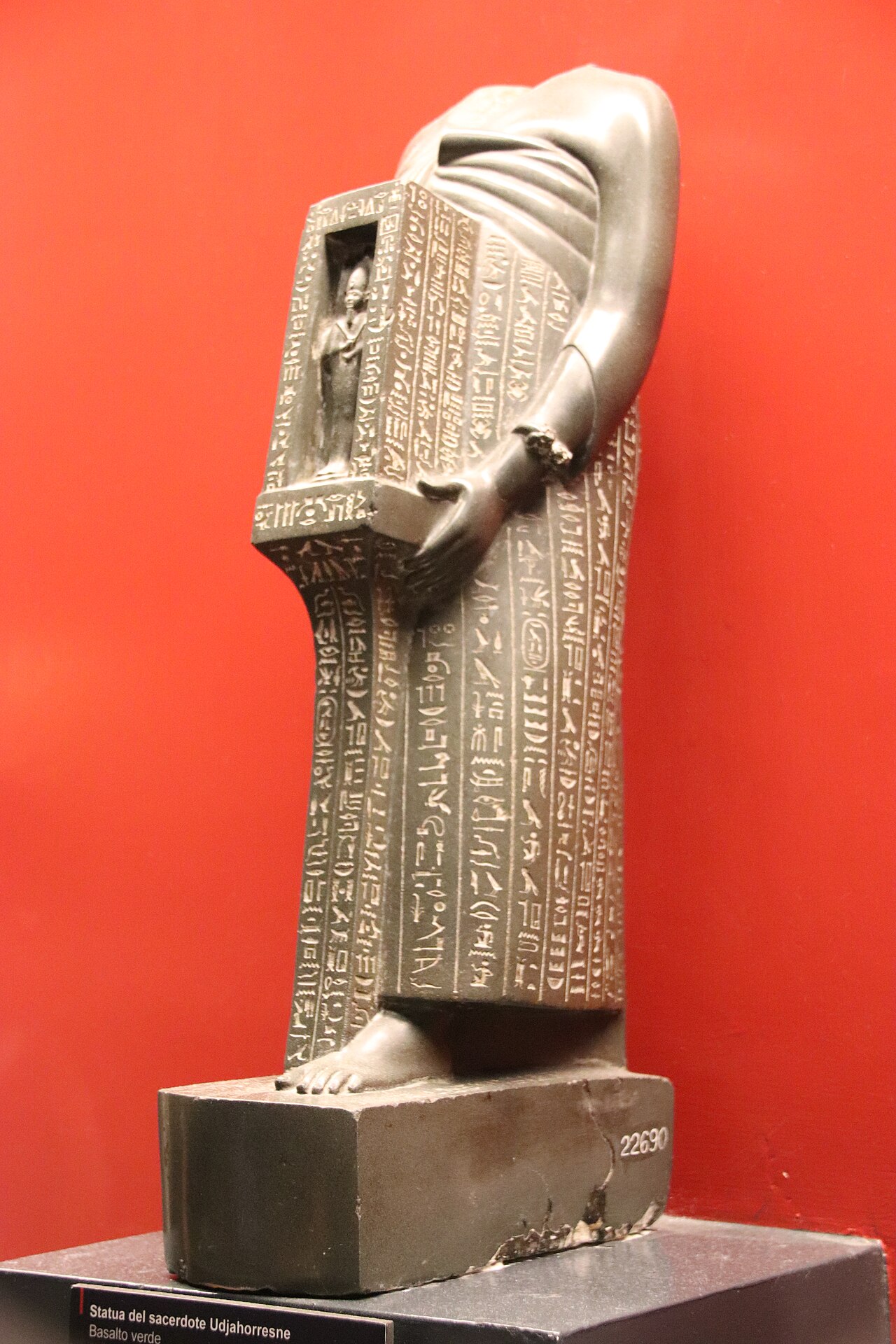

Udjahorresnet: an Egyptian in Persian service
The best witness to the first years is a green stone statue, now in the Vatican Museums, of Udjahorresnet, a priest and physician from Sais. He had commanded the royal fleet under the last native pharaohs, Amasis and Psamtik III. After the conquest he became Cambyses’ chief physician and, by his own account, composed the king’s Egyptian titulary. He persuaded Cambyses to expel foreigners who had camped in the great temple of Neith at Sais and to restore its income.
Under Darius he went to Elam, where the king was, and was then sent home to restore the “House of Life”, the temple school of scribes and doctors at Sais. Some modern writers have called him a collaborator; others see him as a member of the old elite making the best of foreign rule to protect his city and temples. Either way, his inscription shows a Persian king relying on Egyptian experts.
Darius I and Egypt
Darius was remembered well in Egypt. According to a later Demotic text, in his third year he ordered the satrap to assemble wise men from the army, priests and scribes to write down the laws of Egypt as they had stood under Amasis; the collection was copied in Demotic and Aramaic. He built or completed a temple to Amun at Hibis in the Kharga Oasis in the Western Desert, one of the few well-preserved temples of the period. He also finished a canal linking the Nile to the Red Sea, described on Darius’s canal.
A striking object links Egypt and Iran directly: a statue of Darius found at Susa in 1972, carved from Egyptian stone, with hieroglyphic inscriptions and figures of subject peoples on its base. It is now in the National Museum of Iran in Tehran.
How the province worked
The satrap governed from Memphis. Administration ran in Aramaic, the common language of the empire, alongside Egyptian Demotic. Herodotus says that Persian garrisons were stationed at Elephantine on the southern border, at Daphnae in the eastern Delta and at Marea in the west, as under the pharaohs before them.
The Elephantine garrison is unusually well known because papyri survive from it. Many of its soldiers were Jews, with their own temple to Yahweh. In 410 BCE Egyptian priests of the ram-god Khnum, with the help of a local Persian commander, destroyed the temple, and the Jewish community wrote to Bagohi, the governor of Judah, asking for support to rebuild it. Another group of Aramaic letters, written on leather and now in Oxford, comes from the office of Arsames, a Persian prince and satrap of Egypt in the later 5th century, and deals with his estates and servants.
Revolts and the loss of Egypt
Egypt rebelled more often than any other province. A rising at the end of Darius I’s reign, around 486 BCE, was put down by Xerxes, who made his brother Achaemenes satrap. Around 460 BCE Inaros, a Libyan prince, led a larger revolt with Athenian help; Achaemenes was killed in battle at Papremis, and it took the Persian general Megabyzus until about 454 to crush it. The details are on Artaxerxes I.
The decisive break came at the end of Darius II’s reign. Amyrtaeus of Sais rebelled around 404 BCE, and documents from Elephantine show that Persian authority there ended by about 400. For the next sixty years Egypt was independent under the 28th, 29th and 30th Dynasties, the last native pharaohs. Persian armies tried repeatedly to return, under Artaxerxes II with the satrap Pharnabazus in 373 BCE and under Artaxerxes III around 351, and failed each time.
The 31st Dynasty: the second Persian period
Artaxerxes III finally reconquered Egypt in 343/342 BCE, defeating Nectanebo II, who fled south. The campaign is told on Artaxerxes III and the reconquest of Egypt. Greek writers accuse the king of looting temples and killing the Apis bull, echoing the old stories about Cambyses; how far this is true is uncertain, and later Egyptian tradition had good reasons to paint the Persians black.
The second Persian period lasted barely ten years. A local ruler named Khababash held parts of the country around 338–336 BCE before Darius III’s officials recovered it. In 332 BCE the satrap Mazaces, with no army to resist, handed Egypt to Alexander without a fight, as described on Alexander takes Tyre, Gaza and Egypt.
How historians judge Persian rule
Older histories, relying on Herodotus and on hostile Egyptian traditions of the Ptolemaic period, described Persian rule as oppressive and sacrilegious. Egyptian evidence from the time gives a more mixed picture: kings who acted as pharaohs, temples that kept their income, and local elites who served in the administration. The frequent revolts show that many Egyptians never accepted foreign kings, but Persian rule in Egypt was not simply a military occupation. Compare Babylon under Persian rule, where the empire faced similar problems with an ancient kingdom.
Persian words from this page
| مصر | Mesr | Egypt |
| فرعون | fer’oun | pharaoh |
| نیل | Nil | the Nile |
| پادگان | pâdegân | garrison |
| شورش | shuresh | revolt |
| داریوش | Dâriush | Darius |
Sources and further reading
- Inscription of Udjahorresnet (Vatican Museums), translated in A. Kuhrt, The Persian Empire: A Corpus of Sources from the Achaemenid Period (2007).
- Herodotus, Histories Book 3; Thucydides 1.104 and 1.109–110 (the Inaros revolt).
- B. Porten, Archives from Elephantine: The Life of an Ancient Jewish Military Colony (1968).
- Encyclopaedia Iranica, “Egypt i. Persians in Egypt in the Achaemenid period” (E. Bresciani).
- Pierre Briant, From Cyrus to Alexander: A History of the Persian Empire (2002).
Want to learn Persian? Get the free Starter Pack
Get the 14-page printable Starter Pack (all 32 letters, a 7-day reading plan, 100 core words and 20 survival phrases) and a short 5-email course. Free.
More in The Achaemenid Empire (550–330 BCE)
- Achaemenes, Teispes and the Early Persian Kings of Anshan
- Cyrus the Great: Birth, Legends and Rise to Power
- Cyrus Conquers Lydia: Croesus and the Battle of Thymbra
- The Persian Conquest of Ionia and Asia Minor
- Cyrus Takes Babylon (539 BCE)
- The Cyrus Cylinder
- Cyrus and the Return of the Jews
- The Death of Cyrus and the Massagetae
- Pasargadae: Cyrus’s Capital and Tomb
- The Tomb of Cyrus through History
- Cambyses II
- Cambyses Conquers Egypt: The Battle of Pelusium
- Bardiya and Gaumata: The Usurper Question
- Darius the Great Takes the Throne
- The Great Revolts of 522–521 BCE
- The Behistun Inscription
- The Persian Conquest of the Indus Valley
- Darius’s Scythian Campaign
- Darius’s Canal from the Nile to the Red Sea
- Darius’s Reforms: Satrapies, Taxes and Law
- The Royal Road and the Persian Postal System
- The Daric: Achaemenid Coinage and Economy
- The Ionian Revolt (499–493 BCE)
- The Greco-Persian Wars: An Overview
- Mardonius and the First Persian Expedition to Greece (492 BCE)
- The Battle of Marathon (490 BCE)
- The Death of Darius I and the Succession of Xerxes
- The Royal Tombs of Naqsh-e Rostam
- Xerxes I: King of Kings (486–465 BCE)
- Xerxes’ Invasion of Greece (480–479 BCE)
- The Battle of Thermopylae (480 BCE)
- The Battle of Artemisium (480 BCE)
- The Persian Capture of Athens (480–479 BCE)
- The Battle of Salamis (480 BCE)
- The Battle of Plataea and the End of the Invasion (479 BCE)
- The Palace of Darius at Susa
- Building Persepolis: How Darius and Xerxes Built Parsa
- The Persepolis Fortification and Treasury Tablets
- Herodotus and the Persians
- The Apadana Reliefs: Nations Bringing Gifts
- The Achaemenid Paradise Gardens
- The Persian Immortals and the Achaemenid Army
- The Achaemenid Navy
- Religion of the Achaemenid Kings
- Women of the Achaemenid Court
- Old Persian Language and Cuneiform
- Egypt under Persian Rule
- Babylon under Persian Rule
- Artaxerxes I
- The Peace of Callias
- Darius II and the Peloponnesian War
- Famous Satraps of the Persian Empire
- Artaxerxes II Mnemon
- Cyrus the Younger and the Battle of Cunaxa
- The King’s Peace (387 BCE)
- The Great Satraps’ Revolt
- Artaxerxes III and the Reconquest of Egypt
- Darius III, the Last Achaemenid King
- The Battle of the Granicus (334 BCE)
- The Battle of Issus (333 BCE)
- Alexander Takes Tyre, Gaza and Egypt (332 BCE)
- The Battle of Gaugamela (331 BCE)
- Ariobarzanes and the Battle of the Persian Gate
- The Burning of Persepolis (330 BCE)
- The Death of Darius III and Bessus
- The Legacy of the Achaemenid Empire