Mount Sabalan (سبلان; Savalan in local Azerbaijani Turkish) is an extinct volcano in Ardabil province, north-west Iran, and at roughly 4,800 metres it is the country’s third-highest mountain after Damavand and Alam Kuh. Its summit holds a small crater lake that stays frozen for most of the year, and its lower slopes are known for hot springs, summer pastures of the Shahsevan nomads and the spa town of Sareyn.
| Height | About 4,800 m; figures range from 4,740 m (Encyclopaedia Iranica) to 4,811 m |
|---|---|
| Type | Large andesite stratovolcano, no historical eruptions |
| Place | Ardabil province, about 40 km west of Ardabil city |
| Ice | Several small summit glaciers and a crater lake |
| Climbing season | Usually late June to mid-August |
| Nearby towns | Ardabil, Sareyn, Meshgin Shahr |
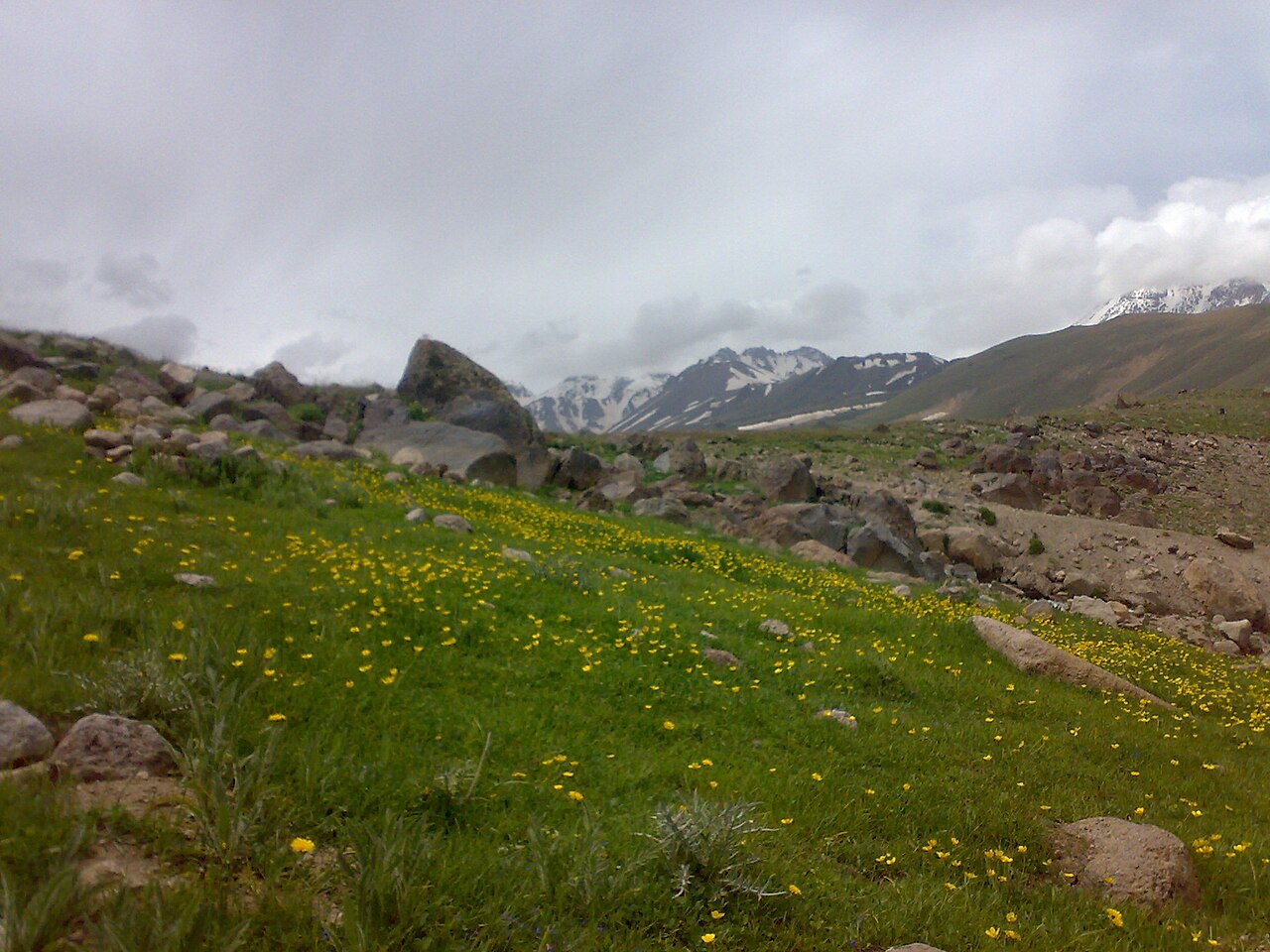

A volcano on the edge of the Caucasus
Sabalan rises out of a broad volcanic region of north-west Iran that also includes Mount Sahand near Tabriz. Its massif stretches about 50 km from east to west and is visible from far across the Ardabil and Meshgin plains. Geologists date its main activity to the last few million years; it has not erupted in recorded history, but the many hot and mineral springs around its base show that the ground below is still warm.
Because it is so high and so far north, Sabalan is one of the few mountains in Iran with glaciers. Encyclopaedia Iranica describes it as the only massif between Mount Ararat and the Alam Kuh range with recent glaciation, carrying seven small glaciers near the summit. The crater lake (دریاچه, daryâche) just below the highest point is usually frozen except for a few weeks in late summer.
Nomads and summer pastures
Sabalan’s slopes have long been the summer pastures (ییلاق, yeylâq) of the Shahsevan, a confederation of Turkic-speaking pastoral tribes. Traditionally they spent the winter on the lowland Moghan steppe to the north and drove their flocks up to Sabalan in spring, camping in round felt tents at heights of up to about 3,500 metres. Large irrigation schemes in Moghan have pushed many families to settle, but in summer you can still see herders’ camps on the mountain, especially on the way up to the climbing base.
Anthropologist Richard Tapper’s long study of the Shahsevan is the best account of their history and way of life.
Hot springs
The thermal springs (آب گرم, âb-e garm) around Sabalan are its main attraction for most Iranian visitors. The sulphurous water has a strong local reputation for healing skin and joint complaints.
- Sareyn, about 25 km west of Ardabil, is a small town built around its springs, with public baths, pools and hotels. In summer its population swells many times over with holidaymakers.
- Qotur Suyi, high on the northern slope above Meshgin Shahr at about 2,450 m, is a remote spring where nomads once brought their animals to bathe.
- Shabil, on the southern side, has springs and is a common starting point for climbs.
Near Sareyn is the Alvares ski area, which offers winter skiing on Sabalan’s lower slopes; for Iran’s main resorts see Skiing in Iran: Dizin and Shemshak.
Climbing Sabalan
For fit, well-prepared walkers Sabalan is a non-technical climb in summer, mostly a scramble over rock and scree, but it is a serious high mountain. Most parties drive to a base hut high on the southern or northern side, spend a night there to acclimatise, and climb to the summit and back the next day. On summer weekends hundreds of Iranian climbers may be on the mountain.
Safety
- Altitude sickness is a real risk above 3,500 m. Spend a night or two at height before the summit day, and descend if you get a severe headache, confusion or breathlessness.
- Storms, hail and snow can hit the summit even in July and August. Carry warm, waterproof clothing.
- Outside the short summer season the mountain is a winter climb needing ice-axe, crampons and experience.
- Hire a local guide through a recognised mountaineering club or agency in Ardabil, and check current access arrangements.
- Follow your own government’s current travel advice for Iran, including for border provinces.
Combining Sabalan with Ardabil
Ardabil itself is the natural base, a cool city in summer with the Safavid family shrine of Sheikh Safi al-Din. See Ardabil for the city, and Mount Damavand for Iran’s highest volcano.
Persian words from this page
| سبلان | Sabalân | Sabalan |
| آتشفشان | âtashfeshân | volcano |
| یخچال | yakhchâl | glacier (also an ice house) |
| دریاچه | daryâche | lake |
| آب گرم | âb-e garm | hot spring (“warm water”) |
| ییلاق | yeylâq | summer pasture |
| عشایر | ashâyer | nomadic tribes |
Sources and further reading
- Encyclopaedia Iranica, “Sabalān Mountain” (Eckart Ehlers).
- Richard Tapper, Frontier Nomads of Iran: A Political and Social History of the Shahsevan (Cambridge University Press, 1997).
- J. V. Harrison, “Geology”, in W. B. Fisher (ed.), The Cambridge History of Iran, vol. 1 (Cambridge, 1968).
Want to learn Persian? Get the free Starter Pack
Get the 14-page printable Starter Pack (all 32 letters, a 7-day reading plan, 100 core words and 20 survival phrases) and a short 5-email course. Free.
More in Top Places to Visit in Iran
- Naqsh-e Jahan Square
- Shah (Imam) Mosque, Isfahan
- Sheikh Lotfollah Mosque
- Ali Qapu Palace
- Jameh Mosque of Isfahan
- Si-o-se Pol and Khaju Bridge
- Vank Cathedral
- Hasht Behesht Palace
- Naqsh-e Rostam
- Eram Garden, Shiraz
- Nasir al-Molk (Pink) Mosque
- Tomb of Hafez (Hafezieh)
- Tomb of Saadi (Saadieh)
- Shah Cheragh Shrine
- Arg of Karim Khan
- Fin Garden, Kashan
- Historic Houses of Kashan
- Jameh Mosque of Yazd
- Yazd Fire Temple and Towers of Silence
- Dowlatabad Garden and Windcatcher
- Amir Chakhmaq Complex
- Golestan Palace
- National Museum of Iran
- Treasury of National Jewels
- Tehran Grand Bazaar
- Milad Tower
- Imam Reza Shrine, Mashhad
- Tomb of Ferdowsi, Tus
- Tomb of Omar Khayyam, Neyshabur
- Tomb of Avicenna, Hamadan
- Ganjnameh Inscriptions, Hamadan
- Behistun (Bisotun): Visiting the Site
- Taq-e Bostan: Visiting the Site
- Tabriz Historic Bazaar
- Takht-e Soleyman
- Armenian Monastic Ensembles of Iran
- Sheikh Safi al-Din Shrine, Ardabil
- Dome of Soltaniyeh
- Alamut Castle
- Falak-ol-Aflak Castle
- Shushtar Historical Hydraulic System
- Chogha Zanbil: Visiting the Ziggurat
- Susa Archaeological Site
- Arg-e Bam
- Ganjali Khan Complex, Kerman
- Shazdeh Garden, Mahan
- Rayen Castle
- Dasht-e Lut (Lut Desert)
- Maranjab Desert and Caravanserai
- Varzaneh Desert
- Mount Damavand
- Hyrcanian Forests
- Lake Urmia
- Badab-e Surt Springs
- Ali Sadr Cave
- The Kaluts of Shahdad
- Qeshm Geopark
- Hormuz Island Colours
- Visiting Persepolis: A Day Trip from Shiraz
- Visiting Pasargadae
- Persian Caravanserais
- The Qanat of Gonabad
- Meymand Village
- Sasanian Sites of Fars: Firuzabad, Bishapur and Sarvestan
- Gonbad-e Qabus: Visiting the Tower
- Zayandeh Rud and Isfahan’s Bridges
- Tochal and Darband: Hiking Above Tehran
- Mount Sabalan
- Skiing in Iran: Dizin and Shemshak
- Golestan National Park