Taq-e Bostan is a group of Sasanian rock carvings at the foot of a mountain on the north-eastern edge of Kermanshah, in western Iran, where a spring feeds a large pool. Carved between the late 4th and early 7th centuries CE, it includes an open-air investiture relief, a small grotto with two kings, and a great arched grotto with royal hunting scenes usually attributed to Khosrow II. They are the last major Sasanian rock reliefs.
| Place | North-eastern Kermanshah, western Iran |
|---|---|
| Persian name | طاق بستان (Tâq-e Bostân) |
| Date | Late 4th century to c. 628 CE |
| Monuments | Investiture of Ardashir II; small grotto of Shapur II and Shapur III; large grotto (Taq-e Bozorg) |
| Large grotto | Usually attributed to Khosrow II (r. 590–628); other attributions proposed |
| Later addition | A Qajar relief of the early 19th century |
A royal garden on the road to the east
Kermanshah sits on the old high road from Mesopotamia to the Iranian plateau, the route that ran from Ctesiphon over the Zagros to Hamadan. Not far east lies Bisotun, where Darius I had his great inscription carved. At Taq-e Bostan a strong spring rises at the base of the cliff, and the Sasanian kings, who spent time in this region as a cool summer retreat and hunting ground, turned the place into a royal setting. The name is usually explained as “the arch of the garden”.
The carvings fall into three groups of different date.
The investiture of Ardashir II
The earliest is an open-air relief on the rock face. A king stands in the centre and receives a beribboned ring from a figure on his right, usually taken as Ohrmazd. On his left stands a god with a halo of rays, holding a bundle of rods (the barsom) and standing on a lotus flower: this is Mithra. Under the feet of the king and Ohrmazd lies a fallen enemy, often identified as the Roman emperor Julian, who died invading Persia in 363 (see Julian’s invasion of Persia). Most scholars assign the relief to Ardashir II (r. 379–383); some prefer Shapur II. It is one of the few Sasanian images of Mithra.
The small grotto of Shapur II and Shapur III
Beside it, Shapur III (r. 383–388) had a small barrel-vaulted recess cut into the rock. On its back wall two kings stand side by side, each resting his hands on a long sword, and Middle Persian inscriptions name them as Shapur II and his son Shapur III. Placing a relief inside a vaulted recess, like the iwan of a palace, was new. The story of this king is told on the page on Shapur III and the partition of Armenia.
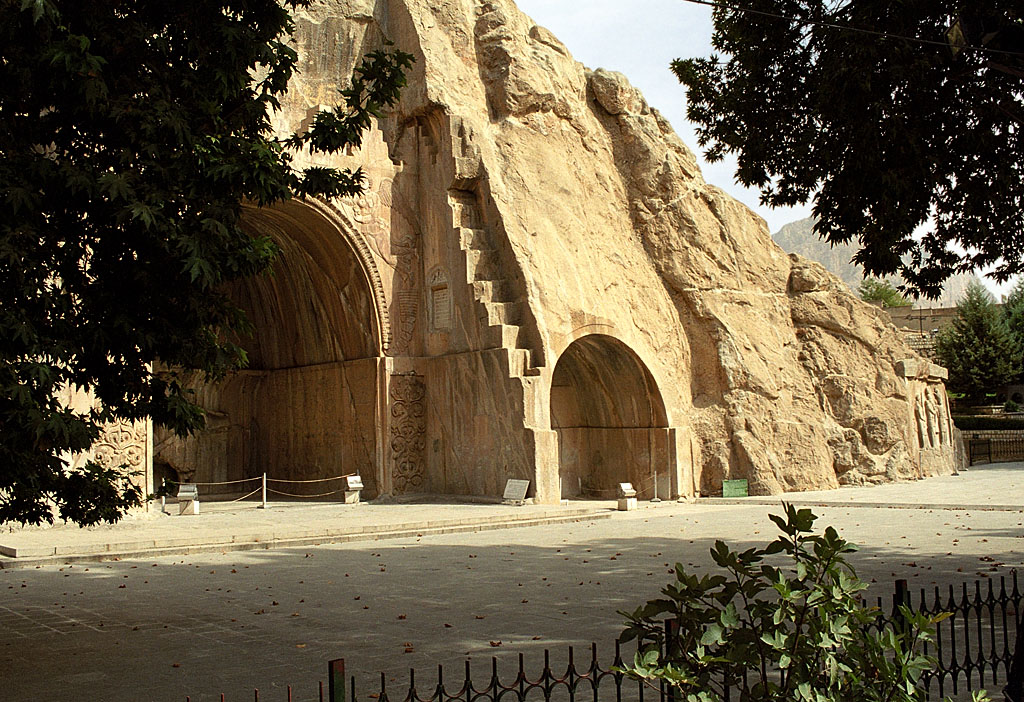

The great grotto
The largest monument, often called Taq-e Bozorg, is a deep arched grotto carved out of the cliff like a palace hall open to the pool. It enlarges the idea of the small grotto into something much grander.
The facade
Above the arch, two winged female figures hold out ribboned diadems. They are clearly modelled on the Victories of Roman and Byzantine art, a sign of how closely the late Sasanian court followed, and competed with, Constantinople. Along the sides of the arch run panels of stylised trees.
The back wall
The back wall has two levels. Above, a king stands between two divine figures: on one side a male figure, usually Ohrmazd, offers him a ring; on the other a female figure holding a ewer, usually identified as Anahita, offers another. Below, filling the lower half, is a huge figure of a horseman in full armour, with helmet, mail veil, lance and shield, riding a heavy horse. It is the best image anywhere of a late Sasanian heavy cavalryman. Popular tradition, already recorded by medieval writers, calls him Khosrow on his famous horse Shabdiz.
The hunting walls
The two side walls show royal hunts in astonishing detail. On the left, a boar hunt in a marsh: the king stands in a boat drawing his bow while elephants drive the boars through reeds, musicians play from other boats, and fish and birds fill the water. On the right, a deer hunt: the king rides out under a parasol, deer are driven into an enclosure, and women musicians play on a platform. Parts of both scenes were left unfinished, so they show how the carvers worked, from sketch to finished relief. The textiles worn by the figures are carved with patterns of birds, animals and roundels that match surviving Sasanian silks, and the panels are a major source for court dress.
Who made it
No inscription names the patron of the great grotto. Most scholars attribute it to Khosrow II Parviz (r. 590–628), whose court was famous for its luxury (see Khosrow II Parviz). The crowns in the investiture scene resemble his coin portraits, and the unfinished state fits a reign that ended in sudden defeat and murder in 628. Other kings, including Peroz (r. 459–484), have been proposed, and the question is still discussed.
Later layers
After the Sasanians the grottoes remained famous. Arab and Persian geographers described them, often under the name Shabdiz, and wove them into the love story of Khosrow and Shirin told by Nizami. In the early 19th century, in the time of the Qajar prince-governor of Kermanshah, Mohammad-Ali Mirza Dowlatshah, a new relief showing Fath-Ali Shah and his court was carved into the rock beside the old ones, a deliberate act of placing the new dynasty beside the Sasanians.
For travel information and what to see on a visit, see the places page on Taq-e Bostan, and for Kermanshah itself, Kermanshah.
Persian words from this page
| طاق | tâq | arch, vault |
| بستان | bostân | garden |
| شبدیز | Shabdiz | Khosrow’s horse |
| خسرو پرویز | Khosrow Parviz | Khosrow II |
| شکار | shekâr | hunt |
| میترا | Mitrâ | Mithra |
Sources and further reading
- Shinji Fukai and Kiyoharu Horiuchi, Taq-i-Bustan, 4 vols. (1969–1984)
- Encyclopaedia Iranica, “Taq-e Bostan” (iranicaonline.org)
- Georgina Herrmann, The Iranian Revival (1977)
- Matthew P. Canepa, The Two Eyes of the Earth (2009)
- Nizami Ganjavi, Khosrow and Shirin
Want to learn Persian? Get the free Starter Pack
Get the 14-page printable Starter Pack (all 32 letters, a 7-day reading plan, 100 core words and 20 survival phrases) and a short 5-email course. Free.
More in The Sasanian Empire (224–651 CE)
- The Origins of the Sasanian Family
- Ardashir I, Founder of the Sasanian Empire
- Firuzabad: Ardashir’s Round City
- Shapur I, King of Kings of Iran and Non-Iran
- Bishapur: Shapur’s City
- The Battle of Edessa and the Capture of Valerian
- The Ka’ba-ye Zartosht Inscription of Shapur I
- Mani and Manichaeism
- Hormizd I and Bahram I
- Kartir and the Zoroastrian Church
- Bahram II
- Narseh and the Peace of Nisibis
- Shapur II the Great
- Julian’s Invasion of Persia (363)
- Christians in the Sasanian Empire
- Shapur III and the Partition of Armenia
- Yazdegerd I
- Bahram V Gur
- Yazdegerd II
- The Battle of Avarayr (451)
- The Hephthalites and Iran’s Eastern Frontier
- Peroz I and the Hephthalite Disaster
- Kavad I
- Zamasp and Kavad’s Return
- Mazdak and the Mazdakite Movement
- Khosrow I Anushirvan the Just
- The Sasanian–Byzantine Wars of the 6th Century
- The Battle of Dara (530)
- Khosrow I Sacks Antioch (540)
- The Lazic War (541–562)
- The Reforms of Khosrow I
- The Academy of Gondishapur: History and Legend
- Borzuya, Chess and Kalila wa Dimna
- Taq Kasra: The Arch of Ctesiphon
- The Sasanian Conquest of Yemen
- The Sasanians and the Western Turks
- Hormizd IV
- Bahram Chobin’s Rebellion
- Khosrow II Parviz
- The Last Great War: Byzantium and Persia, 602–628
- The Siege of Constantinople (626)
- Heraclius Strikes Back
- Shirin: Queen and Legend
- Shahrbaraz, the General Who Became King
- Civil War and the Queens Boran and Azarmidokht
- Yazdegerd III, the Last Sasanian King
- The Sasanian Army
- Sasanian Society and the Class System
- Zoroastrianism under the Sasanians
- Sasanian Art: Silver, Reliefs and Silk
- The Sasanian Reliefs of Naqsh-e Rostam
- Taq-e Bostan
- Sasanian Cities, Palaces and Bridges
- Middle Persian (Pahlavi) Language and Literature
- Sasanian Coins and Silverwork
- Women in the Sasanian Empire
- Polo, Hunting and Games at the Sasanian Court
- The Sasanian Legacy