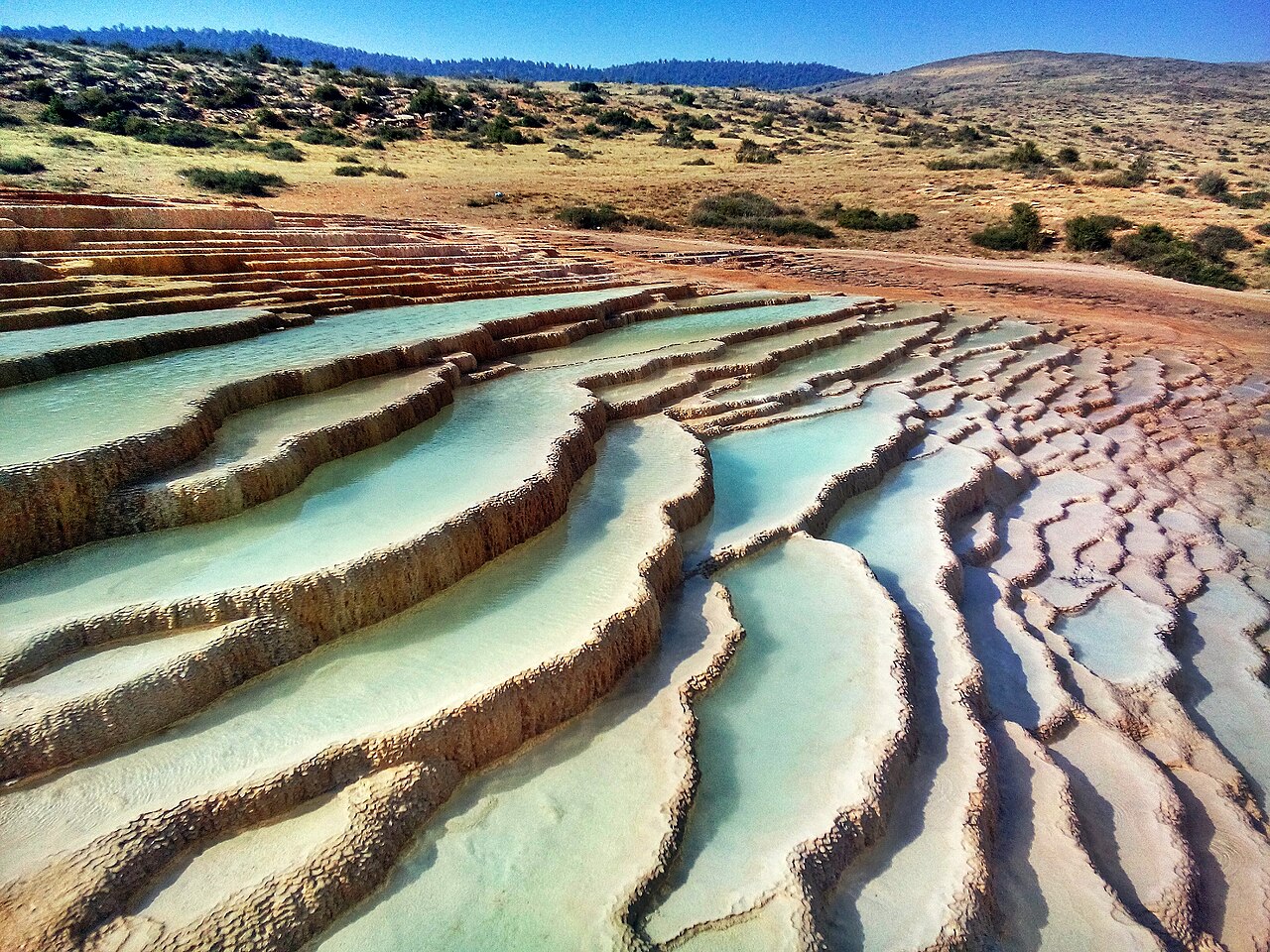
Badab-e Surt (باداب سورت) is a hillside of orange, red and cream travertine terraces in the mountains of Mazandaran, about 95 km south-east of Sari and 7 km from the village of Orost. Two mineral springs at about 1,840 metres have built the terraces over thousands of years, and the site is often compared with Pamukkale in Turkey, on a smaller and wilder scale.
| Persian name | Bâdâb-e Surt |
|---|---|
| Location | Near Orost village, Chahardangeh area, Sari county, Mazandaran |
| Altitude | About 1,840 m |
| What it is | Travertine terraces deposited by two carbonated mineral springs |
| Colours | Orange and red from iron oxides; white and yellow from calcium carbonate |
| Best time | Late spring to autumn, early morning or late afternoon |

What the name means
Bâdâb is made of bâd, “wind” or “gas”, and âb, “water”: gassy, fizzy water, a fair description of carbonated spring water. Surt is taken to be an old name connected with Orost, the nearest village. Locals simply call the site Badab.
How the terraces form
Rain and snowmelt sink into the limestone of the eastern Alborz and pick up carbon dioxide underground, which lets the water dissolve calcium and iron carbonates. When the water reaches the surface, the gas escapes, just as it does when you open a bottle of soda. The water can no longer hold all its dissolved minerals, so they come out of solution and are left behind as a soft, jelly-like deposit that slowly hardens into travertine.
The water flows down the slope in thin sheets. Wherever it slows at an edge, a little more mineral is deposited, so rims grow upwards and pools form behind them. Step by step this builds the staircase of shallow basins you see today. Geologists date the start of the deposits to the late Pliocene and Pleistocene; the visible terraces are still growing where water reaches them.
Two springs, two colours
The site has two separate springs with different water.
- One is very salty and collects in a small natural pool. Local people consider it good for rheumatism and skin complaints.
- The other is sour to the taste and rich in iron. As soon as it meets the air the iron oxidises and stains the rock rust-orange and red, the colour that makes Badab-e Surt famous.
Where the two streams have flowed over time, the terraces are banded in red, orange, yellow and white. The colours are brightest in the low sun and after rain, when the pools are full.
What you see on a visit
From the parking area a path leads along the top of the slope. Below it the terraces spill down the hillside in several fans, with the pools catching the sky. The view across the valley to forested ridges and, in the right light, layers of mountains fading into the distance, is as much a part of the visit as the terraces themselves. Sunset is the most photographed hour; sunrise is quieter.
The terraces are fragile. A footstep breaks the thin growing rims and the iron coating, and heavy visitor numbers in the 2000s and 2010s scarred parts of the site. Treat the terraces as off-limits even where there is no barrier: stay on the path, do not bathe in the pools, and do not take pieces of rock.
Getting there
Badab-e Surt is remote. The usual approach is from Sari on the Caspian side, by the mountain road towards Kiasar and then on to Orost, a drive of several hours that climbs from forest into drier hills. The last stretch is a rough track; it may need a high-clearance vehicle and can be closed by snow or mud in winter and early spring. Many travellers hire a driver in Sari or join a tour, and some stay overnight in villages nearby to see the terraces at both ends of the day.
- Bring warm clothes: at 1,800 m evenings are cool even in summer.
- There are few services on site; carry water and food.
- Check road conditions and any access arrangements locally before you go, and follow your own government’s travel advice for Iran.
The drive passes through the southern fringe of the Hyrcanian forests, and Badab-e Surt can be combined with a stay on the Caspian coast; see the guide to the north of Iran and the page on Sari. For Iran’s other strange rock colours, see the rainbow hills of Hormuz.
Persian words from this page
| چشمه | cheshme | spring |
| آب | âb | water |
| باد | bâd | wind, gas |
| پله | pelle | step |
| نارنجی | nârenji | orange (colour) |
| روستا | rustâ | village |
Sources and further reading
- “Badab-e Surt”, Wikipedia, consulted 2026, with references to Iranian geological literature.
- A. Pentecost, Travertine (Springer, 2005), for how travertine terraces form.
Want to learn Persian? Get the free Starter Pack
Get the 14-page printable Starter Pack (all 32 letters, a 7-day reading plan, 100 core words and 20 survival phrases) and a short 5-email course. Free.
More in Top Places to Visit in Iran
- Naqsh-e Jahan Square
- Shah (Imam) Mosque, Isfahan
- Sheikh Lotfollah Mosque
- Ali Qapu Palace
- Jameh Mosque of Isfahan
- Si-o-se Pol and Khaju Bridge
- Vank Cathedral
- Hasht Behesht Palace
- Naqsh-e Rostam
- Eram Garden, Shiraz
- Nasir al-Molk (Pink) Mosque
- Tomb of Hafez (Hafezieh)
- Tomb of Saadi (Saadieh)
- Shah Cheragh Shrine
- Arg of Karim Khan
- Fin Garden, Kashan
- Historic Houses of Kashan
- Jameh Mosque of Yazd
- Yazd Fire Temple and Towers of Silence
- Dowlatabad Garden and Windcatcher
- Amir Chakhmaq Complex
- Golestan Palace
- National Museum of Iran
- Treasury of National Jewels
- Tehran Grand Bazaar
- Milad Tower
- Imam Reza Shrine, Mashhad
- Tomb of Ferdowsi, Tus
- Tomb of Omar Khayyam, Neyshabur
- Tomb of Avicenna, Hamadan
- Ganjnameh Inscriptions, Hamadan
- Behistun (Bisotun): Visiting the Site
- Taq-e Bostan: Visiting the Site
- Tabriz Historic Bazaar
- Takht-e Soleyman
- Armenian Monastic Ensembles of Iran
- Sheikh Safi al-Din Shrine, Ardabil
- Dome of Soltaniyeh
- Alamut Castle
- Falak-ol-Aflak Castle
- Shushtar Historical Hydraulic System
- Chogha Zanbil: Visiting the Ziggurat
- Susa Archaeological Site
- Arg-e Bam
- Ganjali Khan Complex, Kerman
- Shazdeh Garden, Mahan
- Rayen Castle
- Dasht-e Lut (Lut Desert)
- Maranjab Desert and Caravanserai
- Varzaneh Desert
- Mount Damavand
- Hyrcanian Forests
- Lake Urmia
- Badab-e Surt Springs
- Ali Sadr Cave
- The Kaluts of Shahdad
- Qeshm Geopark
- Hormuz Island Colours
- Visiting Persepolis: A Day Trip from Shiraz
- Visiting Pasargadae
- Persian Caravanserais
- The Qanat of Gonabad
- Meymand Village
- Sasanian Sites of Fars: Firuzabad, Bishapur and Sarvestan
- Gonbad-e Qabus: Visiting the Tower
- Zayandeh Rud and Isfahan’s Bridges
- Tochal and Darband: Hiking Above Tehran
- Mount Sabalan
- Skiing in Iran: Dizin and Shemshak
- Golestan National Park