Old Persian is the language of the Achaemenid kings, the oldest recorded form of Persian, written from about 520 BCE in a cuneiform script made for the royal inscriptions. It is the direct ancestor of Middle Persian and of the Persian spoken in Iran today, so that words such as Old Persian xšāyaθiya, “king”, and brātar, “brother”, live on as modern شاه (shâh) and برادر (barâdar).
| Language family | Indo-European, Iranian branch (Southwestern Iranian) |
|---|---|
| Homeland | Pârsa, today’s Fars province |
| Written | c. 520 to c. 340 BCE |
| Script | Old Persian cuneiform: 36 sound signs, a handful of word signs, a word divider and numerals |
| Main texts | Behistun, Persepolis, Susa, Naqsh-e Rostam, Ganjnameh, Van |
| Deciphered | Georg Friedrich Grotefend (1802), Henry Rawlinson and others (1830s–1840s) |
| Modern Persian name | فارسی باستان (Fârsi-ye bâstân) |

A script made for kings
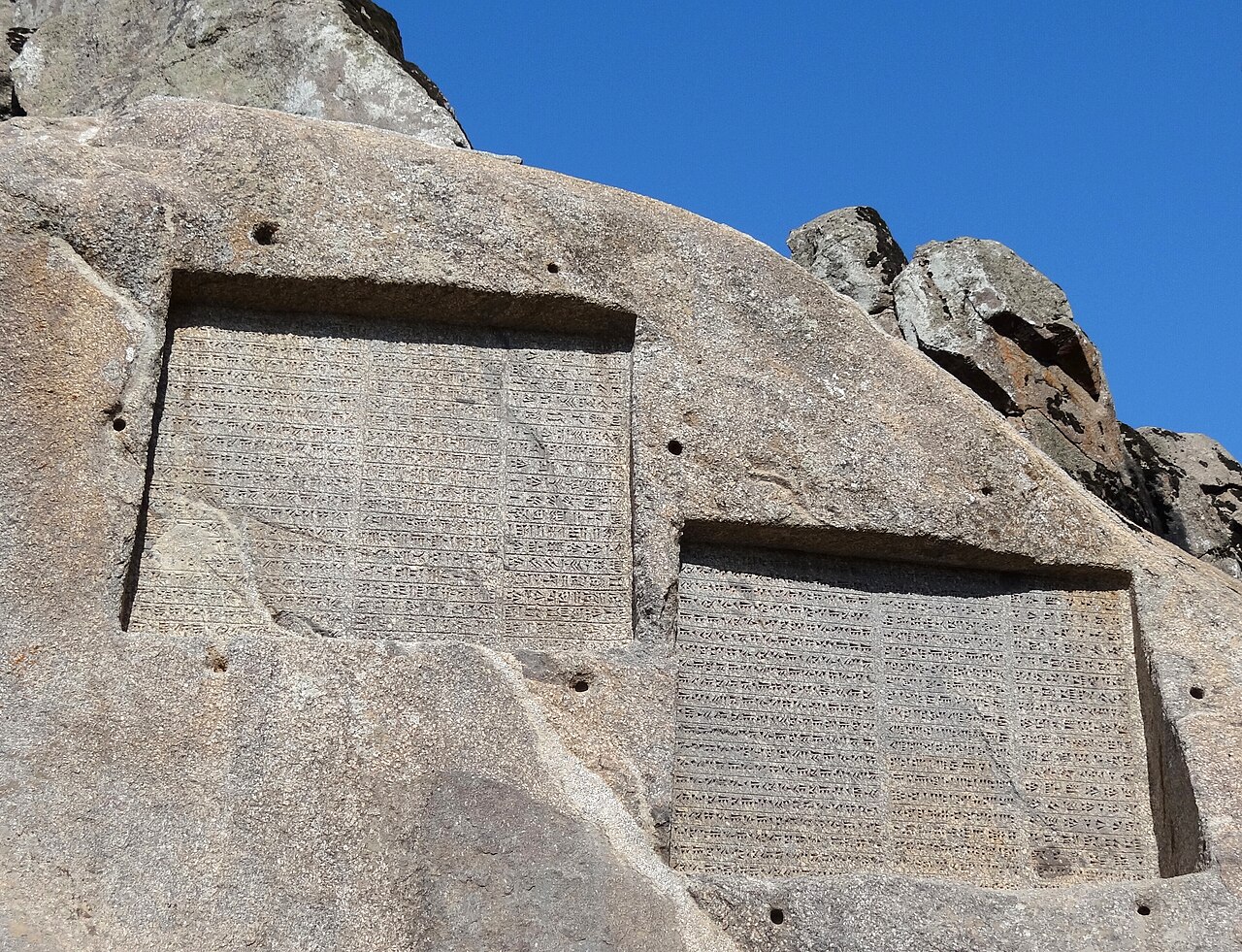
Old Persian cuneiform looks like the wedge writing of Mesopotamia, pressed or carved with the same triangular strokes, but it works quite differently. Babylonian and Elamite cuneiform used hundreds of signs for whole words and syllables. The Old Persian script has only 36 signs for sounds: three for the vowels a, i and u, and the rest for a consonant with a following vowel (such as ka or ku). On top of these come a few word signs for “king”, “country”, “earth”, “god” and the name Ahuramazda, a sloping wedge that divides one word from the next, and signs for numbers. It is a half alphabet, half syllabary, and one of the simplest cuneiform systems ever used.
Who designed it and when is debated. In a passage near the end of the Behistun inscription, Darius I says he made a form of writing “in Aryan” that had not existed before. Many scholars take this as the invention of the script around 520 BCE. The short texts in Cyrus’s name at Pasargadae are then explained as additions made under Darius, and gold tablets in the names of his great-grandfather Ariaramnes and grandfather Arsames are widely thought to be later works, not originals of their time.
Where Old Persian was written
Old Persian was a monument language. It was carved on rock faces, palace walls, column bases, door frames, gold and silver foundation plates, stone weights and seals, nearly always alongside Elamite and Babylonian versions, and sometimes Egyptian hieroglyphs. The largest text is Behistun. Others include Darius’s tomb at Naqsh-e Rostam, the foundation charters of Susa, the inscriptions of Persepolis, the two panels at Ganjnameh near Hamadan, and the Xerxes inscription on the citadel rock of Van in eastern Turkey.
The empire did not run on Old Persian. Its accounts at Persepolis were kept in Elamite, its letters across the provinces in Aramaic, and local records in Babylonian, Egyptian or Greek. Among the tens of thousands of Persepolis tablets, a single administrative text in Old Persian was identified in 2007 by Matthew Stolper and Jan Tavernier, which shows that scribes could use it for business, but rarely did.
The last inscriptions
Old Persian texts continue under Xerxes, Artaxerxes I, Darius II and Artaxerxes II, but grow shorter and more formulaic. Inscriptions of Artaxerxes II and Artaxerxes III contain grammatical forms that look wrong by the standards of Darius’s time: case endings misplaced or dropped. Scholars read them as a sign that the spoken language had already moved toward Middle Persian, while the carvers copied an old formula they no longer fully understood.
How it was deciphered
European travellers copied the Persepolis inscriptions from the seventeenth century, among them the French jeweller Jean Chardin. In the 1760s the Danish traveller Carsten Niebuhr made careful copies and saw that they contained three different scripts, with the simplest always first.
In 1802 a young German teacher, Georg Friedrich Grotefend, guessed that two short texts followed a pattern known from later Persian royal inscriptions: “X, great king, king of kings, son of Y”. Using the Greek king lists, he matched the repeated words to the names Darius, Xerxes and Darius’s father Hystaspes, and read about a third of the signs correctly. The work was completed in the 1830s and 1840s by several scholars, above all Henry Rawlinson, who copied the Behistun inscription on its cliff, and the Old Persian key then opened the Elamite and Babylonian versions beside it.
From Old Persian to the Persian of today
Old Persian was a heavily inflected language, close in structure to Avestan and Sanskrit. Nouns had several cases and three genders, and verbs many endings. By the time of Middle Persian, the language of the Sasanian empire written in the Pahlavi script, most of these endings had gone. Modern Persian, written in Arabic script since the ninth and tenth centuries, continued the simplification and added many Arabic words, but its core vocabulary still runs back to the Achaemenid inscriptions:
- xšāyaθiya “king” became Middle Persian šāh, modern shâh; the title “king of kings” survives as shâhanshâh.
- adam “I” is the ancestor of modern man.
- pitar “father” became pedar, and brātar “brother” became barâdar.
- būmi “earth, land” survives in bum, as in marz-o-bum, homeland.
- Pārsa, the name of the homeland, became Fârs, and through Arabic, the word Fârsi for the language itself.
A reader of modern Persian cannot read Old Persian without study, much as an English speaker cannot read Old English. But the line of descent is direct, and few languages can show their own words carved in stone 2,500 years ago. For the other languages spoken in Iran today, see Languages Spoken in Iran.
Persian words from this page
| فارسی باستان | Fârsi-ye bâstân | Old Persian |
| خط میخی | khatt-e mikhi | cuneiform (“nail script”) |
| شاهنشاه | shâhanshâh | king of kings |
| پدر | pedar | father |
| برادر | barâdar | brother |
| مرز و بوم | marz-o-bum | homeland |
| فارس | Fârs | Fars, ancient Pârsa |
| گنجنامه | Ganjnâmeh | Ganjnameh |
Sources and further reading
- Roland G. Kent, Old Persian: Grammar, Texts, Lexicon (2nd ed., New Haven, 1953).
- Rüdiger Schmitt, The Bisitun Inscriptions of Darius the Great: Old Persian Text (Corpus Inscriptionum Iranicarum, London, 1991).
- Matthew W. Stolper and Jan Tavernier, “An Old Persian Administrative Tablet from the Persepolis Fortification”, ARTA 2007.001.
- Amélie Kuhrt, The Persian Empire: A Corpus of Sources from the Achaemenid Period (2007).
- Encyclopaedia Iranica, “Old Persian” and “Decipherment of Cuneiform Scripts” (articles on iranicaonline.org).
Want to learn Persian? Get the free Starter Pack
Get the 14-page printable Starter Pack (all 32 letters, a 7-day reading plan, 100 core words and 20 survival phrases) and a short 5-email course. Free.
More in The Achaemenid Empire (550–330 BCE)
- Achaemenes, Teispes and the Early Persian Kings of Anshan
- Cyrus the Great: Birth, Legends and Rise to Power
- Cyrus Conquers Lydia: Croesus and the Battle of Thymbra
- The Persian Conquest of Ionia and Asia Minor
- Cyrus Takes Babylon (539 BCE)
- The Cyrus Cylinder
- Cyrus and the Return of the Jews
- The Death of Cyrus and the Massagetae
- Pasargadae: Cyrus’s Capital and Tomb
- The Tomb of Cyrus through History
- Cambyses II
- Cambyses Conquers Egypt: The Battle of Pelusium
- Bardiya and Gaumata: The Usurper Question
- Darius the Great Takes the Throne
- The Great Revolts of 522–521 BCE
- The Behistun Inscription
- The Persian Conquest of the Indus Valley
- Darius’s Scythian Campaign
- Darius’s Canal from the Nile to the Red Sea
- Darius’s Reforms: Satrapies, Taxes and Law
- The Royal Road and the Persian Postal System
- The Daric: Achaemenid Coinage and Economy
- The Ionian Revolt (499–493 BCE)
- The Greco-Persian Wars: An Overview
- Mardonius and the First Persian Expedition to Greece (492 BCE)
- The Battle of Marathon (490 BCE)
- The Death of Darius I and the Succession of Xerxes
- The Royal Tombs of Naqsh-e Rostam
- Xerxes I: King of Kings (486–465 BCE)
- Xerxes’ Invasion of Greece (480–479 BCE)
- The Battle of Thermopylae (480 BCE)
- The Battle of Artemisium (480 BCE)
- The Persian Capture of Athens (480–479 BCE)
- The Battle of Salamis (480 BCE)
- The Battle of Plataea and the End of the Invasion (479 BCE)
- The Palace of Darius at Susa
- Building Persepolis: How Darius and Xerxes Built Parsa
- The Persepolis Fortification and Treasury Tablets
- Herodotus and the Persians
- The Apadana Reliefs: Nations Bringing Gifts
- The Achaemenid Paradise Gardens
- The Persian Immortals and the Achaemenid Army
- The Achaemenid Navy
- Religion of the Achaemenid Kings
- Women of the Achaemenid Court
- Old Persian Language and Cuneiform
- Egypt under Persian Rule
- Babylon under Persian Rule
- Artaxerxes I
- The Peace of Callias
- Darius II and the Peloponnesian War
- Famous Satraps of the Persian Empire
- Artaxerxes II Mnemon
- Cyrus the Younger and the Battle of Cunaxa
- The King’s Peace (387 BCE)
- The Great Satraps’ Revolt
- Artaxerxes III and the Reconquest of Egypt
- Darius III, the Last Achaemenid King
- The Battle of the Granicus (334 BCE)
- The Battle of Issus (333 BCE)
- Alexander Takes Tyre, Gaza and Egypt (332 BCE)
- The Battle of Gaugamela (331 BCE)
- Ariobarzanes and the Battle of the Persian Gate
- The Burning of Persepolis (330 BCE)
- The Death of Darius III and Bessus
- The Legacy of the Achaemenid Empire