Khosrow I, called Anushirvan, “of immortal soul”, ruled the Sasanian Empire from 531 to 579 CE. He crushed the Mazdakite movement, reorganised taxes and the army, fought Justinian’s Byzantium on equal terms and destroyed the Hephthalites in the east. Later Persian and Arabic writers made him the model of the just king, and the name Anushirvan still stands for justice in Persian.
| Reign | 531–579 CE |
|---|---|
| Father | Kavad I |
| Names | Middle Persian Husraw; Persian Khosrow, Anushirvan; Arabic Kisra; Greek Chosroes |
| Title in tradition | Anushirvan-e Dadgar, “Anushirvan the Just” |
| Capital | Ctesiphon |
| Main rivals | Byzantium (Justinian, Justin II), the Hephthalites, later the Western Turks |
| Successor | His son Hormizd IV |
A disputed succession
Khosrow was not Kavad’s eldest son. Kawus, the first-born, was close to the Mazdakites, and Zam had lost an eye, which barred him from the throne. Kavad chose Khosrow and had already tried, in the early 520s, to have the Roman emperor adopt him as a guarantee. When Kavad died in 531 the nobles accepted Khosrow, but within a year a group of them plotted to crown a son of Zam. Procopius says Khosrow had his brothers and their male children killed, as well as the leading conspirators.
The young king had already made his name as the prince who led the massacre of the Mazdakites. For the noble families and the priests this was his main claim to gratitude: he had restored an order that seemed to be dissolving.
The work of the reign
Each of Khosrow’s major achievements has a page of its own in this section. In brief:
- Reforms. A fixed land tax based on a survey of the empire, a graded poll tax, a salaried cavalry drawn from the lesser gentry, and the division of military command among four generals. See The Reforms of Khosrow I.
- War with Byzantium. The “Eternal Peace” of 532, the invasion of Syria and sack of Antioch in 540, the Lazic War in the Caucasus and the Fifty Years’ Peace of 562. See The Sasanian–Byzantine Wars of the 6th Century.
- The east. Around 560, in alliance with the Western Turks, Khosrow destroyed the kingdom of the Hephthalites, ending the tribute Iran had paid since 484.
- Arabia. Around 570 a Persian expedition took Yemen, bringing the Sasanians to the Red Sea. See The Sasanian Conquest of Yemen.
- Building. The great vaulted hall at Ctesiphon has traditionally been credited to him, though the date is debated. See Taq Kasra.
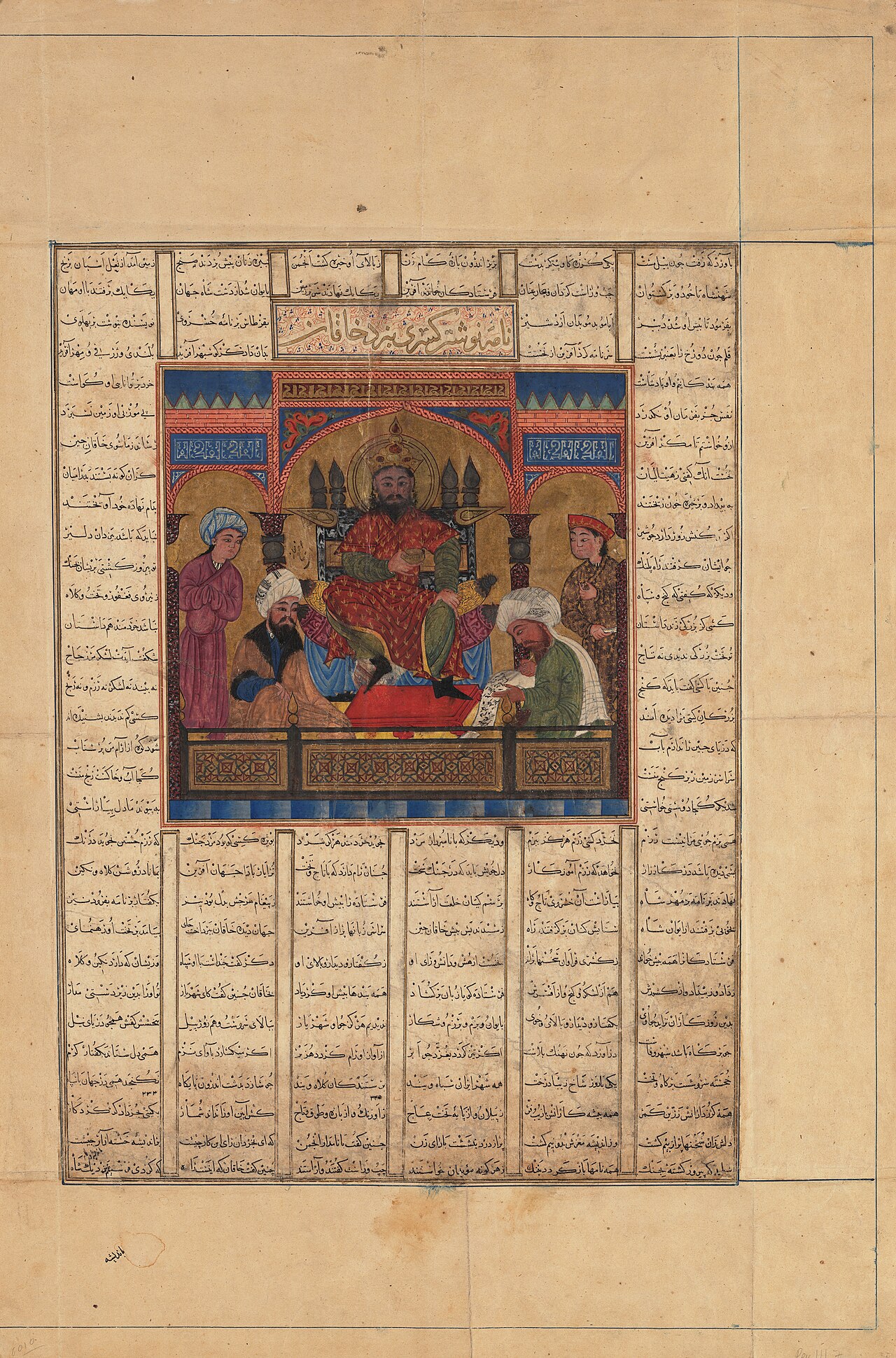

A court of learning
Khosrow wished to be seen as a philosopher-king, and contemporaries took note. The Byzantine historian Agathias tells how seven pagan philosophers from Athens, among them Damascius and Simplicius, came to his court around 531–532 when they could no longer teach freely in the Roman empire. They were disappointed by Persia and went home, but Khosrow had a clause written into the peace treaty of 532 guaranteeing that they would not be punished. Agathias, who disliked the king, mocked his claim to understand Aristotle and Plato.
Other evidence is more positive. A Syriac Christian scholar, Paul the Persian, dedicated a treatise on Aristotle’s logic to Khosrow. The physician Borzuya was sent to India and brought back the book of fables known as Kalila wa Dimna. Later tradition placed a great medical school at Gondishapur in his reign, a story that modern scholars treat with caution. Much Middle Persian wisdom literature (andarz) was later attributed to Khosrow and his circle, and some historians think the royal chronicle of Iran’s kings, the Khwaday-namag, took shape in his time.
The last wars
The peace of 562 broke down in 572, when Justin II stopped the agreed payments and supported a revolt in Persian Armenia. Khosrow, now in his sixties, struck back hard. In 573 his armies took Dara, the fortress the Romans had built to watch the border, a blow so severe that Byzantine writers say it drove Justin II mad. In 576 Khosrow campaigned in Anatolia but suffered a reverse near Melitene, and Byzantine sources say he then made a law that the king should not lead the army in person. Peace talks were still under way when he died early in 579. The war passed to his son Hormizd IV.
Anushirvan the Just
Khosrow’s lasting fame comes less from his campaigns than from the image later writers built around him. The Persian royal tradition, written down by his successors’ scribes, presented him as the restorer of order after Mazdak. Muslim writers of the following centuries adopted that picture and made Anushirvan the type of the righteous ruler, a figure who could be held up even to Muslim princes.
Stories of a just king
Many anecdotes gathered around his name. One tells of an old woman whose small house stood where his palace was to be built; she refused to sell, and the king left the house in place, spoiling the symmetry of the building rather than wrong her. Another, told by Saadi in the Golestan, has Anushirvan insist on paying for a little salt during a hunt, because, he said, small acts of injustice by kings grow into great ones. Persian tradition also gives him a wise vizier, Bozorgmehr, whose sayings fill later collections, though historians doubt that Bozorgmehr existed in the form the stories describe.
A saying attributed to the Prophet Muhammad, that he was born in the time of the “just king”, was widely quoted in later Persian literature. Hadith scholars generally regard it as unreliable, but its popularity shows how firmly the reputation had taken hold.
How historians see him
Modern historians accept that Khosrow I was an able ruler who left the empire stronger, richer and more centralised than he found it. They also note the other side: the killing of his brothers, the massacre of the Mazdakites, the sack of Antioch, and a tax system that some sources, and some scholars, describe as heavy for the peasantry. The “just king” was, in large part, the creation of a court that wanted its version of events to last. It succeeded: fourteen centuries later, Anushirvan remains a byword for justice in Persian.
Persian words from this page
| خسرو انوشیروان | Khosrow Anushirvân | Khosrow Anushirvan |
| دادگر | dâdgar | just |
| کسری | Kasrâ | Kisra, the Arabic form of Khosrow |
| بزرگمهر | Bozorgmehr | Bozorgmehr, the legendary vizier |
| نمک | namak | salt |
| گلستان | Golestân | Saadi’s Golestan, “the rose garden” |
Sources and further reading
- Procopius, History of the Wars, Books 1–2.
- Agathias, The Histories, Book 2 (the Athenian philosophers and Khosrow’s learning).
- Al-Tabari, The History of al-Tabari, vol. V, trans. C. E. Bosworth (SUNY Press, 1999).
- Ferdowsi, Shahnameh, reign of Nushin-ravan; English translation by Dick Davis (Penguin, 2006).
- “Ḵosrow I”, Encyclopaedia Iranica (sections on his life and times, reforms and coinage).
- Touraj Daryaee, Sasanian Persia: The Rise and Fall of an Empire (I.B. Tauris, 2009).
Want to learn Persian? Get the free Starter Pack
Get the 14-page printable Starter Pack (all 32 letters, a 7-day reading plan, 100 core words and 20 survival phrases) and a short 5-email course. Free.
More in The Sasanian Empire (224–651 CE)
- The Origins of the Sasanian Family
- Ardashir I, Founder of the Sasanian Empire
- Firuzabad: Ardashir’s Round City
- Shapur I, King of Kings of Iran and Non-Iran
- Bishapur: Shapur’s City
- The Battle of Edessa and the Capture of Valerian
- The Ka’ba-ye Zartosht Inscription of Shapur I
- Mani and Manichaeism
- Hormizd I and Bahram I
- Kartir and the Zoroastrian Church
- Bahram II
- Narseh and the Peace of Nisibis
- Shapur II the Great
- Julian’s Invasion of Persia (363)
- Christians in the Sasanian Empire
- Shapur III and the Partition of Armenia
- Yazdegerd I
- Bahram V Gur
- Yazdegerd II
- The Battle of Avarayr (451)
- The Hephthalites and Iran’s Eastern Frontier
- Peroz I and the Hephthalite Disaster
- Kavad I
- Zamasp and Kavad’s Return
- Mazdak and the Mazdakite Movement
- Khosrow I Anushirvan the Just
- The Sasanian–Byzantine Wars of the 6th Century
- The Battle of Dara (530)
- Khosrow I Sacks Antioch (540)
- The Lazic War (541–562)
- The Reforms of Khosrow I
- The Academy of Gondishapur: History and Legend
- Borzuya, Chess and Kalila wa Dimna
- Taq Kasra: The Arch of Ctesiphon
- The Sasanian Conquest of Yemen
- The Sasanians and the Western Turks
- Hormizd IV
- Bahram Chobin’s Rebellion
- Khosrow II Parviz
- The Last Great War: Byzantium and Persia, 602–628
- The Siege of Constantinople (626)
- Heraclius Strikes Back
- Shirin: Queen and Legend
- Shahrbaraz, the General Who Became King
- Civil War and the Queens Boran and Azarmidokht
- Yazdegerd III, the Last Sasanian King
- The Sasanian Army
- Sasanian Society and the Class System
- Zoroastrianism under the Sasanians
- Sasanian Art: Silver, Reliefs and Silk
- The Sasanian Reliefs of Naqsh-e Rostam
- Taq-e Bostan
- Sasanian Cities, Palaces and Bridges
- Middle Persian (Pahlavi) Language and Literature
- Sasanian Coins and Silverwork
- Women in the Sasanian Empire
- Polo, Hunting and Games at the Sasanian Court
- The Sasanian Legacy