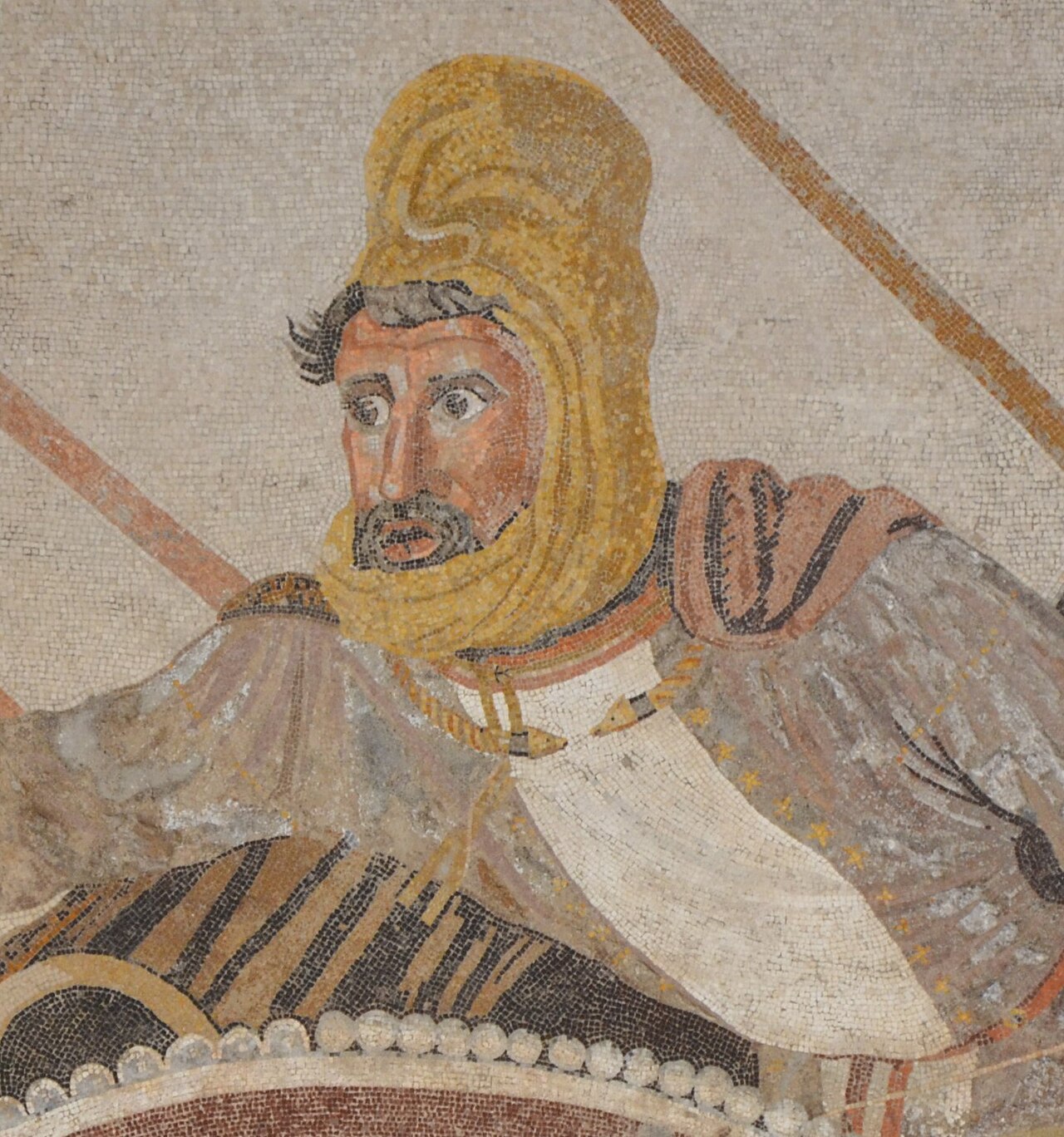
Darius III was the last king of the Achaemenid Persian Empire, ruling from 336 to 330 BCE. He came to the throne through a court crisis, lost three great battles to Alexander of Macedon at the Granicus, Issus and Gaugamela, and was killed by his own nobles in July 330 BCE. Almost everything known about him was written by his enemies’ historians, which makes him one of the hardest Persian kings to judge fairly.
| Reign | 336 to July 330 BCE |
|---|---|
| Personal name | Artashata in Babylonian documents; Codomannus in the Roman writer Justin |
| Born | c. 380 BCE (Arrian says he was about 50 at his death) |
| Family | Mother Sisygambis; wife Stateira; daughters Stateira and Drypetis; son Ochus |
| Died | July 330 BCE, near Hecatompylos in Parthia |
| Persian name | داریوش سوم (Dâriush-e sevvom); دارا (Dârâ) in the Shahnameh |
From the side branch of the royal house
Darius was not a king’s son. Diodorus calls him the son of Arsames and grandson of Ostanes, a brother of Artaxerxes II, so he belonged to a collateral line of the Achaemenid family. Diodorus also says he made his name under Artaxerxes III by killing an enemy champion in single combat during a campaign against the Cadusians, a mountain people near the Caspian. Later Greek authors who wanted to belittle him claimed he had been a mere royal courier, or even a slave. Those stories belong to propaganda written after his defeat.
His chance came from the murders at court. The eunuch Bagoas had poisoned Artaxerxes III in 338 BCE and his son Arses in 336 BCE. With no adult heir in the direct line, Bagoas chose Darius. When Bagoas then tried to poison him too, Diodorus says, Darius found out and forced him to drink the cup himself. As king he took the name Darius, linking himself to the founder of the empire’s great age.

The empire he inherited
Darius did not inherit a ruin. The empire still stretched from the Aegean to the Indus, with its treasuries at Susa and Persepolis full. Egypt seems to have slipped briefly out of control under a local ruler named Khababash around the time of his accession, but it was in Persian hands again when Alexander arrived. In the same year that Darius became king, Philip II of Macedon sent an advance force into Asia Minor, and Philip’s murder later that year brought his son Alexander to power.
The war with Alexander
When Alexander crossed the Hellespont in spring 334 BCE, Darius left the first response to the satraps of Asia Minor. Their defeat at the Granicus opened Anatolia. Darius then backed a naval counter-offensive in the Aegean under Memnon of Rhodes, which looked promising until Memnon died in 333 BCE.
Darius led the royal army himself in November 333 at Issus. He lost, fled the field, and left his mother, wife and children in Alexander’s hands. In letters he offered ransom, then territory and an alliance. Alexander refused. While Alexander took Tyre, Gaza and Egypt, Darius raised a new army from the eastern satrapies, and in October 331 he faced Alexander again at Gaugamela, on ground he had chosen and levelled. He lost again, and the royal army never re-formed.
He fled to Ecbatana in Media (modern Hamadan), hoping to gather the eastern peoples for a third battle. In 330, as Alexander approached, he moved east. Bessus, satrap of Bactria, and other nobles arrested him and finally stabbed him; the story is told on the death of Darius III and Bessus.
A coward or an unlucky king
The Greek writers, above all Arrian, built a contrast: Alexander the bold leader, Darius the king who fled first at Issus and Gaugamela. Arrian’s verdict on him is that he was weak and incompetent in war. Other ancient writers were kinder. Diodorus and Curtius Rufus describe a king who fought bravely and was beaten by a better army and by bad fortune, and Curtius gives him dignified speeches.
Modern scholarship has moved away from Arrian’s portrait. Pierre Briant, in Darius in the Shadow of Alexander, shows how the image of Darius was built after the fact to make Alexander’s victories look inevitable. Darius chose sensible strategies: he tried to fight at sea and to stir up Greece behind Alexander, he chose open ground at Issus first (Alexander’s speed changed that) and prepared the field at Gaugamela. His real problem was a Macedonian army of a quality that no Persian king had faced, led by a commander of rare talent.
Why Persian sources are silent
No inscription of Darius III survives in Old Persian, and no Persian chronicle of his reign was ever written down. Babylonian clay tablets give dates and a few events, including an astronomical diary that mentions the battle of Gaugamela. Everything else comes from Greek and Roman historians writing centuries later, using lost accounts by Alexander’s officers. The unfinished rock tomb south of the Persepolis terrace has sometimes been linked to him, but the attribution is uncertain.
Dara in Persian memory
The Iranian tradition that reached Ferdowsi kept a very different king. In the Shahnameh he is Dara, son of Darab, and Iskandar (Alexander) is his half-brother, the son of Darab and a daughter of the Greek king Filqus (Philip). The defeat is therefore a quarrel inside the Iranian royal family, not a foreign conquest. Dara is murdered by two of his own ministers, and the dying king gives Iskandar his daughter Roshanak in marriage. This legend is discussed on Alexander the Great in Iran and on the page about Ferdowsi and the Shahnameh.
Persian words from this page
| داریوش | Dâriush | Darius |
| دارا | Dârâ | Darius in the Shahnameh |
| داراب | Dârâb | Dara’s father in the Shahnameh |
| اسکندر | Eskandar | Alexander |
| روشنک | Roshanak | Roxana, Dara’s daughter in the Shahnameh |
| شاهنامه | Shâhnâme | the Book of Kings |
Sources and further reading
- Arrian, Anabasis of Alexander, Books 1 to 3
- Diodorus of Sicily, Library of History, Book 17; Quintus Curtius Rufus, History of Alexander
- Pierre Briant, Darius in the Shadow of Alexander (Harvard University Press, 2015)
- Encyclopaedia Iranica, “Darius v. Darius III“
- Ferdowsi, Shahnameh, the reigns of Darab and Dara
Want to learn Persian? Get the free Starter Pack
Get the 14-page printable Starter Pack (all 32 letters, a 7-day reading plan, 100 core words and 20 survival phrases) and a short 5-email course. Free.
More in The Achaemenid Empire (550–330 BCE)
- Achaemenes, Teispes and the Early Persian Kings of Anshan
- Cyrus the Great: Birth, Legends and Rise to Power
- Cyrus Conquers Lydia: Croesus and the Battle of Thymbra
- The Persian Conquest of Ionia and Asia Minor
- Cyrus Takes Babylon (539 BCE)
- The Cyrus Cylinder
- Cyrus and the Return of the Jews
- The Death of Cyrus and the Massagetae
- Pasargadae: Cyrus’s Capital and Tomb
- The Tomb of Cyrus through History
- Cambyses II
- Cambyses Conquers Egypt: The Battle of Pelusium
- Bardiya and Gaumata: The Usurper Question
- Darius the Great Takes the Throne
- The Great Revolts of 522–521 BCE
- The Behistun Inscription
- The Persian Conquest of the Indus Valley
- Darius’s Scythian Campaign
- Darius’s Canal from the Nile to the Red Sea
- Darius’s Reforms: Satrapies, Taxes and Law
- The Royal Road and the Persian Postal System
- The Daric: Achaemenid Coinage and Economy
- The Ionian Revolt (499–493 BCE)
- The Greco-Persian Wars: An Overview
- Mardonius and the First Persian Expedition to Greece (492 BCE)
- The Battle of Marathon (490 BCE)
- The Death of Darius I and the Succession of Xerxes
- The Royal Tombs of Naqsh-e Rostam
- Xerxes I: King of Kings (486–465 BCE)
- Xerxes’ Invasion of Greece (480–479 BCE)
- The Battle of Thermopylae (480 BCE)
- The Battle of Artemisium (480 BCE)
- The Persian Capture of Athens (480–479 BCE)
- The Battle of Salamis (480 BCE)
- The Battle of Plataea and the End of the Invasion (479 BCE)
- The Palace of Darius at Susa
- Building Persepolis: How Darius and Xerxes Built Parsa
- The Persepolis Fortification and Treasury Tablets
- Herodotus and the Persians
- The Apadana Reliefs: Nations Bringing Gifts
- The Achaemenid Paradise Gardens
- The Persian Immortals and the Achaemenid Army
- The Achaemenid Navy
- Religion of the Achaemenid Kings
- Women of the Achaemenid Court
- Old Persian Language and Cuneiform
- Egypt under Persian Rule
- Babylon under Persian Rule
- Artaxerxes I
- The Peace of Callias
- Darius II and the Peloponnesian War
- Famous Satraps of the Persian Empire
- Artaxerxes II Mnemon
- Cyrus the Younger and the Battle of Cunaxa
- The King’s Peace (387 BCE)
- The Great Satraps’ Revolt
- Artaxerxes III and the Reconquest of Egypt
- Darius III, the Last Achaemenid King
- The Battle of the Granicus (334 BCE)
- The Battle of Issus (333 BCE)
- Alexander Takes Tyre, Gaza and Egypt (332 BCE)
- The Battle of Gaugamela (331 BCE)
- Ariobarzanes and the Battle of the Persian Gate
- The Burning of Persepolis (330 BCE)
- The Death of Darius III and Bessus
- The Legacy of the Achaemenid Empire