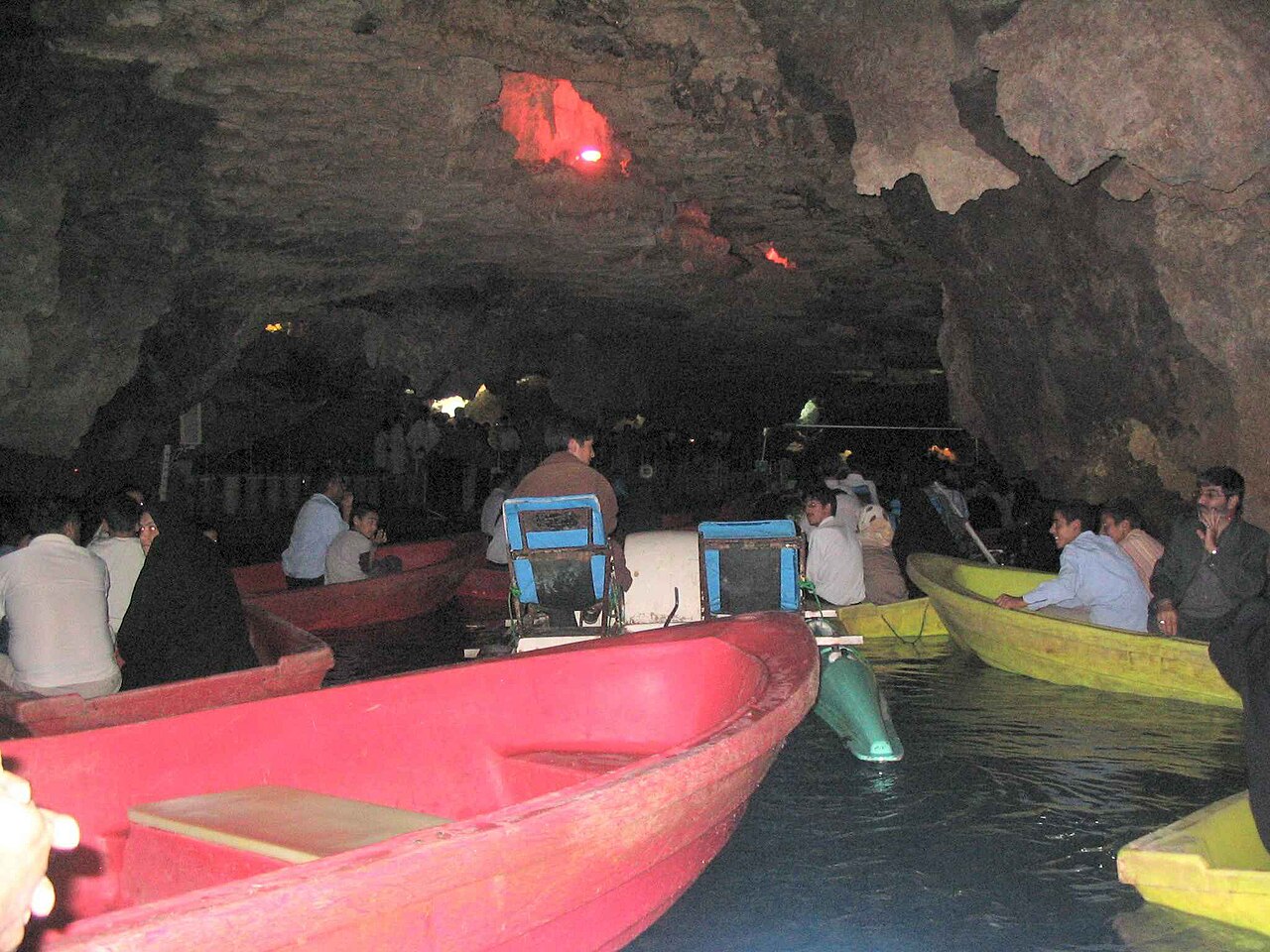
Ali Sadr Cave (غار علیصدر) is a limestone cave about 100 km north of Hamadan whose passages are flooded by a network of underground lakes and channels. Visitors tour it by boat, gliding between stalactites under floodlights, which makes it one of the largest show caves of its kind in the world and one of the most visited natural sites in western Iran.
| Persian name | Ghâr-e Ali Sadr |
|---|---|
| Location | Ali Sadr village, Kabudarahang county, Hamadan province |
| Surveyed length | 11.44 km (German and British survey, 2001) |
| Water | About 0.5 to 14 m deep; hard, lime-rich, around 12 °C all year |
| Modern rediscovery | 1963, by Iranian mountaineers |
| Visit | Guided boat tour with short walking sections |

A cave cut by water
Ali Sadr formed the way most limestone caves do. Rainwater picks up carbon dioxide from the air and soil and becomes a weak acid. Seeping along cracks in the limestone hills around Ali Sadr, it slowly dissolved the rock and widened the cracks into passages and halls. Unlike many caves, which drain and dry out once their water finds a lower outlet, much of Ali Sadr is still full of water. The result is a maze of long channels and lakes, some only knee-deep, others deep enough to swim in, with dry chambers rising above them.
Where water drips from the roof, it gives up some of its dissolved calcium carbonate and builds stalactites downward and stalagmites upward. Ali Sadr has curtains, columns and flowstone, many of them coloured by minerals. The cave water is very hard and not drinkable.
The water stays at about 12 °C through the year, so the air inside is cool and damp in all seasons: a relief in summer, a shock if you arrive in a T-shirt. Almost nothing lives in the water itself except tiny blind amphipods of the genus Niphargus, crustaceans adapted to total darkness.
Discovery and exploration
The name is usually explained as coming from an older form, Ali Sard, sard being Persian for “cold”, a fair description of the air inside. Villagers had long known of an opening in the hill, but the cave’s extent was unknown until 1963, when a group of Iranian mountaineers explored the flooded passages. Development as a show cave followed.
Systematic mapping came much later. In the summer of 2001 a German and British expedition surveyed the cave and recorded 11.44 km of passages. Iran’s heritage authorities have proposed the cave for World Heritage status, citing its long navigable waterways; it is not, so far, inscribed.
Claims of very old cave paintings and an Achaemenid inscription at the entrance circulate widely in popular accounts. They are not well documented in published archaeology, so treat them with caution.
The boat tour
Visitors put on life jackets at the entrance and board small boats, pedalled or paddled by a guide, in groups. The route follows channels through a series of named halls, stopping at a dry section where you get out and walk among formations before returning by water. The whole visit takes about one to two hours, depending on crowds.
- The cave is floodlit, but some passages are low; mind your head when the guide warns you.
- Flash photography is often discouraged; a phone camera in low-light mode works better.
- At busy times, especially during Nowruz and summer holidays, queues outside can be long. Arrive early in the day.
Practical notes and safety
- Bring a warm layer even in summer and shoes with good grip for wet steps.
- Keep your hands in the boat and wear the life jacket; the water is cold and in places deep.
- The tour is not suited to people with severe claustrophobia, though the main halls are large.
- Do not touch formations. Skin oils stop growth, and broken stalactites take thousands of years to re-form.
- Most visitors come from Hamadan by car or tour; check current access and arrangements locally, and follow your own government’s travel advice for Iran.
Ali Sadr combines naturally with Hamadan, ancient Ecbatana, and its Ganjnameh inscriptions and Tomb of Avicenna. For Iran’s other underground wonder, a salt cave rather than a limestone one, see Namakdan in the Qeshm Geopark.
Persian words from this page
| غار | ghâr | cave |
| قایق | qâyeq | boat |
| سرد | sard | cold |
| آهک | âhak | lime, limestone |
| استالاکتیت | estâlâktit | stalactite |
| کوهنورد | kuhnavard | mountaineer |
Sources and further reading
- Speläoclub Berlin, publications of the 2001 Ghar Alisadr survey expedition.
- UNESCO World Heritage Centre, Tentative List of Iran, entry for Ali Sadr Cave.
- “Ali-Sadr Cave”, Wikipedia, consulted 2026, as a pointer to the survey reports.
- A. N. Palmer, Cave Geology (2007), for how limestone caves form.
Want to learn Persian? Get the free Starter Pack
Get the 14-page printable Starter Pack (all 32 letters, a 7-day reading plan, 100 core words and 20 survival phrases) and a short 5-email course. Free.
More in Top Places to Visit in Iran
- Naqsh-e Jahan Square
- Shah (Imam) Mosque, Isfahan
- Sheikh Lotfollah Mosque
- Ali Qapu Palace
- Jameh Mosque of Isfahan
- Si-o-se Pol and Khaju Bridge
- Vank Cathedral
- Hasht Behesht Palace
- Naqsh-e Rostam
- Eram Garden, Shiraz
- Nasir al-Molk (Pink) Mosque
- Tomb of Hafez (Hafezieh)
- Tomb of Saadi (Saadieh)
- Shah Cheragh Shrine
- Arg of Karim Khan
- Fin Garden, Kashan
- Historic Houses of Kashan
- Jameh Mosque of Yazd
- Yazd Fire Temple and Towers of Silence
- Dowlatabad Garden and Windcatcher
- Amir Chakhmaq Complex
- Golestan Palace
- National Museum of Iran
- Treasury of National Jewels
- Tehran Grand Bazaar
- Milad Tower
- Imam Reza Shrine, Mashhad
- Tomb of Ferdowsi, Tus
- Tomb of Omar Khayyam, Neyshabur
- Tomb of Avicenna, Hamadan
- Ganjnameh Inscriptions, Hamadan
- Behistun (Bisotun): Visiting the Site
- Taq-e Bostan: Visiting the Site
- Tabriz Historic Bazaar
- Takht-e Soleyman
- Armenian Monastic Ensembles of Iran
- Sheikh Safi al-Din Shrine, Ardabil
- Dome of Soltaniyeh
- Alamut Castle
- Falak-ol-Aflak Castle
- Shushtar Historical Hydraulic System
- Chogha Zanbil: Visiting the Ziggurat
- Susa Archaeological Site
- Arg-e Bam
- Ganjali Khan Complex, Kerman
- Shazdeh Garden, Mahan
- Rayen Castle
- Dasht-e Lut (Lut Desert)
- Maranjab Desert and Caravanserai
- Varzaneh Desert
- Mount Damavand
- Hyrcanian Forests
- Lake Urmia
- Badab-e Surt Springs
- Ali Sadr Cave
- The Kaluts of Shahdad
- Qeshm Geopark
- Hormuz Island Colours
- Visiting Persepolis: A Day Trip from Shiraz
- Visiting Pasargadae
- Persian Caravanserais
- The Qanat of Gonabad
- Meymand Village
- Sasanian Sites of Fars: Firuzabad, Bishapur and Sarvestan
- Gonbad-e Qabus: Visiting the Tower
- Zayandeh Rud and Isfahan’s Bridges
- Tochal and Darband: Hiking Above Tehran
- Mount Sabalan
- Skiing in Iran: Dizin and Shemshak
- Golestan National Park