The historic houses of Kashan are a group of 18th- and 19th-century merchant mansions in the old town, the best known being the Tabatabaei, Borujerdi, Abbasian and Ameri houses. Built after the earthquake of 1778 by families grown rich on carpets, silk and trade, they hide behind plain mud-brick walls a sequence of sunken courtyards, mirrored halls, stained glass and carved stucco. Together they are the finest surviving examples of the traditional Iranian courtyard house.
| Where | Sultan Amir Ahmad quarter, south of the Kashan bazaar, all within a few minutes’ walk of each other |
|---|---|
| Period | Late 18th to late 19th century (Zand and Qajar periods) |
| Architect | Ustad Ali Maryam is credited with the Tabatabaei and Borujerdi houses |
| Built for | Merchant families: carpet and textile traders, a glass merchant, local notables |
| Today | Museums, restaurants and hotels; several are open to visitors |
How a Kashan house works
Every one of these houses follows the same logic, and once you know it you can read any of them. Kashan sits on the edge of the central desert. Summers are very hot and dry, winters cold, and the wind brings dust. The answer was to turn the house inward and to dig down.
The door and the vestibule
From the lane you see only a blank wall and a wooden door. Many doors carry two knockers: a heavy bar (kube, کوبه) for men and a ring (halghe, حلقه) for women. Each makes a different sound, so the household knew who should answer. Behind the door is the hashti, an octagonal vestibule from which corridors turn, so that nobody in the lane could see into the courtyard.
Outer and inner houses
The larger houses are divided into a biruni (بیرونی), the outer part where the master received guests and did business, and an andaruni (اندرونی), the inner part for the family and the women of the house. Servants had their own court. That is why the Tabatabaei House has four courtyards rather than one.
Sunken courtyards and seasonal rooms
The courtyards are dug several metres below the lane. The deeper ground stays cooler, and it also reaches the level of the qanat water channels that ran under the town and fed the pools. Rooms on the shaded side of a courtyard were used in summer, rooms facing the low winter sun in winter. Basements (sardâb) and windcatchers (bâdgir) kept the summer rooms cool.
The great hall
Each house centres on a tall reception hall facing the main courtyard, closed by orosi, sash windows of coloured glass set in wooden lattices. Inside, the walls and vaults carry stucco carved into flowers, birds and hunting scenes, and mirror work around the high alcove where the head of the family sat.
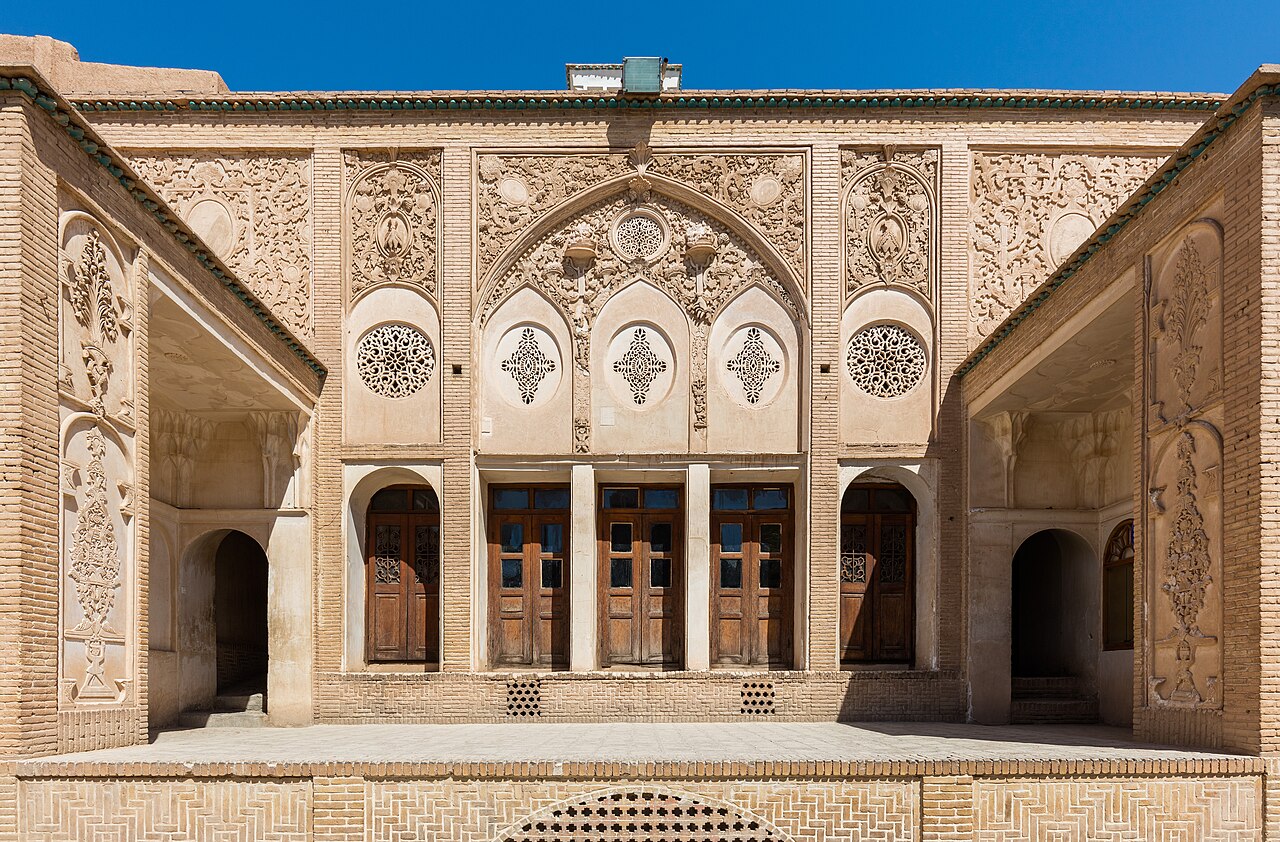

Tabatabaei House
The Tabatabaei House was built for Seyyed Ja’far Tabatabaei, a carpet merchant, and is usually dated to around 1880. It is a long complex with four courtyards. The main courtyard has a long pool between sunken garden beds, and the hall at its end is the richest room in the house, with mirror work, stained glass and some of the most delicate stucco in Iran. Take time over the plaster panels around the courtyard façades, carved in relief with flowers, arches and geometric frames.
Borujerdi House
A few lanes away, the Borujerdi House belonged to a merchant known as Borujerdi because he traded with the city of Borujerd in western Iran. The story told in Kashan is that he wanted to marry a daughter of the Tabatabaei family, and that her father asked for a house as fine as his own before he would agree. The house is smaller than its neighbour, with one main courtyard, but its silhouette is the most famous in Kashan: a domed hall flanked by three tall windcatchers, and a ceiling painted with Qajar scenes.
Sources do not agree on the dates. Many give 1857 for the Borujerdi House, which is hard to fit with a story that has it built after the Tabatabaei House of the 1880s. Treat the romance as a local tradition and the dates as approximate.
Abbasian and Ameri houses
The Abbasian House, built in the late 18th or early 19th century for a glass merchant, is one of the largest. Its courtyards are stepped on several levels, with bridges and terraces between them, and it is decorated with mirror work, stucco and coloured glass. Part of it now serves as a teahouse and restaurant.
The Ameri House, built for a family who served as governors of Kashan, is larger still. After a long restoration much of it has become a hotel, so access depends on what is open to non-guests.
Around the houses
The same quarter holds the Sultan Amir Ahmad Bathhouse, whose roof of small domes and light wells can be walked on, and the Agha Bozorg Mosque and school, with its sunken courtyard. Our Kashan page places them in the city, and Fin Garden is a short ride away.
Practical notes
- All four houses are within walking distance of one another, and a morning is enough for two or three of them. Several have courtyard cafés.
- Mornings are quieter. Tour groups often arrive around midday.
- Many traditional houses in the same quarter now operate as guesthouses, which is a way to sleep in one.
- Opening hours and ticket prices change, and each house is ticketed separately. Check current information locally.
For the same desert architecture on a city scale, see Yazd and its Dowlatabad windcatcher.
Persian words from this page
| خانه | khâne | house |
| بیرونی | biruni | outer, public part of a house |
| اندرونی | andaruni | inner, family part of a house |
| هشتی | hashti | octagonal entrance vestibule |
| بادگیر | bâdgir | windcatcher |
| ارسی | orosi | sash window with coloured glass |
| سرداب | sardâb | cool basement room |
Sources and further reading
Want to learn Persian? Get the free Starter Pack
Get the 14-page printable Starter Pack (all 32 letters, a 7-day reading plan, 100 core words and 20 survival phrases) and a short 5-email course. Free.
More in Top Places to Visit in Iran
- Naqsh-e Jahan Square
- Shah (Imam) Mosque, Isfahan
- Sheikh Lotfollah Mosque
- Ali Qapu Palace
- Jameh Mosque of Isfahan
- Si-o-se Pol and Khaju Bridge
- Vank Cathedral
- Hasht Behesht Palace
- Naqsh-e Rostam
- Eram Garden, Shiraz
- Nasir al-Molk (Pink) Mosque
- Tomb of Hafez (Hafezieh)
- Tomb of Saadi (Saadieh)
- Shah Cheragh Shrine
- Arg of Karim Khan
- Fin Garden, Kashan
- Historic Houses of Kashan
- Jameh Mosque of Yazd
- Yazd Fire Temple and Towers of Silence
- Dowlatabad Garden and Windcatcher
- Amir Chakhmaq Complex
- Golestan Palace
- National Museum of Iran
- Treasury of National Jewels
- Tehran Grand Bazaar
- Milad Tower
- Imam Reza Shrine, Mashhad
- Tomb of Ferdowsi, Tus
- Tomb of Omar Khayyam, Neyshabur
- Tomb of Avicenna, Hamadan
- Ganjnameh Inscriptions, Hamadan
- Behistun (Bisotun): Visiting the Site
- Taq-e Bostan: Visiting the Site
- Tabriz Historic Bazaar
- Takht-e Soleyman
- Armenian Monastic Ensembles of Iran
- Sheikh Safi al-Din Shrine, Ardabil
- Dome of Soltaniyeh
- Alamut Castle
- Falak-ol-Aflak Castle
- Shushtar Historical Hydraulic System
- Chogha Zanbil: Visiting the Ziggurat
- Susa Archaeological Site
- Arg-e Bam
- Ganjali Khan Complex, Kerman
- Shazdeh Garden, Mahan
- Rayen Castle
- Dasht-e Lut (Lut Desert)
- Maranjab Desert and Caravanserai
- Varzaneh Desert
- Mount Damavand
- Hyrcanian Forests
- Lake Urmia
- Badab-e Surt Springs
- Ali Sadr Cave
- The Kaluts of Shahdad
- Qeshm Geopark
- Hormuz Island Colours
- Visiting Persepolis: A Day Trip from Shiraz
- Visiting Pasargadae
- Persian Caravanserais
- The Qanat of Gonabad
- Meymand Village
- Sasanian Sites of Fars: Firuzabad, Bishapur and Sarvestan
- Gonbad-e Qabus: Visiting the Tower
- Zayandeh Rud and Isfahan’s Bridges
- Tochal and Darband: Hiking Above Tehran
- Mount Sabalan
- Skiing in Iran: Dizin and Shemshak
- Golestan National Park