Gondishapur was a Sasanian city in Khuzestan, southwest Iran, founded by Shapur I in the 3rd century CE. Later Arabic writers described it as the home of a great medical school and hospital, supposedly founded or expanded by Khosrow I, where Greek, Indian and Persian learning met. Modern historians accept that Gondishapur had physicians and, by the 8th century, a hospital, but most regard the “Academy of Gondishapur” as a much later legend.
| Founded | By Shapur I, probably between 256 and 260 CE |
|---|---|
| Original name | Weh-Andiok-Shabuhr, “Shapur’s better than Antioch”; Syriac Beth Lapat |
| Persian name | Jondishapur (Gondishapur) |
| Location | Near the village of Shahabad, about 14 km southeast of Dezful, Khuzestan |
| Medical fame | Attested from 765, when the caliph al-Mansur called its chief physician to Baghdad |
| Abandoned | Probably by the 10th–11th century |
The real city
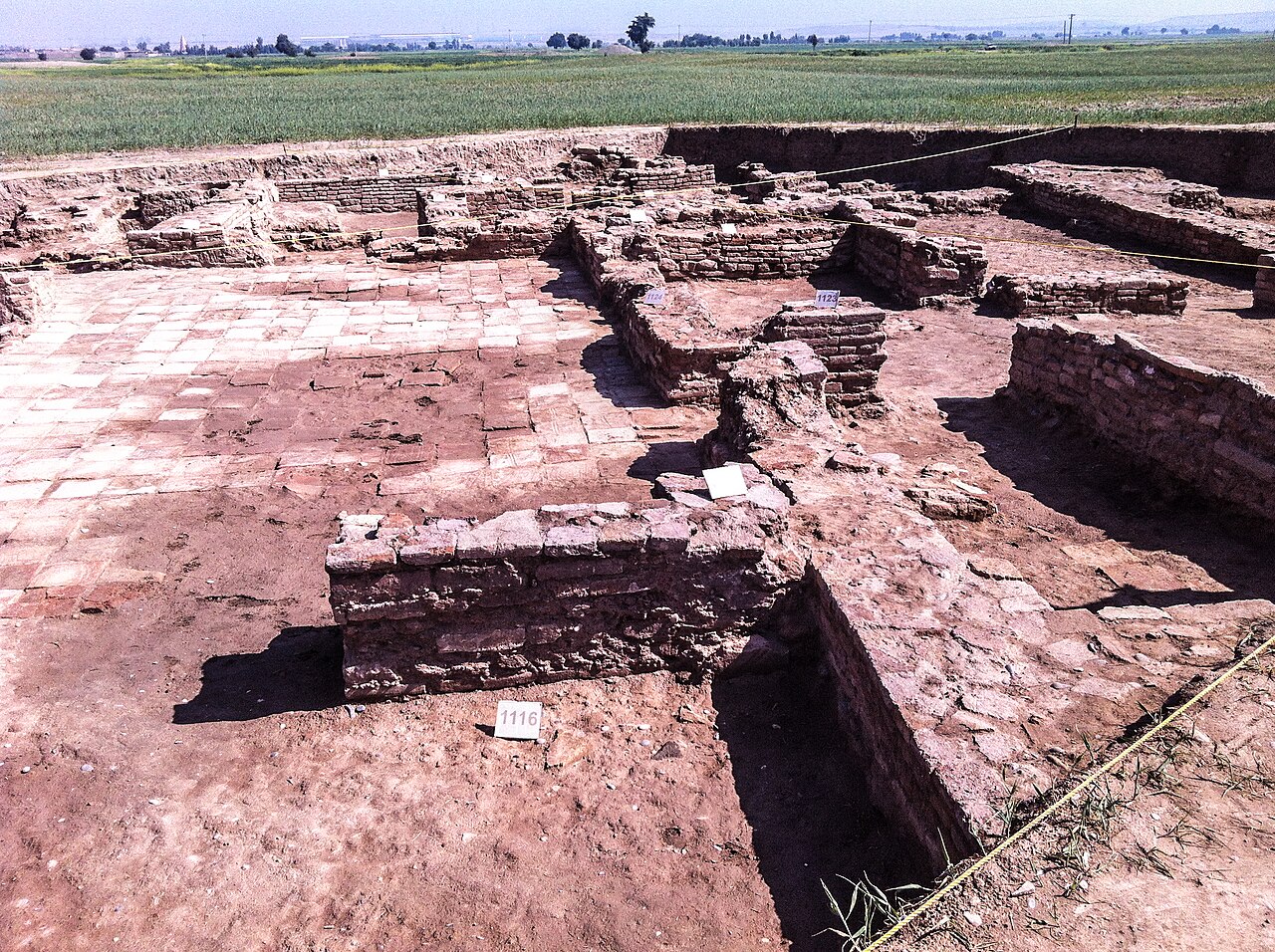
Shapur I built the city after his victories over Rome and settled it with captives from Antioch and other Roman towns; its foundation is described on the page on Shapur I. It became one of the main towns of Khuzestan and a royal residence. Its Syriac name, Beth Lapat, appears often in Christian sources because it was the seat of a metropolitan bishop of the Church of the East. It was here that the prophet Mani died in prison in 276 or 277 (see Mani and Manichaeism), and here that a church synod met in 484.
The city surrendered to the Arab armies around 638. It flourished for another two centuries; the Saffarid ruler Ya’qub ibn al-Layth made it his residence and was buried there in 879. Pottery from the site suggests it was largely abandoned by the 11th century. Today the ruins are low mounds in farmland.

The legend of the Academy
The story most people know comes from Arabic writers of the 12th and 13th centuries, especially Ibn al-Qifti in his History of the Learned. In its fullest form it says that Gondishapur had a great hospital and school of medicine, where Christian physicians trained in the Greek tradition of Hippocrates and Galen worked beside Indian and Persian doctors. Khosrow I is said to have expanded it, gathered learned men there, and ordered translations from Greek, Syriac and Sanskrit. One story tells of a medical congress held at his command. Some modern books add that the pagan philosophers who left Athens in the 530s settled at Gondishapur, and describe the city as the world’s first university or teaching hospital.
From there, the story continues, the medicine of Gondishapur passed to Baghdad, where its physicians served the caliphs and helped launch the great movement of translating Greek science into Arabic.
What the evidence shows
Physicians, yes
Some parts of the story rest on good evidence. The Sasanian court did employ Christian physicians trained in Greek medicine, and Khuzestan, with its large Christian population, was a natural home for them. A Syriac source records a medical and theological debate before Khosrow II around 610 in which the court physician Gabriel of Sinjar took part. Khosrow I’s interest in learning is attested by contemporaries, and his physician Borzuya brought Indian books back to Iran.
A hospital, later
The first clear reference to a hospital at Gondishapur dates from 765, when the Abbasid caliph al-Mansur fell ill and summoned its chief physician, Jurjis ibn Jibril ibn Bukhtishu, to Baghdad. The Bukhtishu family served the caliphs for generations, and another Gondishapur physician, Sabur ibn Sahl, who died in 869, wrote an influential book of drug recipes. So there was a medical community at Gondishapur in the early Islamic period, with roots in Sasanian times.
An academy, no
What is missing is any evidence from the Sasanian period itself for a school, academy or hospital on the scale of the legend. No Sasanian, Syriac or Byzantine source of the 6th century mentions one. Agathias, who tells the story of the Athenian philosophers, says they went to the Persian court, not to Gondishapur, and that they soon returned home. The detailed accounts all date from centuries after Khosrow I.
How the legend grew
In an article of 1987, the historian of medicine Michael Dols argued that the famous hospital of Gondishapur was largely a myth, and that the hospital as an institution in the Islamic world grew up in Baghdad rather than being imported whole from Iran. Dimitri Gutas, in his study of the Greek-Arabic translation movement, went further. He pointed out that much of the story comes from the Bukhtishu family and their admirers, who had every reason to give their home town and their own medical lineage an ancient and glorious pedigree at the Abbasid court. Later Arabic biographers repeated these family traditions, and they were taken up again by modern writers.
Not every scholar is so sceptical. Lutz Richter-Bernburg, in the Encyclopaedia Iranica, accepts that a hospital existed and was directed by the Bukhtishu family for several generations, while noting how scattered the evidence is. A reasonable summary of current opinion is this: Gondishapur was a real centre of Christian medicine with a hospital by the 8th century, but the “Academy”, the royal university of Khosrow I, is a later construction.
One small piece of linguistic evidence does point to Iranian influence on Islamic medicine. The usual Arabic word for hospital, bimaristan, is Persian, from bimar, “sick”, and -stan, “place”. The word shows that the institution had Persian associations for early Muslims, even if it does not prove that a hospital of the legendary kind existed under the Sasanians.
Gondishapur today
The name lives on. The medical university of Ahvaz, the capital of Khuzestan, is called the Ahvaz Jundishapur University of Medical Sciences, and Gondishapur is often presented in Iran as a symbol of the country’s scientific past. For the wider story of medicine and science in Iran, which needs no legend to be impressive, see Science in Iranian History. For the city of Ahvaz, see Ahvaz.
Persian words from this page
| جندیشاپور | Jondishâpur | Gondishapur |
| بیمارستان | bimârestân | hospital |
| بیمار | bimâr | sick, a patient |
| پزشک | pezeshk | physician |
| دزفول | Dezful | Dezful |
| خوزستان | Khuzestân | Khuzestan |
Sources and further reading
- A. Shapur Shahbazi and Lutz Richter-Bernburg, “Gondēšāpur”, Encyclopaedia Iranica, iranicaonline.org.
- Michael W. Dols, “The Origins of the Islamic Hospital: Myth and Reality”, Bulletin of the History of Medicine 61 (1987).
- Dimitri Gutas, Greek Thought, Arabic Culture: The Graeco-Arabic Translation Movement in Baghdad and Early ‘Abbasid Society (Routledge, 1998).
- Peter E. Pormann and Emilie Savage-Smith, Medieval Islamic Medicine (Edinburgh University Press, 2007).
- Agathias, The Histories, Book 2, on the Athenian philosophers in Persia.
Want to learn Persian? Get the free Starter Pack
Get the 14-page printable Starter Pack (all 32 letters, a 7-day reading plan, 100 core words and 20 survival phrases) and a short 5-email course. Free.
More in The Sasanian Empire (224–651 CE)
- The Origins of the Sasanian Family
- Ardashir I, Founder of the Sasanian Empire
- Firuzabad: Ardashir’s Round City
- Shapur I, King of Kings of Iran and Non-Iran
- Bishapur: Shapur’s City
- The Battle of Edessa and the Capture of Valerian
- The Ka’ba-ye Zartosht Inscription of Shapur I
- Mani and Manichaeism
- Hormizd I and Bahram I
- Kartir and the Zoroastrian Church
- Bahram II
- Narseh and the Peace of Nisibis
- Shapur II the Great
- Julian’s Invasion of Persia (363)
- Christians in the Sasanian Empire
- Shapur III and the Partition of Armenia
- Yazdegerd I
- Bahram V Gur
- Yazdegerd II
- The Battle of Avarayr (451)
- The Hephthalites and Iran’s Eastern Frontier
- Peroz I and the Hephthalite Disaster
- Kavad I
- Zamasp and Kavad’s Return
- Mazdak and the Mazdakite Movement
- Khosrow I Anushirvan the Just
- The Sasanian–Byzantine Wars of the 6th Century
- The Battle of Dara (530)
- Khosrow I Sacks Antioch (540)
- The Lazic War (541–562)
- The Reforms of Khosrow I
- The Academy of Gondishapur: History and Legend
- Borzuya, Chess and Kalila wa Dimna
- Taq Kasra: The Arch of Ctesiphon
- The Sasanian Conquest of Yemen
- The Sasanians and the Western Turks
- Hormizd IV
- Bahram Chobin’s Rebellion
- Khosrow II Parviz
- The Last Great War: Byzantium and Persia, 602–628
- The Siege of Constantinople (626)
- Heraclius Strikes Back
- Shirin: Queen and Legend
- Shahrbaraz, the General Who Became King
- Civil War and the Queens Boran and Azarmidokht
- Yazdegerd III, the Last Sasanian King
- The Sasanian Army
- Sasanian Society and the Class System
- Zoroastrianism under the Sasanians
- Sasanian Art: Silver, Reliefs and Silk
- The Sasanian Reliefs of Naqsh-e Rostam
- Taq-e Bostan
- Sasanian Cities, Palaces and Bridges
- Middle Persian (Pahlavi) Language and Literature
- Sasanian Coins and Silverwork
- Women in the Sasanian Empire
- Polo, Hunting and Games at the Sasanian Court
- The Sasanian Legacy