The Achaemenid Persians ruled the northwest of the Indian subcontinent for nearly two centuries, from the time of Cyrus or Darius I until Alexander’s arrival in 327 BCE. Gandhara, around modern Peshawar and Taxila, was already Persian by 520 BCE, and Darius added Hindush, the land along the Indus river, around 515 BCE. According to Herodotus this “Indian” province paid the largest tribute of the empire, in gold dust.
| Provinces | Gandhara (Old Persian Gandara), Hindush (the Indus valley, roughly modern Sindh and Punjab), Sattagydia (Thatagush) |
|---|---|
| Gandhara under Persia | By 520 BCE (listed in the Behistun inscription); probably conquered by Cyrus |
| Hindush added | c. 518–515 BCE, under Darius I; first named in his later inscriptions |
| Tribute | 360 talents of gold dust a year (Herodotus 3.94) |
| Explorer | Scylax of Caryanda, sent by Darius down the Indus |
| End | Alexander’s campaigns of 327–325 BCE |
Gandhara before Darius
Persian rule east of the Hindu Kush probably began under Cyrus the Great, who is said by later Greek and Roman writers to have campaigned in the region of Kapisa, north of modern Kabul. When Darius listed his lands at Behistun in about 520 BCE, he included Gandhara and Sattagydia, but not yet the Indus valley itself. Gandhara was the land of the Kabul and Swat rivers, with its centres at Pushkalavati, near modern Charsadda, and Taxila, east of the Indus.
Scylax’s voyage
Herodotus (4.44) says that Darius wanted to know where the Indus reached the sea, and sent ships under a Greek captain, Scylax of Caryanda in Caria. They set out from a city called Caspatyrus in the land of the Pactyes, sailed down the river to the sea, and then turned west along the coasts of Iran and Arabia. In the thirtieth month they reached the head of the Red Sea, in Egypt. After this voyage, Herodotus says, Darius conquered the Indians and made use of the sea route.
Scylax later wrote an account of his travels, now lost apart from a few quotations. Herodotus gets one detail wrong: he says the Indus flows east, which it does not. The voyage fits with Darius’s canal in Egypt, which completed a sea link from the Nile to the Persian Gulf (see Darius’s canal from the Nile to the Red Sea).

Hindush: the new province
The name Hindush first appears in Darius’s inscriptions at Persepolis, Susa and Naqsh-e Rostam, carved after the Behistun text. The conquest of the Indus valley is therefore placed after 520 BCE, often around 518–515. No account of the fighting survives. Hindush probably covered the middle and lower Indus, in what is now Pakistan, but its exact borders are not known.
The Old Persian name Hindu-, from Sanskrit Sindhu, “river”, is the source of many later words. The Persians pronounced the initial s as h, and the Greeks, borrowing from them, dropped the h: Indos for the river and India for the land. Modern Persian keeps both forms: Hend for India and Send for the Indus and Sindh.
Gold dust and ants
Herodotus calls the Indians the most numerous people known to him and says they paid 360 talents of gold dust a year, more than any other province. He explains where the gold came from with a famous story: in a desert of the north, ants smaller than dogs but larger than foxes dig up sand full of gold, and Indians steal it on fast camels before the ants can catch them. Scholars have suggested that the story grew from tales of burrowing marmots in the Himalayan highlands or from a confusion of words; it should not be taken literally.
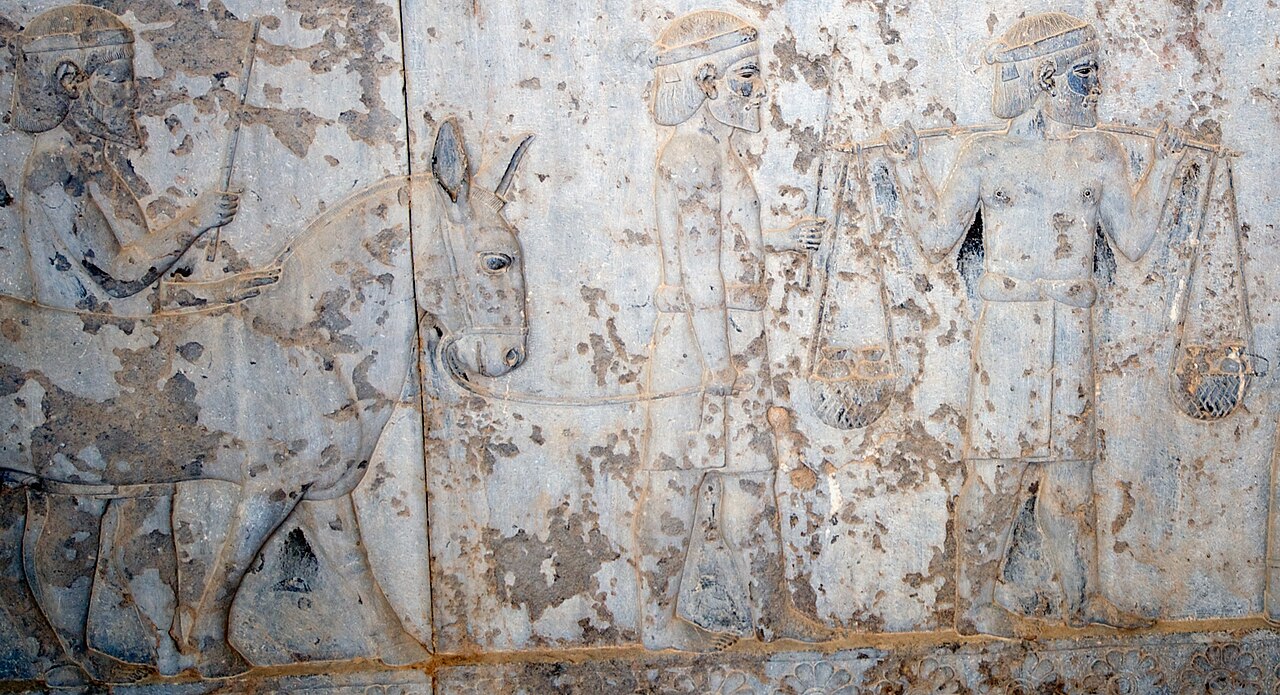
The Indian delegates on the Apadana staircase at Persepolis, wearing short kilts and sandals, carry containers usually read as gold dust and lead a donkey. Indian soldiers stand among the throne-bearers on the tomb of Darius at Naqsh-e Rostam. The Apadana reliefs page discusses how these delegations should be read.
Goods, soldiers and travellers
Darius’s foundation charter from his palace at Susa lists the materials brought from across the empire. Ivory came from Kush, from Sind and from Arachosia, and a kind of timber called yaka came from Gandhara and Carmania. The Persepolis Fortification Tablets record travellers on the roads between Persepolis and India carrying sealed travel documents, as described on the Royal Road.
Indian soldiers served in Persian armies. Herodotus describes the Indians in Xerxes’ army of 480 BCE wearing cotton clothes and carrying cane bows with iron-tipped arrows, with the Gandharans armed differently. At Gaugamela in 331 BCE, Indian contingents fought for Darius III, along with a small number of war elephants.
What Persian rule left behind
The clearest legacy is writing. Imperial Aramaic, the administrative language of the empire, gave rise to the Kharoshthi script, used to write the local Prakrit languages of Gandhara for centuries afterwards. When the Indian emperor Ashoka issued edicts in the 3rd century BCE, some in this region were written in Aramaic, and others in Kharoshthi. Some historians also see Persian models in the Mauryan court and its stone columns, a view that others think is overstated.
At Taxila and Charsadda, archaeologists have found levels of the Achaemenid period, though it is hard to tie specific buildings to Persian rule. By the time Alexander crossed the Hindu Kush in 327 BCE, Persian control over the Indus seems to have weakened, and local rulers such as the king of Taxila acted largely on their own.
Persian words from this page
| هند | Hend | India |
| سند | Send | the Indus, Sindh |
| طلا | talâ | gold |
| مورچه | murche | ant |
| فیل | fil | elephant |
| عاج | âj | ivory |
Sources and further reading
- Herodotus, Histories, Book 3, chapters 94 and 98–105; Book 4, chapter 44; Book 7, chapters 65–66.
- Darius I, Susa foundation charter (DSf) and the lists of lands at Persepolis and Naqsh-e Rostam, in Amélie Kuhrt, The Persian Empire: A Corpus of Sources (2007).
- Arrian, Anabasis of Alexander, Books 3–5.
- Pierre Briant, From Cyrus to Alexander (2002), chapters 4 and 18.
- Encyclopaedia Iranica, “India ii. Historical and cultural relations: pre-Islamic period”.
Want to learn Persian? Get the free Starter Pack
Get the 14-page printable Starter Pack (all 32 letters, a 7-day reading plan, 100 core words and 20 survival phrases) and a short 5-email course. Free.
More in The Achaemenid Empire (550–330 BCE)
- Achaemenes, Teispes and the Early Persian Kings of Anshan
- Cyrus the Great: Birth, Legends and Rise to Power
- Cyrus Conquers Lydia: Croesus and the Battle of Thymbra
- The Persian Conquest of Ionia and Asia Minor
- Cyrus Takes Babylon (539 BCE)
- The Cyrus Cylinder
- Cyrus and the Return of the Jews
- The Death of Cyrus and the Massagetae
- Pasargadae: Cyrus’s Capital and Tomb
- The Tomb of Cyrus through History
- Cambyses II
- Cambyses Conquers Egypt: The Battle of Pelusium
- Bardiya and Gaumata: The Usurper Question
- Darius the Great Takes the Throne
- The Great Revolts of 522–521 BCE
- The Behistun Inscription
- The Persian Conquest of the Indus Valley
- Darius’s Scythian Campaign
- Darius’s Canal from the Nile to the Red Sea
- Darius’s Reforms: Satrapies, Taxes and Law
- The Royal Road and the Persian Postal System
- The Daric: Achaemenid Coinage and Economy
- The Ionian Revolt (499–493 BCE)
- The Greco-Persian Wars: An Overview
- Mardonius and the First Persian Expedition to Greece (492 BCE)
- The Battle of Marathon (490 BCE)
- The Death of Darius I and the Succession of Xerxes
- The Royal Tombs of Naqsh-e Rostam
- Xerxes I: King of Kings (486–465 BCE)
- Xerxes’ Invasion of Greece (480–479 BCE)
- The Battle of Thermopylae (480 BCE)
- The Battle of Artemisium (480 BCE)
- The Persian Capture of Athens (480–479 BCE)
- The Battle of Salamis (480 BCE)
- The Battle of Plataea and the End of the Invasion (479 BCE)
- The Palace of Darius at Susa
- Building Persepolis: How Darius and Xerxes Built Parsa
- The Persepolis Fortification and Treasury Tablets
- Herodotus and the Persians
- The Apadana Reliefs: Nations Bringing Gifts
- The Achaemenid Paradise Gardens
- The Persian Immortals and the Achaemenid Army
- The Achaemenid Navy
- Religion of the Achaemenid Kings
- Women of the Achaemenid Court
- Old Persian Language and Cuneiform
- Egypt under Persian Rule
- Babylon under Persian Rule
- Artaxerxes I
- The Peace of Callias
- Darius II and the Peloponnesian War
- Famous Satraps of the Persian Empire
- Artaxerxes II Mnemon
- Cyrus the Younger and the Battle of Cunaxa
- The King’s Peace (387 BCE)
- The Great Satraps’ Revolt
- Artaxerxes III and the Reconquest of Egypt
- Darius III, the Last Achaemenid King
- The Battle of the Granicus (334 BCE)
- The Battle of Issus (333 BCE)
- Alexander Takes Tyre, Gaza and Egypt (332 BCE)
- The Battle of Gaugamela (331 BCE)
- Ariobarzanes and the Battle of the Persian Gate
- The Burning of Persepolis (330 BCE)
- The Death of Darius III and Bessus
- The Legacy of the Achaemenid Empire