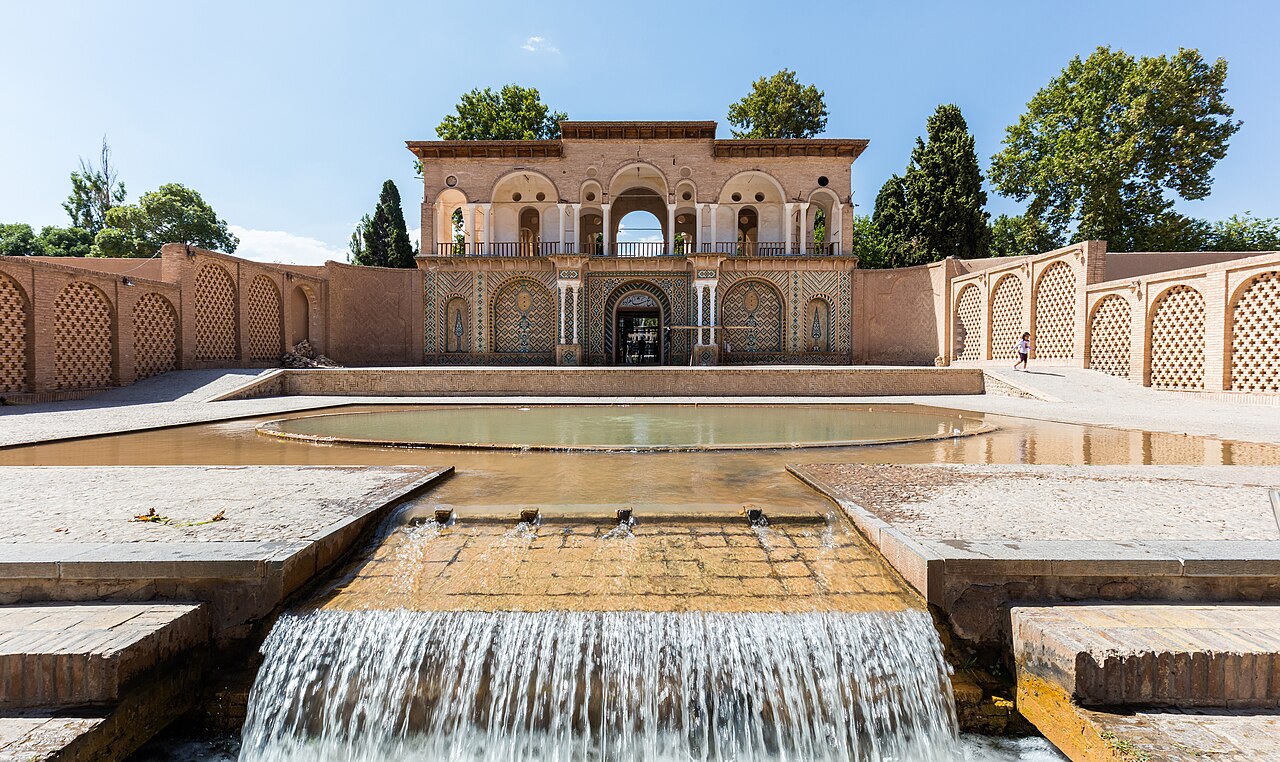
Shazdeh Garden, the “Prince’s Garden”, is a walled Qajar garden just outside the town of Mahan, about 35 km south-east of Kerman. Built mainly in the 1880s for the governor of Kerman, it sends water down a long series of terraces and fountains between rows of trees, a green strip set against bare desert and mountains, and since 2011 it has been one of the nine gardens of the UNESCO World Heritage Site “The Persian Garden”.
| Persian name | باغ شاهزاده ماهان, locally باغ شازده (Bâgh-e Shâzde) |
|---|---|
| Built for | Abdolhamid Mirza Naser od-Dowleh, governor of Kerman, c. 1881–1891, on a garden begun by an earlier governor |
| Size | About 400 m long and 120 m wide |
| Altitude | Close to 2,000 m, on the slope below the mountains south of Mahan |
| UNESCO | Part of “The Persian Garden”, World Heritage List, 2011 |

A prince’s garden that was never finished
According to Persian sources, the garden was first laid out on the orders of Mohammad Hasan Khan Sardar Iravani, a Qajar governor of Kerman. Its buildings were mostly put up by Abdolhamid Mirza Naser od-Dowleh, a Qajar prince who governed Kerman for about eleven years, from 1298 to 1309 in the Islamic calendar (roughly 1881–1891). The garden takes its popular name from him: shazdeh is the everyday form of shahzadeh, “prince”.
When the governor died suddenly, work stopped. A local story says that a builder finishing the tiled gateway heard the news, threw his tray of plaster against the wall and walked away. Whether or not that is true, gaps in the tilework over the entrance can still be seen. The garden was registered as a national monument in 1974 and restored in later decades.
How the garden works
A Persian garden is built around water, and Shazdeh shows the idea very clearly. The site lies on a slope. Water, brought from the mountains above, enters at the top near the residence and flows down the central axis through a chain of stepped falls and pools. The difference in height alone gives the fountains their pressure; there are no pumps in the original design. On each side, rows of tall trees shade the paths and the planted beds. Outside the high wall, the land is almost bare.
The layout follows the classic four-part plan only loosely: the garden is a long rectangle with the main axis running up the slope, so the main view is along the line of falling water. For other examples of the same tradition, see Fin Garden in Kashan, Eram Garden in Shiraz and Dowlatabad Garden in Yazd.
What to look at
The entrance building
At the lower end, the gateway building has an upper pavilion with windows looking up the length of the garden. Stand here first: the view of the cascades rising towards the residence, framed by the trees, is the garden’s best-known picture.
The cascades
Walk up beside the water. Each terrace has its own small fall and pool, and the sound of water changes as you go. Notice the stone edges and the shallow, carved steps that make the water break and sparkle.
The residence
At the upper end stands the two-storey residence, a light, open building with arcades and a pool in front, where the governor and his guests could sit and look down the garden. Which rooms are open inside varies.
Late afternoon and evening
The garden is at its best late in the day, when the low sun lights the trees and the mountains behind turn pink. In the evening the fountains and buildings are often lit.
Mahan
The small town of Mahan is also known for the shrine of the Sufi master and poet Shah Nematollah Vali, who died in the 15th century, with its tiled domes and courtyards. The two are easily seen in one half-day trip from Kerman, and the Ganjali Khan Complex in the city makes a good Safavid counterpart to this Qajar garden.
Practical notes
- Mahan is about half an hour by road from Kerman. Taxis and tours are easy to arrange in the city.
- Spring and autumn are the best times; in winter nights are cold at this altitude, and the trees are bare.
- Check current opening hours and tickets locally.
Persian words from this page
| باغ | bâgh | garden |
| شاهزاده | shâhzâde | prince |
| شازده | shâzde | prince (colloquial) |
| ماهان | Mâhân | Mahan |
| فواره | favvâre | fountain |
| عمارت | emârat | mansion, building |
Sources and further reading
- UNESCO World Heritage Centre, The Persian Garden.
- Persian Wikipedia, “باغ شاهزاده ماهان” (history of the governors and dates), consulted November 2026.
- Penelope Hobhouse, The Gardens of Persia (London, 2003).
- Encyclopaedia Iranica, “Gardens” (on the Persian garden tradition).
Want to learn Persian? Get the free Starter Pack
Get the 14-page printable Starter Pack (all 32 letters, a 7-day reading plan, 100 core words and 20 survival phrases) and a short 5-email course. Free.
More in Top Places to Visit in Iran
- Naqsh-e Jahan Square
- Shah (Imam) Mosque, Isfahan
- Sheikh Lotfollah Mosque
- Ali Qapu Palace
- Jameh Mosque of Isfahan
- Si-o-se Pol and Khaju Bridge
- Vank Cathedral
- Hasht Behesht Palace
- Naqsh-e Rostam
- Eram Garden, Shiraz
- Nasir al-Molk (Pink) Mosque
- Tomb of Hafez (Hafezieh)
- Tomb of Saadi (Saadieh)
- Shah Cheragh Shrine
- Arg of Karim Khan
- Fin Garden, Kashan
- Historic Houses of Kashan
- Jameh Mosque of Yazd
- Yazd Fire Temple and Towers of Silence
- Dowlatabad Garden and Windcatcher
- Amir Chakhmaq Complex
- Golestan Palace
- National Museum of Iran
- Treasury of National Jewels
- Tehran Grand Bazaar
- Milad Tower
- Imam Reza Shrine, Mashhad
- Tomb of Ferdowsi, Tus
- Tomb of Omar Khayyam, Neyshabur
- Tomb of Avicenna, Hamadan
- Ganjnameh Inscriptions, Hamadan
- Behistun (Bisotun): Visiting the Site
- Taq-e Bostan: Visiting the Site
- Tabriz Historic Bazaar
- Takht-e Soleyman
- Armenian Monastic Ensembles of Iran
- Sheikh Safi al-Din Shrine, Ardabil
- Dome of Soltaniyeh
- Alamut Castle
- Falak-ol-Aflak Castle
- Shushtar Historical Hydraulic System
- Chogha Zanbil: Visiting the Ziggurat
- Susa Archaeological Site
- Arg-e Bam
- Ganjali Khan Complex, Kerman
- Shazdeh Garden, Mahan
- Rayen Castle
- Dasht-e Lut (Lut Desert)
- Maranjab Desert and Caravanserai
- Varzaneh Desert
- Mount Damavand
- Hyrcanian Forests
- Lake Urmia
- Badab-e Surt Springs
- Ali Sadr Cave
- The Kaluts of Shahdad
- Qeshm Geopark
- Hormuz Island Colours
- Visiting Persepolis: A Day Trip from Shiraz
- Visiting Pasargadae
- Persian Caravanserais
- The Qanat of Gonabad
- Meymand Village
- Sasanian Sites of Fars: Firuzabad, Bishapur and Sarvestan
- Gonbad-e Qabus: Visiting the Tower
- Zayandeh Rud and Isfahan’s Bridges
- Tochal and Darband: Hiking Above Tehran
- Mount Sabalan
- Skiing in Iran: Dizin and Shemshak
- Golestan National Park